
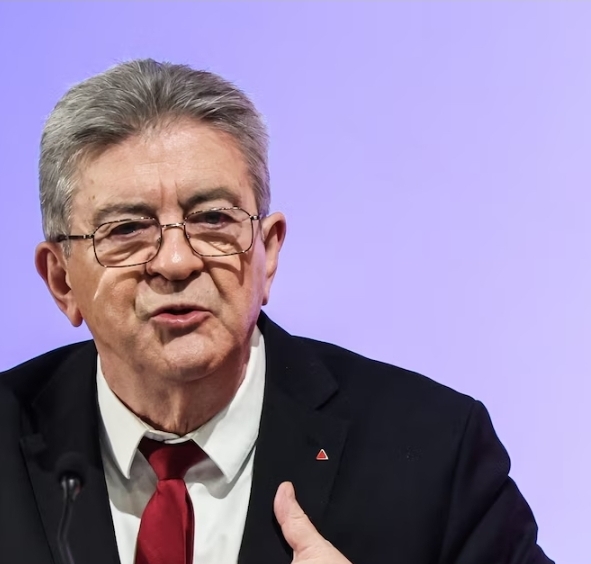
War on the National Rally, which he designates as his main adversary, war on the moderate left that hoped to see him withdraw, and finally war on a world order that he judges to be in full disintegration.
The announcement was expected. It nonetheless fundamentally reshapes the French political landscape less than a year before the election.
The return of the one who was supposed to leave
Despite having promised during his fourth presidential bid in 2022 that he wished to pass the baton to a new generation—declaring at the time, «It is obvious that this is my candidacy»—the reality of 2026 is quite different: no credible successor has emerged within LFI, and the movement, bolstered by three well-oiled campaigns, has chosen to rely on continuity rather than the risk of the unknown.
The Insoumis elected officials, gathered in Paris on the morning of 3 May, officially designated Mélenchon as their candidate even before his appearance on TF1. His justification: urgency. «We are entering a very turbulent season in the history of the world. We are threatened by a generalised war, threatened by a dramatic change in climate. And then we have an economic and social crisis bearing down on us,» he declared. The register is the one he favours: the man of destiny facing a collapsing world.
A manifesto for decisive change
Substantively, Mélenchon hasn’t changed course. On 8 May, in an interview granted to LCI, he reaffirmed his promise to withdraw France from NATO «in stages» if he were elected, considering that the Atlantic Alliance «serves only one purpose: to place us under the tutelage of the United States.» It is a line he has maintained for years, but which takes on a particular resonance in a context of European rearmament and persistent tensions surrounding the Ukrainian conflict. For a France seeking to exert influence in the reshaping of the post-Trump global order, such a stance represents a radical break with the entire traditional political spectrum.
Domestically, the programme remains one of strong ecological planning, a Sixth Republic and a break with European institutions as they currently function. Mélenchon says he is convinced he will beat the RN: «I think we are going to soundly defeat them,» adding that he even doubts they will make it to the second run-off. This is an optimism that current polls do not support, but which also serves to rally his base.
The non-rebellious left, between anger and powerlessness
The announcement had the desired effect on the left: division. Although Mélenchon claimed 150,000 signatures of support the day after his announcement, his enthusiasm is far from shared by the whole of the non-LFI left. Several Socialist and Green figures bitterly recalled his promises not to stand again. For them, this return is less a political act than an ego trip.
The real question, eighteen months before the presidential election, is not just about knowing who is running. Above all, it is about knowing which camp this candidate helps to structure, and which one they weaken. Does Mélenchon's candidacy trap the left in a repetition of 2022, or does it finally provoke an organised response built around a joint candidacy? That is where the real issue lies.
Boris Vallaud’s departure from the leadership of the Socialist Party, which came five days after Mélenchon’s announcement, illustrates just how much this candidacy serves to highlight pre-existing divisions. By declaring his candidacy, Mélenchon is forcing every left-wing actor to take a stand: for, against, or waiting for a hypothetical joint candidate. LFI rejects any primary that would force them to abandon Mélenchon, whilst the Socialists, Greens and various reformist groups are seeking a third way that is struggling to materialise.
The strength and limitation of the unbowed apparatus
Organisationally, LFI starts with considerable assets. Three presidential campaigns have forged a disciplined activist machine, well-versed in signature collection, grassroots mobilisation and digital communication. Collecting the 150,000 citizen endorsements now required instead of elected officials' sponsorships should be a formality for the founder of LFI. Its campaign website went live as soon as the announcement was made, a sign of long-prepared organisation.
However, the strength of the party machine does not compensate for the structural weaknesses of the candidacy. Along with the RN, Mélenchon is the political figure who most polarises the French electorate. His score of 22 % in the first round of 2022 was both a ceiling and a floor, a loyal base, but with a chronic inability to expand beyond the activist core and urban working classes. At 74 years old, on his fourth attempt, the issue of personal fatigue adds to that of the electoral ceiling.
A gamble on global disorder
What sets the Mélenchon 2027 presidential bid apart from previous ones is the geopolitical context in which it is taking place. International instability, the war in Ukraine, transatlantic turbulence and the climate crisis provide him with rhetorical ground that he exploits with skill. «Standing firm in the face of war, climate change and economic and social crisis is not something you improvise,» he declared, presenting himself as a man of experience in the face of adversity.
It is a gamble on disorder: the more the world is perceived as chaotic, the more his rhetoric of disruption resonates. But it is also his main risk: at a time when the French are seeking stability, a candidacy that promises to leave NATO and break with existing institutional frameworks can prove just as mobilising for his opponents as for his supporters.
With less than a year to go before the first round, Jean-Luc Mélenchon has taken a firm stance where others are still hesitating. He is already campaigning. The rest of the left, meanwhile, is still trying to work out whether it even exists.

 French
  English
  Chinese
  Arabic