
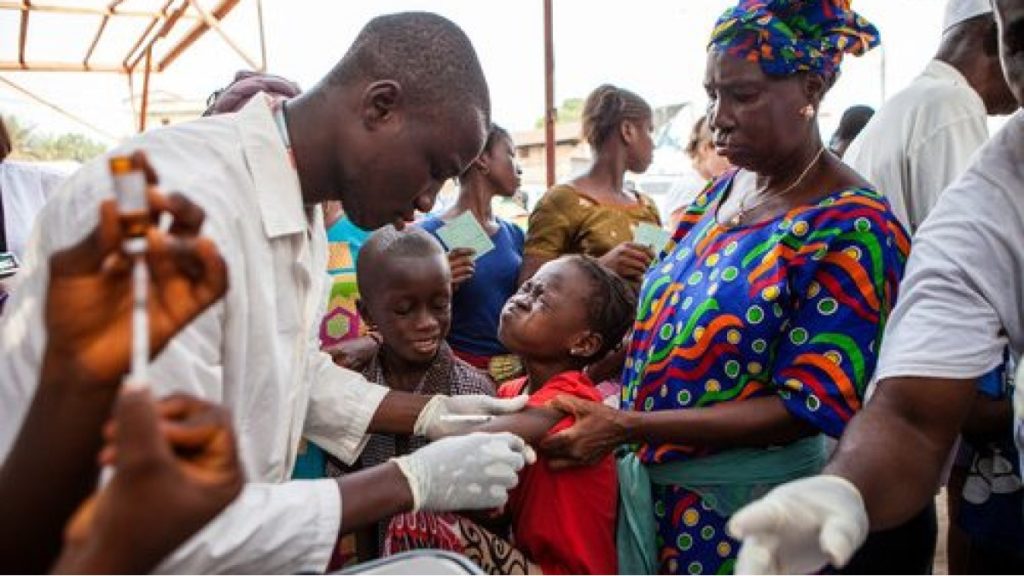
Maximum alert has been decreed in the Democratic Republic of the Congo in the face of a mysterious epidemic that has appeared in the remote region of Panzi, south-east of Kinshasa. Health authorities are questioning this infection, the origin of which is still undetermined.
A mysterious illness that is sweeping through the south-west of the DRC and primarily affecting women and children.
A «mysterious illness» recently struck the south-west of the Democratic Republic of the Congo (DRC), resulting in between 67 and 143 casualties over a two-week period. The latter reportedly manifests itself through flu-like symptoms of fever, headaches, a cough and anaemia, bearing a striking resemblance to a form of COVID.
In a statement to Reuters agency, An epidemiologist notes that for now, it is mainly women and children who have been seriously affected due to these new, particularly lightning-fast pathologies. And for the medical expert to add: « little is known about the disease so far ».
On the Congolese government side and when questioned by geopolitics, the latter indicates to us that several senior public health officials in the DRC have already travelled to the region concerned, in order to« to investigate this incident as a matter of urgency in order to identify the cause of this fatal outbreak »Attempting to be more or less reassuring, we are told that« initially, experts would consider potential illnesses known to be endemic to the region, such as malaria, dengue or chikungunya ».
An epidemic probably underestimated due to a lack of detection methods
However, national health authorities are already considering difficulties in detecting the cause due to problems with diagnostic test infrastructure, as well as difficulties related to the collection and transport of these samples to the laboratory, and finally in carrying out these tests.
In the opinion of an expert at the WHO also interviewed by geopolitics, the major issue for low-income countries like the DRC is that many clinical laboratories can only test for common pathogens.
Thus, with regard to unusual and rarer suspected pathogens, these often require samples to be sent to more specialised laboratories authorised and equipped to carry out advanced analyses, such as genetic sequencing.
Frequently and depending on the circumstances surrounding the occurrence of a major epidemiological risk, sample specimens must be sent to and analysed by laboratories abroad. However, the international sharing of these biological samples is highly controversial, as it is feared that the knowledge benefits derived from these analyses are often not fairly shared among countries.
Of course, given the emergency, the priority for the Congolese health authorities is to understand the extent and severity of the epidemic. Already, the high mortality rate and the number of people affected are alarming. However, it currently seems complicated to determine the true scale of this epidemic at the time of our publication, as not all infected patients are, and probably will not be, detected due to a lack of sufficient appropriate resources.
Furthermore, and for various reasons, not all suspected infected cases will necessarily seek treatment.firstly because health and care centres are too few in number, particularly in areas far from major urban centres, and lack personnel sufficiently trained in these types of new pathologies.
Indeed, the DRC has fewer than two doctors per 10,000 inhabitants (editor's note: by comparison, the United Kingdom has more than 31 doctors per 10,000 inhabitants).
For the WHO, the conclusion is irrefutable: « even if patients went to hospital or to a clinic, not all infections would be diagnosed. Not all patients would be tested for the infection, and not all infections detected are reported to health authorities », replies the UN organisation.
The lack of statistical and formal information regarding the cause, extent and number of infected people further complicates the accurate assessment of the threat posed by this new epidemic. However, this is not an isolated risk confined to developing countries. Recent Western history, and indeed global history, has demonstrated the emergence of new infectious diseases over the years.
According to experts, the reasons are legion: undeniable climate change, demographic trends and population movements, urbanisation and deforestation, which are favouring the «spread and mutation» of certain viral and infectious strains from animals to humans.
Our global epidemiological radar is no longer working.
Briefly and unfortunately, our global epidemiological radar No longer works. Also, disease surveillance cooperation is globally fragmented, undoubtedly for economic and scientific data collection reasons!
According to the WHO and in the Global South, more particularly in the poorest countries, there still remain far too many regions where pandemics are not detected or are detected far too late given the masses of populations affected, who are often nomadic or on the move. This obviously does nothing to help the collection of essential epidemiological data, both for prevention and curative measures. Epidemiological surveillance services lack both material resources and sufficiently trained personnel, or indeed supervision. Furthermore, due to a lack of genuine interest from the international community on the one hand, and a lack of sharing of knowledge and statistical data on the other, their reports and alerts are rarely standardised on the scale of the global scientific community.
Furthermore, the wide gap between the time a person is infected and diagnosed with a particularly suspicious or even unknown disease, and the time they are reported to public health authorities, dramatically delays the control responses to these unfolding pandemics. Naturally, as things currently stand, these findings are exacerbated in sub-Saharan Africa, but not exclusively so.
What are the measurements, tests, resolutions?
A notable WHO initiative aims to pilot the «7-1-7 project» in several countries in Africa, South America, and South Asia. The latter has the ambitious objective of achieving a suspicious detection responsiveness during infectious disease outbreaks within a seven-day timeframe. This alert, notified to local and national public health authorities during the day, provides for a seven-day period to allow an initial response to any epidemics to be carried out. This is certainly a commendable objective, but many experts consider that sometimes this mechanism is still too late, particularly with regard to fast-moving epidemics.
Obviously, another much more pragmatic solution consists in better integrating and coordinating existing monitoring activities and systems with the international scientific database. Thus, one of the WHO's other hobbyhorses, apart from those dedicated directly to the countries concerned, lies in the integration of integrated disease surveillance and response, mainly deployed in Africa over the last two decades, into the main international scientific research frameworks.
Unfortunately, this pious hope has met with mixed success so far. A recent report on this vital issue highlights obstacles linked to technological information-sharing systems, more specifically financial constraints explaining this data-sharing shortfall, as well as shortages of skilled laboratory staff yet again.
As part of this investigation, geopolitics particularly attentive to the issues of international Geneva through your humble servant, notably discovered the «International Pathogen Surveillance Network», established by the «WHO Hub for Pandemic and Epidemic Intelligence». These organisations aim to promote collaborative surveillance between different public and private bodies and sectors (from human health to animal health and the environment), rising above both institutional rivalries and economic protectionism in order to convince them to work together, but above all to share crucial information for the benefit of humanity.
As is often the case with the rhetoric and efforts of UN organisations, the effectiveness of these initiatives remains to be seen in practice, even though theoretically they are binding on all its members. Nevertheless, they constitute a step in the right direction.
In conclusion, the finding is clear: without better global disease surveillance and selfless cooperation, it is not out of the question that we will miss the next pandemic coming from elsewhere, or at the very least realise it far too late.

 French
  English
  Chinese
  Arabic