
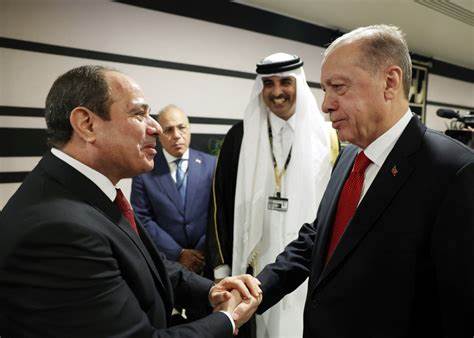
Shortly before the summer, Egyptian President Abdel Fattah al-Sissi welcomed his Turkish counterpart Recep Tayyip Erdoğan in Cairo for an unprecedented visit, marking a turning point in relations between the two countries after a decade of friction.
After more than a decade of strained relations with Egypt, Turkish President Recep Tayyip Erdoğan traveled to Cairo last spring, rather discreetly and without much media fanfare, thus responding to the Egyptian president’s invitation.
Until then, the two leaders considered each other as persona non grata for almost ten years, mainly due to the coup d’état carried out in 2013 by Sissi against his predecessor Mohamed Morsi, Erdoğan’s ideological ally.
However, since 2021 and in the diplomatic circles, everything seemed to be being done to find economic convergences. In particular, while the finances of both countries are not exactly in good shape. The first signs of this «relational détente» appeared during the 2022 World Cup in Doha, when the two men agreed to appear in public after briefly meeting «officially» for the first time.
The latest sign of a renewed commitment to dialogue is the Turkish Foreign Minister, Hakan Fidan, to declare to anyone who wants to hear it that Turkey could sell drones to Egypt. «We have concluded an agreement to deliver unmanned aerial vehicles and other technologies to [Egypt],» Hakan Fidan had announced at the time in a televised interview, without elaborating further on the details of the transaction.
More recently, the Turkish foreign minister, trying to diffuse the tensions in the region since the Israeli assault on Gaza, also visited Cairo last October and had previously visited the presidential office to meet several senior Egyptian military leaders and then President Sissi himself. Mehmet Özkan, a professor at the National Defense University in Turkey, perceives this détente as « a transition from strategic stubbornness to relationships of mutual benefit.».
«After the Arab Spring, Turkey and Egypt have stubbornly defended certain issues. However, the changing circumstances mean that this stubbornness is now relatively broken,» he explains. «Certainly, it remains to be seen what the vitality of relations between the two countries will be.» That said: beyond the short-term opportunities.
No regional analyst will be able to ignore the fact that the effort to normalize relations with the regional powers is fully part of the objectives of the foreign policy of the current Turkish government, which was elected in May, but which is also «highly expected» by a suffering population.
Hakan Fidan, the new head of Foreign Affairs and «relations» with other countries, is striving to improve relations with other countries, especially Western ones, since his appointment., This hardly comes as a surprise. As a striking example, in the context of its post-election foreign policy, Turkey finally ratified Sweden’s application to join NATO, then concluded an agreement with the United States on the sale of F-16 fighter jets, followed by engaging in bilateral talks with Greece, before finally consolidating its relations with the United Arab Emirates and Saudi Arabia.
«The recent talks with Greece and Iraq are a sign of this.» The process initiated with Egypt is also in line with this logic," Mehmet Özkan specifies. Mevlüt Çavuşoğlu, then Turkish Foreign Minister, had already visited Cairo on an official visit in March 2023, the first official visit by a high-ranking Turkish diplomat since Sissi's accession to the Egyptian presidency. This visit was followed by a reciprocal visit by the Egyptian Foreign Minister, Sameh Shoukry, to Ankara the following month. The ambassadors then continued their discussions.
Meanwhile, the Ankara palace has since taken a number of measures to reduce the influence of leaders from the Muslim Brotherhood in Turkey, one of the main concerns, to say the least, for Egypt. Remains unresolved The future of the satellite channel Mekameleen TV, a media radically opposed to the Egyptian regime, has ceased broadcasting since 2021 from Turkey. Also, a number of intellectuals and influential exiles in Turkey are regularly calling for an end to the criticism of the regime of the Egyptian president.
A decade of ideological and political rupture
Turkey and Egypt, which had rather chaotic relations over the last century, came closer to each other significantly with the signing of a free trade agreement in 2005. A few years later, during and immediately after the ouster of former Egyptian President Hosni Mubarak in 2011, Ankara provided unwavering support to the country’s democratization efforts. Erdoğan will visit Cairo during the period of government transition and will be welcomed in the land of the pharaohs not without enthusiasm. Upon leaving the polls in the 2012 elections, Mohamed Morsi, then a prominent figure of the Muslim Brotherhood, became the first democratically elected Egyptian president. Morsi’s victory will give an unprecedented boost to bilateral relations with the shores of the Bosphorus, especially thanks to the affinities between his party and the AKP, Erdoğan’s party, both rooted in the ideology of political Islam.
Morsi's presidency, however, will only last one year. Relations between the two countries will reach a breaking point in 2013 when Sissi, then Minister of Defense, supported by the United Arab Emirates and Saudi Arabia, will overthrow
the Morsi government.
On the Turkish side, the state upheaval in Egypt will trigger a national political movement, whose symbol is and is still today the four-fingered sign of Rabia, a symbol of the pro-democratic movement following the massacre of hundreds of people in Rabia al-Adawiya Square in August 2013.
Sissi’s government and those who will follow it will, in turn, regularly mobilize the media and public figures against the Turkish regime and its alleged support for the Muslim Brotherhood., That Cairo declared them permanently outlawed upon taking power. The disagreements over a number of regional issues, in particular Libya and the continental shelf in the eastern Mediterranean, There will be long-term obstacles to the restoration of relations.
Regional factors with multiple dimensions of interest
The relations between Turkey and Egypt are of crucial importance not only for the two countries, but also for the stability of the region, as the analysts in the region rightly affirm. From the Gulf to Libya, from Sudan to Israel and Palestine, the countries of the region are directly concerned by the rapprochement between Egypt and Turkey, believes Giuseppe Dentice, head of the Middle East and North Africa office at the Italian Centre for International Studies (CeSI).
As a result of the process initiated by the Arab Spring, the Gulf countries, with the exception of Qatar, have all adopted a very protectionist attitude and have faced numerous obstacles related to the democratic movements in the Arab world.
In Tunisia, Ennahdha, one of the most established movements in the Maghreb historically, was sidelined from the political scene after the coming to power and renewal of Kais Saied, while figures such as General Hemetti in Sudan or Khalifa Haftar in Libya, who used the force of their military contingents, sometimes unofficial, rather than political action, benefited from some support. Similarly, Abdel Fattah al-Sissi came to power not without the financial support of the Gulf, and relying on the brute force of the army.
Contrary to the Gulf countries and against the tide, Turkey has preferred to support the newly elected democratic actors in these various countries. She even militarily supported the internationally recognized government against Khalifa Haftar in Libya. However, the constantly changing Arab situation has changed over the last decade.
Turkey, the Gulf countries and Egypt then began to find compromises on the thorny issues at the root of many tensions, particularly due to the economic and social difficulties Egypt and Turkey have faced in recent years.
For its part, Turkey has first restored its diplomatic relations with the United Arab Emirates with the primary and stated goal of attracting investments from this oil-rich Gulf country, after years of tensions due in part to Turkey’s support for the Arab Spring. «We could witness a new era [of fruitful relations] between the two countries, especially due to their common internal socio-economic problems,» asserts Giuseppe Dentice.
According to Mehmet Özkan, the process of normalization between Turkey and Egypt must be analyzed in the context of the evolution of the circumstances in the region.
Similarly, Giuseppe Dentice argues that Erdoğan’s visit constitutes «an opportunity for the current discourse of de-escalation in the region».
The disturbing Israeli-Palestinian conflict
The Israeli-Palestinian conflict, especially since October 7th, is one of the most pressing issues in relations between Turkey and Egypt.
To date, the Israeli military operations carried out in Gaza following the Hamas attack on October 7th have killed more than 28,500 Palestinians and are affecting the Rafah border line, on the northeastern border of Egypt. More than 1.4 million Palestinians are refugees in this border city of Rafah, the southernmost territory of Gaza, after most of them were displaced from the north and center of the enclave during the hostilities. The Israeli government is now threatening to invade the city, which Egypt views as a major and unacceptable escalation.
Since the first day of the armed conflict, Israeli officials have been discussing the possibility of evacuating Gaza and moving the Palestinians to Sinai, on the other side of the border in Rafah. Egypt firmly rejects this possibility and finds itself completely powerless in the face of the humanitarian crisis raging at its doorstep.. More recently, Israeli military forces have also begun targeting Palestinians displaced and refugees in Rafah, a few meters from Egyptian territory. According to Mehmet Özkan, since October 7, Regional actors have understood that there is a need for communication both within and outside their borders «Inevitably, a space for communication has opened up. Consequently, the process of normalizing relations between Turkey and Egypt has accelerated,» he explains.
Giuseppe Dentice, for his part, also believes that, in addition to other survival factors such as economic ones, the situation in Gaza has paved the way for the resumption of talks between the two countries.
A cautious and measured approach towards their electorates
Cairo and Ankara remain, however, wary, history being the judge, according to Mehmet Özkan: «There is a serious crisis of trust that has developed over the last ten years. The two countries are working to overcome this crisis.», «The agreement concluded by Turkey to provide Egypt with equipment, including from the defense industry, and even technologies, is part of an effort to break down this mistrust,» he asserts.»
Political will, whether internal or international, is a key element of rapprochement, according to Giuseppe Dentice.
«A large part of this new potential boost [in relations] will depend on the leaders» willingness to resolve sensitive issues: the Libyan dossier, energy and exploration in the eastern Mediterranean, the question of the Muslim Brotherhood," he specifies.
A consolidation of the renewal of relations has nevertheless been confirmed
Recep Tayyip Erdoğan, for his part, received his Egyptian counterpart Abdel Fattah al-Sissi for the first time on Wednesday, September 4, 2024 in Ankara, seven months after the unprecedented visit of the Turkish leader to the Egyptian capital. These successive visits seem to seal, despite all the suspicions, a reconciliation between the two countries.
Turkish-Egyptian relations finally seem to be on the path to harmony. The visit to Ankara by Abdel Fattah al-Sissi – whom Recep Tayyip Erdoğan came to greet at the airport – was rare enough to be noteworthy – it ended with the signing of no fewer than 17 bilateral agreements. Energy, health, industry, tourism, but above all trade: the two countries seem determined to make up for lost time, after a decade of rupture.
Their goal: to increase their trade to $15 billion, compared to $10 currently. In front of the press, The two iron-fisted leaders are, however, silent about Turkey’s ambitions to sell military equipment to Egypt, notably the drones mentioned in this article.

 French
  English
  Chinese
  Arabic