
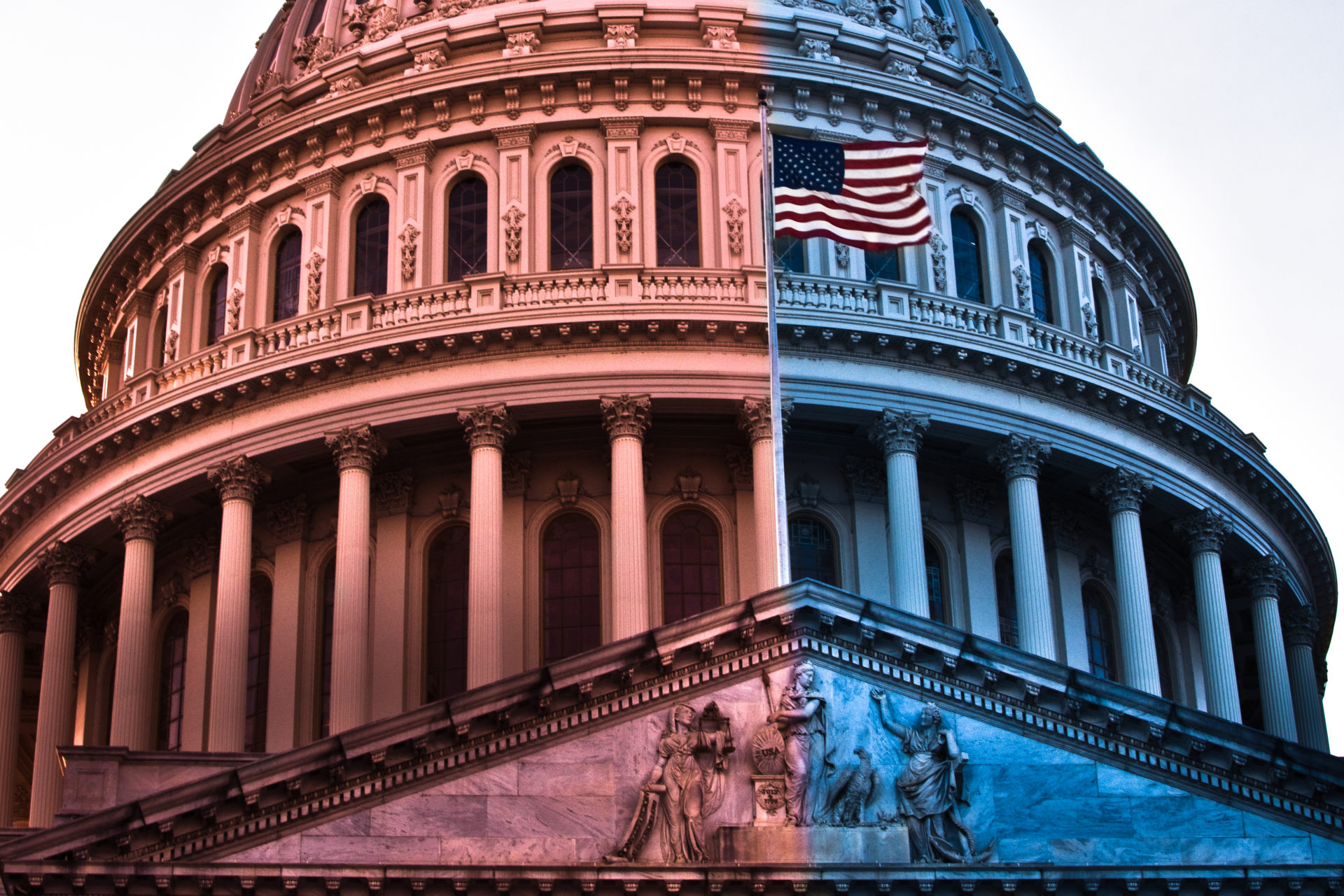
An amendment to the State Department funding bill was all it took to shatter one of the last taboos of American foreign policy. By 314 votes to 104, the House confirmed the continuation of military aid, but the real earthquake lies elsewhere: more than a hundred Democratic lawmakers have publicly questioned support that was long considered untouchable. For the White House, the equation is becoming more complex. While Donald Trump remains resolutely aligned with Tel Aviv, the dissent taking root in the Democratic camp is gradually turning the relationship with Israel into an ideological battleground, just a few months ahead of the November 2026 midterm elections.
The Democratic consensus is cracking
The vote on 15 July goes far beyond the framework of a rebellion by the progressive wing. It reveals an ideological realignment that is now winning over moderate elected officials, who are faced with the political cost of the heavy humanitarian toll in Gaza and the lasting impasse of the Israeli-Palestinian process. Divisions have now reached the very top of the Democratic Party: while its House leader, Hakeem Jeffries, opposed the amendment, its number two, Katherine Clark, supported it, illustrating a fracture taking root at the heart of the party apparatus.
Support for Israel thus ceases to be a consensual reflex and becomes a subject of political confrontation. For the US executive branch, the challenge now lies in preserving a strategic partnership without turning it into an electoral burden among younger generations and independent voters.
AIPAC on the defensive
This new reality forces pro-Israeli organisations to review their strategy. Long the guardian of an almost unchallenged bipartisan consensus, AIPAC is now adopting a more offensive approach. By withdrawing its financial support from Democrats who favour the amendment, the organisation implicitly acknowledges that the automatic obedience of elected officials belongs to the past. Its influence remains considerable, but it is now exercised in a much more fragmented political environment.
At the same time, organisations like J Street, as well as several once-unconditional elected officials, are redrawing the contours of the pro-Israeli camp. The latter no longer appears as a homogeneous bloc, but as a space crossed by fault lines pitting supporters of unconditional support against reformers in favour of conditional aid and parliamentarians who are increasingly critical of the Israeli government.
Israel is discovering its political vulnerability
In Israel, the vote on 15 July was not seen as a simple parliamentary episode, but as a strategic warning. The concern is less financial than political: Israeli leaders are noting the gradual erosion of their capital of support in the United States. Military aid no longer benefits from an unquestioned moral and political consensus; it is becoming a subject of partisan debate.
This realisation comes at a time when the American and Israeli electoral calendars overlap. With the Israeli legislative elections in October 2026 followed by the US midterm elections in November, the two countries are entering a particularly uncertain political sequence.
In Israel, a question now arises: should signals of appeasement likely to revive dialogue with a rapidly changing Democratic Party be sent, or should an unashamedly security-focused line be maintained at the risk of accelerating its alienation?
The midterms: the hour of truth
The US midterm elections of November 2026 go far beyond the scope of an ordinary electoral event. They will constitute the first real test of the ongoing mutation in the US-Israeli relationship. For the first time in several decades, support for Israel no longer commands a consensus within the Democratic Party. Long confined to the progressive wing, the dissent is now spreading to moderate elected officials and reaching the very heart of Congress.
This development does not yet call into question the strategic foundations of the alliance. On the other hand, it profoundly transforms the political conditions for its maintenance.
A more demanding Congress
Democratic gains in the House or Senate would naturally amplify this dynamic. New members elected from major metropolitan areas, university constituencies, or a younger electorate bring a noticeably different approach to the Israeli file. They have grown up in a context marked by successive wars in Gaza, the omnipresence of social media, and a heightened sensitivity to international humanitarian law issues.
This shift would rapidly alter the work of Congress. Initiatives aimed at conditioning military aid would gain in profile. Congressional committees would exercise closer scrutiny over the use of US weaponry. As for congressional delegations to the Middle East, they would further diversify their interlocutors by more broadly incorporating representatives of Palestinian civil society.
A Republican victory without any real respite
Conversely, a Republican majority would strengthen the Trump administration in its support for Israel. Any potential restrictions on military aid would remain politically doomed to failure. This stability would nevertheless be largely deceptive. Polarisation would not disappear; it would shift towards public opinion, the media and the preparations for the 2028 presidential election.
This partisan shift reveals the fragility of support that has long been presented as intangible: as soon as it becomes the preserve of a single American political camp, it ceases to be a strategic asset and becomes an electoral issue like any other — exposed, as such, to the vagaries of every election.
The new electoral geography
The results of 15 July also highlight the profound shifts within the American electorate. The states where Democratic elected officials have been most supportive of reducing aid to Israel — California, New York, Illinois and Massachusetts — also correspond to the areas where mobilisation around the Palestinian issue is strongest. These regions concentrate a younger, more diverse population and particularly influential liberal Jewish communities.
For elected officials, the vote is now a genuine political marker. Those who have maintained their support for military aid will have to meet the expectations of a more critical Democratic base; those who opposed it will face the financial and political pressure of major pro-Israel organisations. In any case, the midterms will make the relationship with Israel a major theme of the US electoral debate.
Means-tested support
The real issue of midterms does not lie so much in the amount of military aid as in the conditions that could henceforth govern it. Whatever the future majority in Congress, the pressure in favour of support accompanied by demands is expected to continue to grow.
Transparency regarding the use of American weaponry, a freeze on the expansion of West Bank settlements, the revival of a credible political process with the Palestinians, or respect for international humanitarian law: all conditions that, until very recently, would have seemed politically unthinkable.
Such a development would profoundly alter the nature of the bilateral relationship. Israel would no longer benefit from quasi-automatic support, but rather from a strategic partnership increasingly subject to a logic of political accountability. For Tel Aviv, this shift would represent a major break: it would no longer suffice to invoke historical solidarity; it would henceforth be necessary to persuade.
The battle for public opinion
The midterms will not only be played out at the ballot box; they will also be fought out in the court of public opinion. Polls show an increasingly marked generational divide. While support for Israel remains solid among conservative voters and older generations, it is rapidly eroding among Democrats under the age of forty.
This generation neither knew the Oslo Accords nor grew up with the narrative of a democracy constantly under siege. Its perspective has been shaped by successive wars in Gaza and the instantaneous circulation of images on social media networks. For it, the question is no longer whether Israel has the right to defend itself, but under what conditions it exercises that right and at what human cost.
Faced with this evolution, traditional security arguments are gradually losing their effectiveness. It is now the political and moral legitimacy of Israeli action that is being debated at the very heart of American society.
The alliance is changing its nature
The alliance between Washington and Tel Aviv is not disappearing. Its strategic foundations remain solid. On the other hand, the political framework that has long protected it is undergoing profound transformation. The era of bipartisan consensus is giving way to a relationship that is increasingly exposed to electoral changes, parliamentary power dynamics and the expectations of a changing public opinion.
The November 2026 midterms will tell whether this shift is here to stay or if it was merely a temporary blip. A Democratic gain would likely accelerate the rise in demands for conditionality on military aid.
Even if a Republican majority is maintained, the underlying trend would remain unchanged: support for Israel would become a permanent subject of domestic political debate.
What is faltering today is therefore not the alliance between Washington and Tel Aviv, whose strategic foundations remain intact. It is the American political consensus which, for nearly half a century, guaranteed its unquestioned strength — and whose gradual disappearance is redefining, for a long time to come, the very terms of the support.

 French
  English