
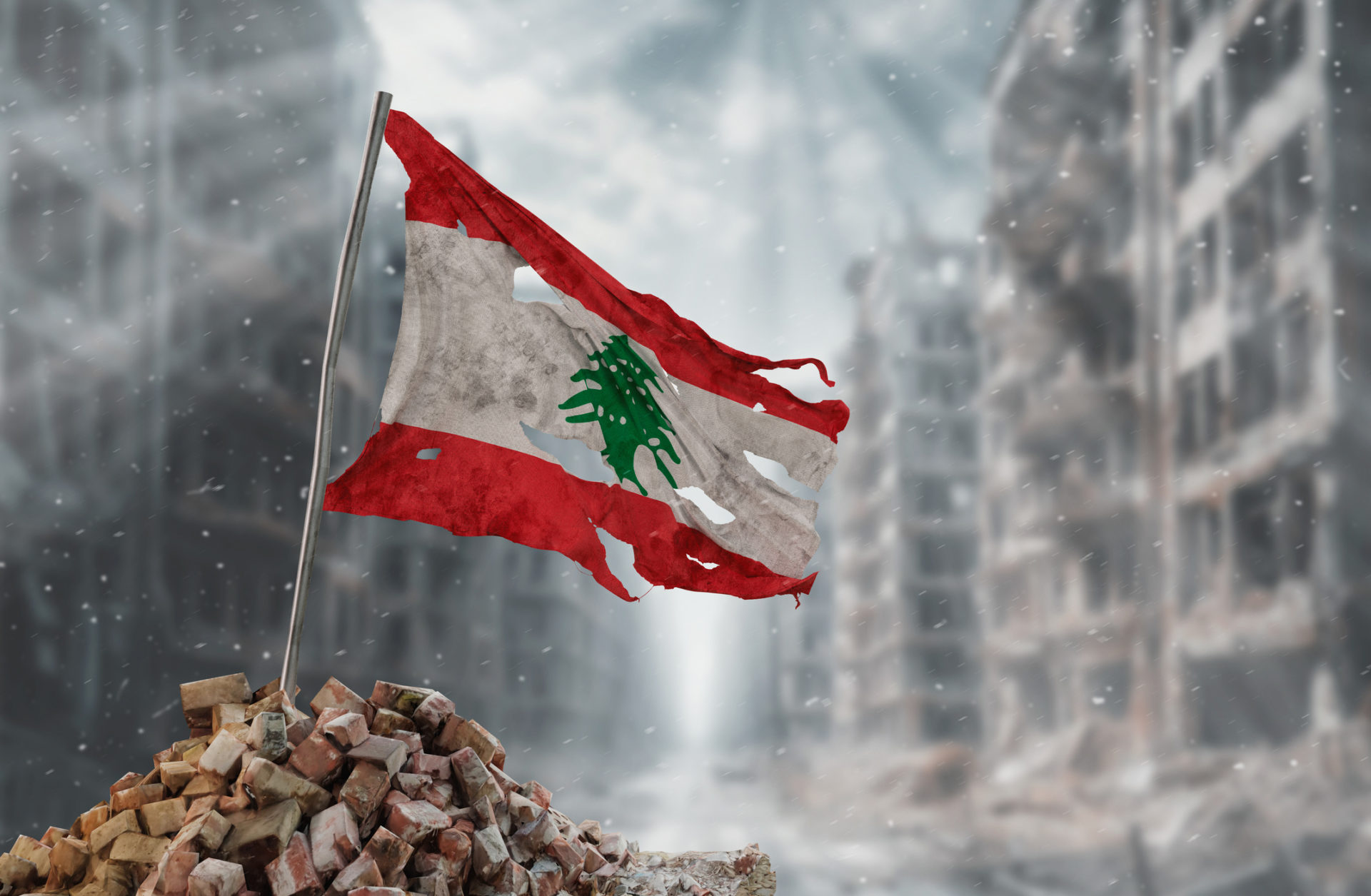
Lebanon is a country whose very existence rests on a founding paradox. It can only survive by maintaining a fiction of sovereignty that all its internal and external actors strive, consciously or not, to strip of its substance. What we have been observing for years is not a cyclical crisis, nor even a series of superimposed crises. It is a structural pathology anchored in the very architecture of political confessionalism inherited from the French mandate. A system designed to balance communities has become the machinery of their mutual paralysis.
The financial collapse that began to manifest itself publicly in the autumn of 2019 finished revealing what the Lebanese elites had known for a long time. Their state was running on credit, in the most literal sense of the term. The pound evaporated, bank deposits were de facto confiscated, and the middle classes plunged into precariousness. Public services: electricity, water, health, education, collapsed in a cascade. This is not a recession. It is a destruction of social capital accumulated over several generations, carried out in a few years by an oligarchy incapable of reforming itself because its survival depends precisely on immobilism. «Beirut will not rebuild itself through the addition of reform plans. It will rebuild itself, if it rebuilds itself, through a break with the logics that destroyed it and no one, either inside or outside, seems ready to pay that price.»
Hezbollah: A State within a State
To understand Lebanon without starting with Hezbollah is to analyse a body while ignoring its nervous system. The Shia movement is not just a militia that survived the civil sitäge. It is a total organisation that provides social services and administers territories. It possesses a military capability superior to that of the national army and maintains an organic relationship with Tehran that makes it impervious to Lebanese institutional pressures. Its communal legitimacy, built on resistance to Israel and the distribution of social welfare, confers upon it a genuine resilience. Corruption scandals or partial military defeats have not been enough to erode it.
The 2024 Israeli strikes, which eliminated part of its command and destroyed a significant fraction of its arsenal, inflicted on Hezbollah its most severe trauma since 2006. But an organisation so deeply rooted in the Shia social fabric does not disappear beneath bombs. It is recomposing itself, more discreetly, by redistributing the cards among its internal factions whilst preserving the core of its institutional presence. Disarming it would presuppose unanimous Lebanese political will, credible international cover and an economic alternative for the populations that depend on it. None of these conditions are met.
Regional sponsors and the balance of dependency
Lebanon has always been the playground of its neighbours, and this reality has not faded with time. It has simply been reshaped around new actors and new priorities. Saudi Arabia, which had abruptly cut ties at the time of the Hariri affair in 2017, has since shown a cautious and conditional re-engagement. Riyadh makes no secret of its demands: the effective marginalisation of Hezbollah in governmental mechanisms, the normalisation of Lebanon within the Sunni Arab fold, and a guarantee that Beirut will no longer serve as an Iranian proxy on its doorstep. This Saudi return represents a real financial opportunity for a country in a state of asphyxiation, but it brings with it the risk of a satellisation that would replace one dependency with another.
Iran, for its part, has no interest in letting go of Lebanon, which constitutes the western link of its arc of resistance connecting Tehran to the Mediterranean via Baghdad and Damascus. Even weakened, Hezbollah remains its most precious lever in the regional competition with the Gulf monarchies. Between these two poles, Lebanon's room for manoeuvre is so narrow as to border on non-existence. This situation makes the persistence of a national political debate, however dysfunctional it may be, all the more remarkable.
Reconstruction as a mirage
International aid conferences for Lebanon have followed one another for years, punctuated by conditionalities that Beirut accepts outwardly and bypasses in practice. The IMF has set its conditions. Successive governments have promised reforms that they have not implemented. This is not simply bad will: it is a systemic constraint. Any serious reform—of taxation, the banking sector, public enterprises, or electricity distribution—affects the economic rents that major political families have shared for decades. To reform is to commit political suicide. And in a system where survival takes precedence over governance, no one does it.
Lebanon will continue to exist, in the sense that its territory will remain populated and its flag will fly at the United Nations. But the idea of a sovereign Lebanese state, capable of deciding its own future without external arbitration, is today more of a project than a reality. The path to this sovereignty goes through a refoundation of the political contract which the current actors have neither the interest nor the will to carry out. That is the real Lebanese tragedy: not the absence of solutions, but the absence of a political will capable of imposing them.

 French
  English
  Chinese
  Arabic