
Instability, the new permanent state
The sequence that began with the surprise dissolution of June 2024 is still producing its effects. The dissolution of the National Assembly announced by Emmanuel Macron opened a period of political instability. Michel Barnier was appointed Prime Minister in September 2024 at the head of a government relying on a «common ground» between the Macronists and The Republicans. Before being toppled by a motion of no confidence in December—the second adopted under the Fifth Republic after that of 1962. François Bayrou succeeded him, before in turn being brought down on 9 September 2025, leading to the appointment of Sébastien Lecornu to Matignon.
This succession of Prime Ministers in less than two years has produced profound legislative paralysis and a sense of weightless governance. This succession of minority governments is accompanied by a slowdown in legislative activity. The executive is relying more heavily on private members' bills originating in parliament, as well as on the Senate and joint mixed committees, to get texts passed.
The French: The Great Divorce
In this context, the gap between citizens and their representatives is reaching unprecedented proportions. Purchasing power remains the primary concern for French people (49%), ahead of the future of the social security system (41%) and the level of debt and deficits (30%). This concern is accompanied by deep pessimism: according to Ipsos, 91% of French people describe themselves as pessimistic about the country's economic situation.
The May 2026 barometer reveals a political earthquake of historic proportions: the central bloc is collapsing, and an unprecedented force is emerging, the «Rejection Party», representing 23% of voters who categorically refuse any candidate from current parties. A quarter of the electorate saying no to everyone is a sign of a crisis of representation that the polls are struggling to fully grasp.
The RN in a position of strength, but with a legal wild card
Jordan Bardella would dominate the results of the 2027 presidential election, coming out ahead of Édouard Philippe and Jean-Luc Mélenchon according to a Toluna Harris Interactive poll. The RN remains in the lead in voting intentions: Bardella would win 34 to 35% of voting intentions, and Marine Le Pen 32 to 33%.
But a sword of Damocles is hanging over the party. The appeal judgment in the Marine Le Pen case is expected on 7 July 2026. Jordan Bardella, her successor at the head of the National Rally, appears as a potential replacement, including in the eyes of Marine Le Pen herself if her ineligibility were confirmed. The summer of 2026 could therefore change everything.
A fractured right, an elusive left
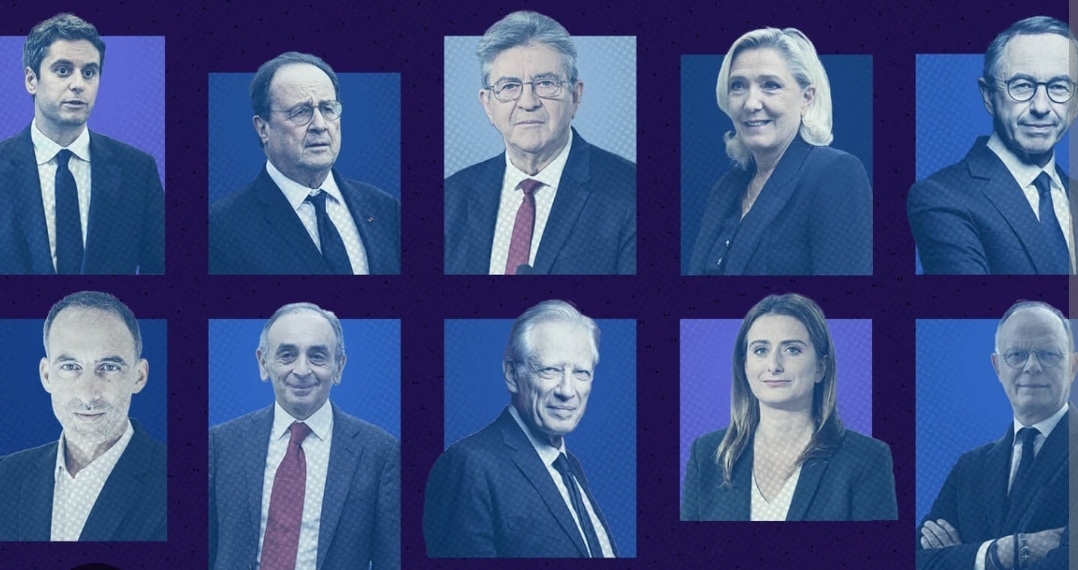
With one year to go, Bardella and Le Pen are still leading the figures whose accession to the presidency would cause the most satisfaction. Gabriel Attal is in third position with an increase of 5 points in a month (24%), while Édouard Philippe sees his rating fall by 4 points (22%). On the left, it is François Hollande who is at his highest level this month (18%), according to Ipsos.
The right, for its part, is caught up in its internal wars. Bruno Retailleau was officially designated as the LR candidate on 19 April 2026, following a vote by party members. However, Gérald Darmanin, Laurent Wauquiez and David Lisnard remain in favour of a primary election in order to unite the right. Michel Barnier is proposing a programmatic coalition project entitled «Building Together» in an attempt to unite the right and centre around a common platform.
Édouard Philippe is emerging as the natural leader of the centre bloc (62%), whilst the left remains deeply divided between figures such as Jean-Luc Mélenchon and Raphaël Glucksmann, making unity unattainable. The New Popular Front is gradually becoming weaker due to strategic differences between its constituent parties, particularly between the Socialist Party and La France insoumise, both regarding parliamentary strategy and preparations for the presidential election.
An extraordinary election in prospect
The number of declared or presumed candidacies is unprecedented under the Fifth Republic. By mid-February 2026, eleven figures had already declared their candidacy, and several others are expected; Le HuffPost and the Revue politique et parlementaire counted around thirty potential candidacies in April. Among the names circulating is even Cyril Hanouna, a further symptom of a political system in disarray.
With a year to go until the deadline, the 2027 presidential election could mark a turning point: that of a return to voting on substantive issues. Healthcare, purchasing power, education... The French electoral survey reveals a clear hierarchy of the French people's priorities, far from the mere logic of casting or tactical voting.
The question is no longer whether France will change course in 2027. It is whether the opposing forces will be capable of offering it one and whether the voters will still trust them enough to believe in it.

 French
  English
  Chinese
  Arabic