
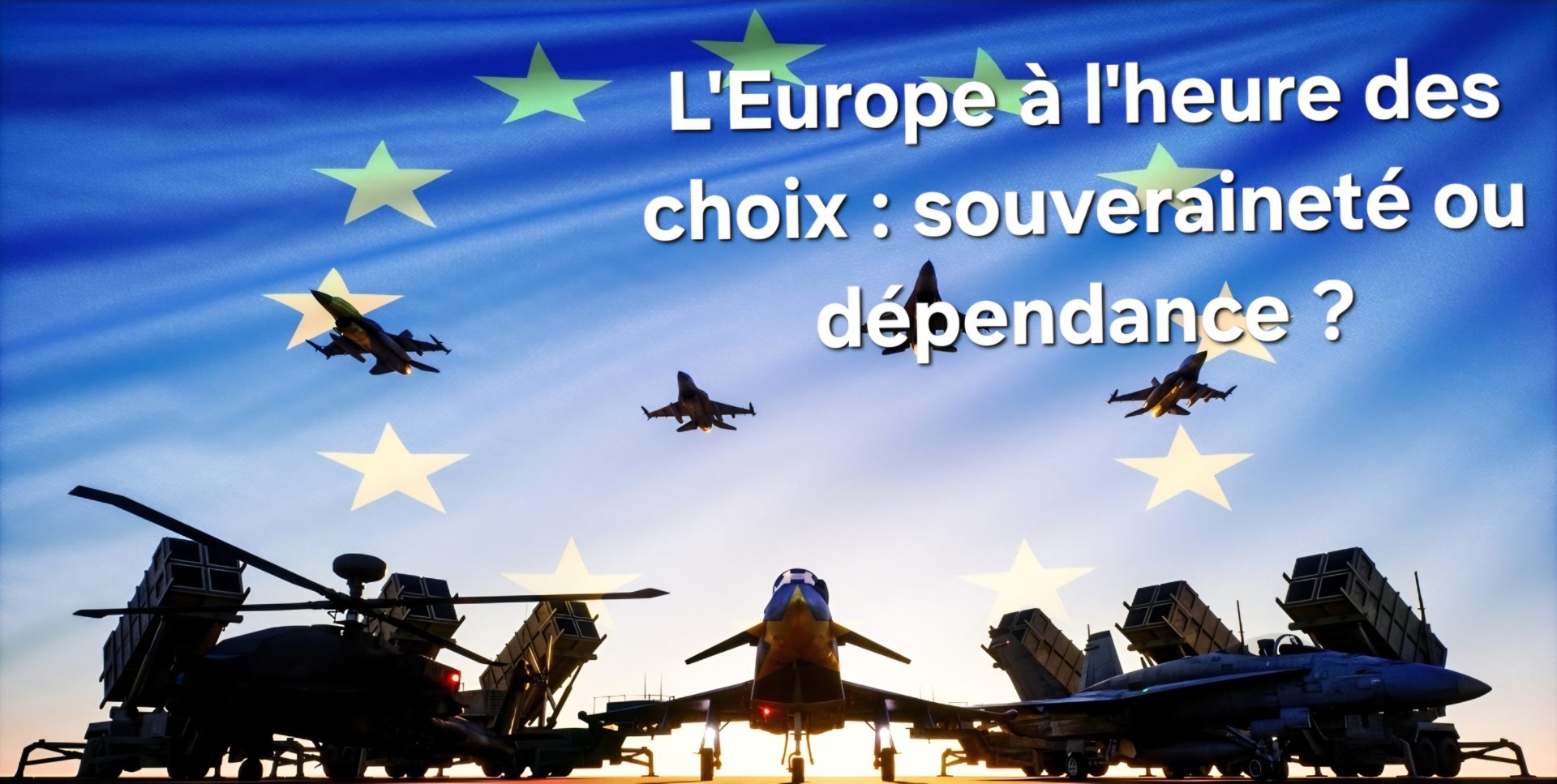
The great gamble of European rearmament
Donald Trump's return to the White House acted as a brutal eye-opener. Far from the narrative of a «peacemaker», the Trumpist agenda did not lead to the swift outcomes promised in the wars in Ukraine and Gaza. Worse still, President Trump's desire to reduce US military commitment to the transatlantic alliance, at a time when Russia is continuing its war against Ukraine, has left Europe facing a twofold challenge: strengthening its defence capabilities in the face of threats developing on its borders, and ensuring its strategic autonomy to reduce its dependence on American protection.
Europe finds itself faced with a striking strategic paradox: having returned to the heart of world history and facing an aggressor three times less populous than it and roughly eight times less wealthy, it remains at this stage incapable of ensuring its own security. This observation, as cruel as it is salutary, has produced an unprecedented political electric shock since the end of the Cold War.
800 billion: the figure that changes everything
The European response has been spectacular in its scale. The European Commission's plan, ReArm Europe / Readiness 2030, announced in February 2025 with 800 billion euros in funding, is beginning to be implemented across all European countries. National budgets for 2026 provide for significant increases in military spending: military spending is up by 22 billion euros (+21%) in Germany and 6.7 billion euros (+13%) in France in 2026 compared to 2025.
The initial effects are already tangible. The European SAFE programme provides 150 billion euros in loans for joint purchases of military equipment, and its implementation is swift, with the first disbursements having taken place as early as March 2026. Added to this is the European Defence Fund, equipped with one billion euros for 2026, which finances collaborative projects focusing on priorities such as critical technologies, multi-domain combat, cybersecurity, energy resilience and space-based defence applications.
The gaping holes of an ill-prepared continent
Behind these impressive figures lie deep structural vulnerabilities. The Sparta 2.0 document, made public by the Kiel Institute for the World Economy, puts the effort required to build European defence autonomy at around 50 billion euros per year. The authors describe a pronounced dependency on the United States and set windows of three to five years for noticeable progress. The study identifies ten critical gaps affecting command and control, autonomous systems, precision strike and air defence, and estimates the investment needed by 2030 at between 150 and 200 billion euros.
Above all, this ambition runs up against major orders placed by several European capitals for non-European equipment, which steer effect and support chains away from the continent. Poland has thus chosen Korean K2 tanks, Germany is preparing to equip its frigates with American AEGIS combat systems, and Spain is exploring Turkish partnerships for its next-generation fighters. Operational urgency is leading many states—Poland, the Netherlands, Germany, and the Nordic countries—to rapidly purchase already proven American or Israeli systems that are immediately available, to the detriment of consolidating a European industrial sector.
The nuclear dilemma
The most mind-boggling question is that of nuclear power. European autonomy could be short-lived to the extent that the Trump administration has discovered that American security guarantees constitute a formidable lever over its allies, especially in the nuclear field. While the United States might abandon its partners, the European debate on Franco-British nuclear deterrence in Europe could experience a form of revival.
France, the European Union's sole nuclear power, thus finds itself in a position that is both central and uncomfortable. Through its long tradition of strategic autonomy, France has a decisive role to play in building a genuine European defence. However, its budgetary situation and the controversies surrounding foreign interventions show that military power remains necessary yet insufficient to guarantee political influence in a multipolar world.
Russia, Ukraine and time running out
Whilst Europe debates, threats certainly do not wait. By multiplying drone incursions and acts of sabotage across an ever-larger portion of European territory, Vladimir Putin is running the risk of an escalation involving multiple nuclear powers. To finance the Ukrainian resistance, a creative solution has emerged on the French side: Macron has helped save the EU from a deadlock by offering the solution of a 90 billion euro loan to Ukraine through a Covid-style borrowing mechanism on the EU budget.
Linking European industry to Ukraine is increasingly emerging as a coherent strategic path. Making Kyiv not just a beneficiary but an industrial defence partner would make it possible to pool the lessons of a high-intensity conflict that is unique since 1945.
2026, the pivotal year
2026 could mark the entry into a decade where European countries will have to choose between strategic resignation and the active construction of a credible defence sovereignty, ideally in a coordinated manner. The money is there, the political will finally seems real, but coherence is still lacking. Between national industries defending their historical remits, short-termist purchases from outside Europe, and doctrinal divergences over the place of nuclear weapons and NATO, the project of European strategic autonomy still resembles a puzzle in which each state is trying to keep its own pieces.
History will judge whether 2026 was the year Europe finally took its destiny into its own hands or the one where it let slip the last window of strategic clarity before it was too late.

 French
  English
  Chinese
  Arabic