
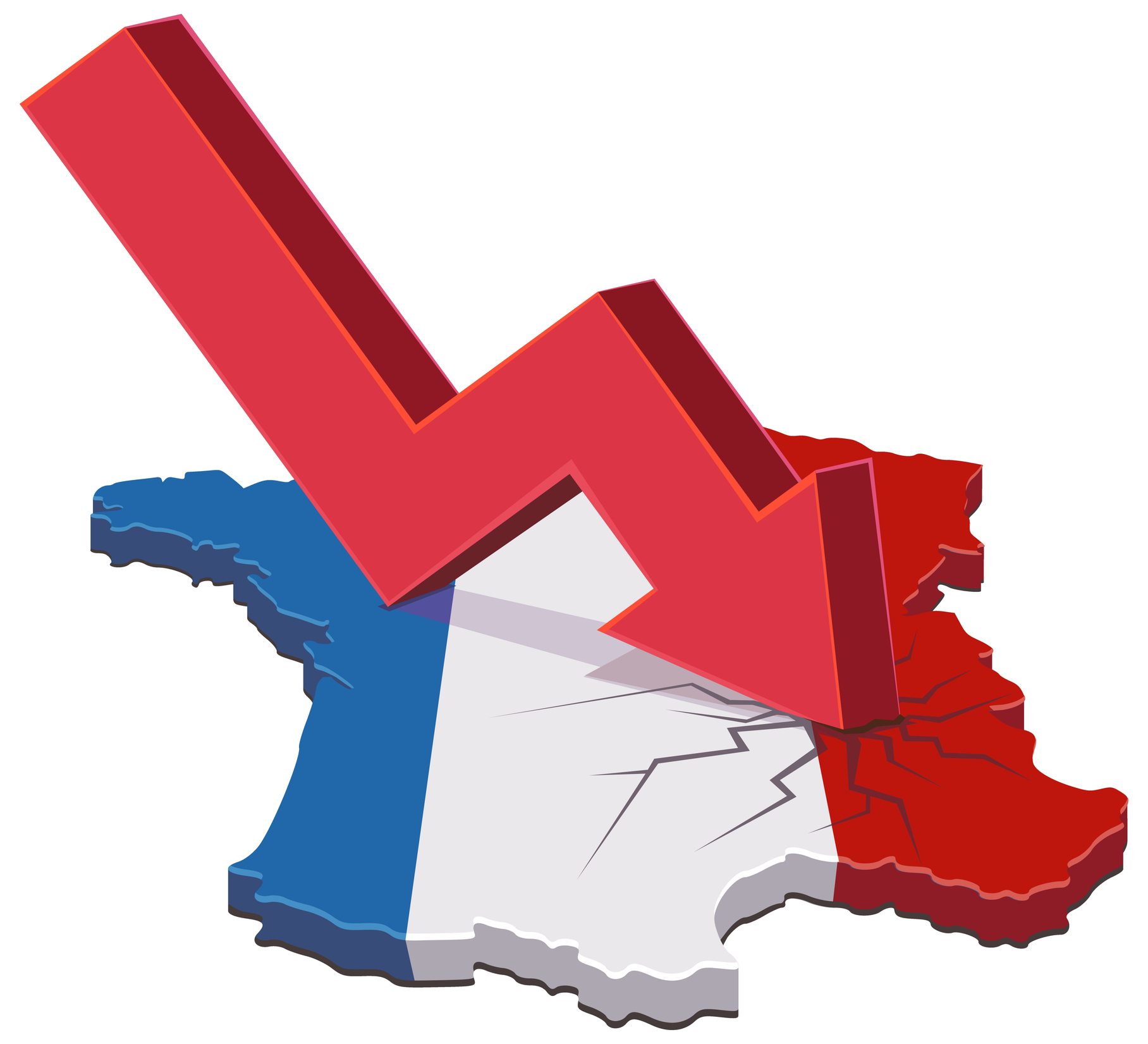
What the figures reveal: a power that is transforming, not disappearing
First, the facts. According to the IMF, France remains the world's 7th largest economic power, with a nominal GDP of 2,920 billion euros in 2024 and growth of +1.1 %, slightly above the euro area average. In 2025, annual growth stands at +0.9 % according to INSEE, driven by household consumption and public spending.
These figures seem reassuring. But they mask a darker reality once the analysis is refined. In terms of GDP per capita, France ranked 11th in the world in 1980, and is now down to 24th in 2024 according to the IMF. In terms of purchasing power parity, it sits at 25th. A drop of more than thirteen places in four decades, which is difficult to ignore.
Another warning sign is public finances. France's public debt reached 113,2 % of GDP at the end of 2024, compared with 97,9 % before the pandemic in 2019. In the second quarter of 2025, it surpassed 115,6 % of GDP, or 3,416 billion euros. The 2024 public deficit stood at 5,8 % of GDP, which is more than double the ceiling permitted by European rules. As a result, France is now borrowing on the markets at rates higher than those of Greece, a symbol that would have seemed inconceivable ten years ago.
Deindustrialisation: the heart of the malaise
This is where the reality of the decline becomes most tangible. Since 1980, French industrial sectors have lost nearly half of their workforce, representing 2.2 million jobs. Industry's share of GDP has fallen by nearly 10 points over the same period. Today, France is, along with the United Kingdom, the most deindustrialised country in the G7.
Between 2009 and 2013 alone, according to the firm Trendeo, more than a thousand factories employing at least ten people closed their doors. Between 2012 and 2017, industrial employment lost a further 150,000 jobs. And the trend continues: from September to December 2025, according to Les Échos, more than 10,000 jobs were cut or put at risk across more than 165 industrial sites in France, compared with 120 sites over the same period the previous year.
The knock-on effects are devastating. An economic study estimates that one job lost in industry leads to the loss of three jobs in the rest of the local economy. Some areas still bear the scars: in Arques (Pas-de-Calais), Arc France employed 12,000 people twenty years ago compared to 3,500 today.
These economic fractures have a direct political translation. Globalisation and deindustrialisation have economically, and then politically, polarised the French territory. The areas most affected – distance from major centres, disappearance of industrial jobs, receding public services – are also those where declinist rhetoric finds the strongest resonance.
The key variable, according to a Fondapol study, is not so much the level of income as the level of education: the populist vote is more concentrated in the least educated communes outside major conurbations. It is not an abstract ideological adherence, but the expression of a lived social experience, that of territorial and professional decline which traditional parties have failed to name or stem.
Territorial inequalities have become accentuated, widening a structural divide between dynamic conurbations and struggling peripheries. This divide is captured and exploited by the narrative of decline.
Geopolitical retreat: real, but needs to be put into perspective
On the international stage, France has indeed suffered a relative decline. Its influence in Africa, long a pillar of its power, has eroded significantly, particularly in the Sahel where its military forces have been forced to withdraw. A recent parliamentary report points to an African policy devised in isolation, a reduction in civilian and military resources, and a widespread loss of expertise regarding the continent.
Its share of global GDP has fallen from 4.5 % in the 1990s to less than 3 % today, as a mechanical result of the rise of emerging economies. France still accounts for 15 % of European GDP and retains 4th place worldwide for patent applications, but its ability to influence major multilateral negotiations is constrained by its domestic budgetary imbalances.
Political instability is worsening the situation: since the dissolution in June 2024, France has had an Assembly without a stable majority, illustrating a form of ungovernability that undermines its external credibility.
A Western phenomenon, not a French singularity
Placed in its international context, French declinism loses its exceptional character. The United States, with Donald Trump, experienced the height of a similar narrative, «Make America Great Again», implicitly confessing that greatness had been lost. The United Kingdom structured Brexit around the promise to «take back control». Orbán's Hungary has established the defence of «European Christian civilisation» as a programme of government.
In all these cases, the pattern is identical: a power that perceives itself as declining, a narrative that points the finger at internal and external culprits, a promise to restore a previous order. «French decline» is part of this conservative international of resentment that has been running through Western democracies since the 2008 financial crisis.
This is not a coincidence. Globalisation has produced winners and losers. The losers are looking for narratives that explain their demotion. Political entrepreneurs of decline have known how to provide them.
Who benefits from the decline?
The «French decline» cannot be understood in a single way. Real transformations are affecting France's position in the world: massive deindustrialisation, a drop in GDP per capita, public debt exceeding 115 % of GDP, and a decline in geopolitical influence. These realities are indisputable.
However, the narrative of decline is also a powerful political construction, shaped to mobilise, direct and polarise. The question is therefore not so much whether France is declining, but why this narrative is thriving now, and who benefits from it.
Between measured fact and instrumentalised emotion, France is above all a democracy confronted with a rapidly changing world, in search of a redefinition of its role. Clear-sightedness in the face of figures is the minimum condition for responding to this seriously without yielding either to wishful thinking or to the sirens of catastrophism.

 French
  English
  Chinese
  Arabic