
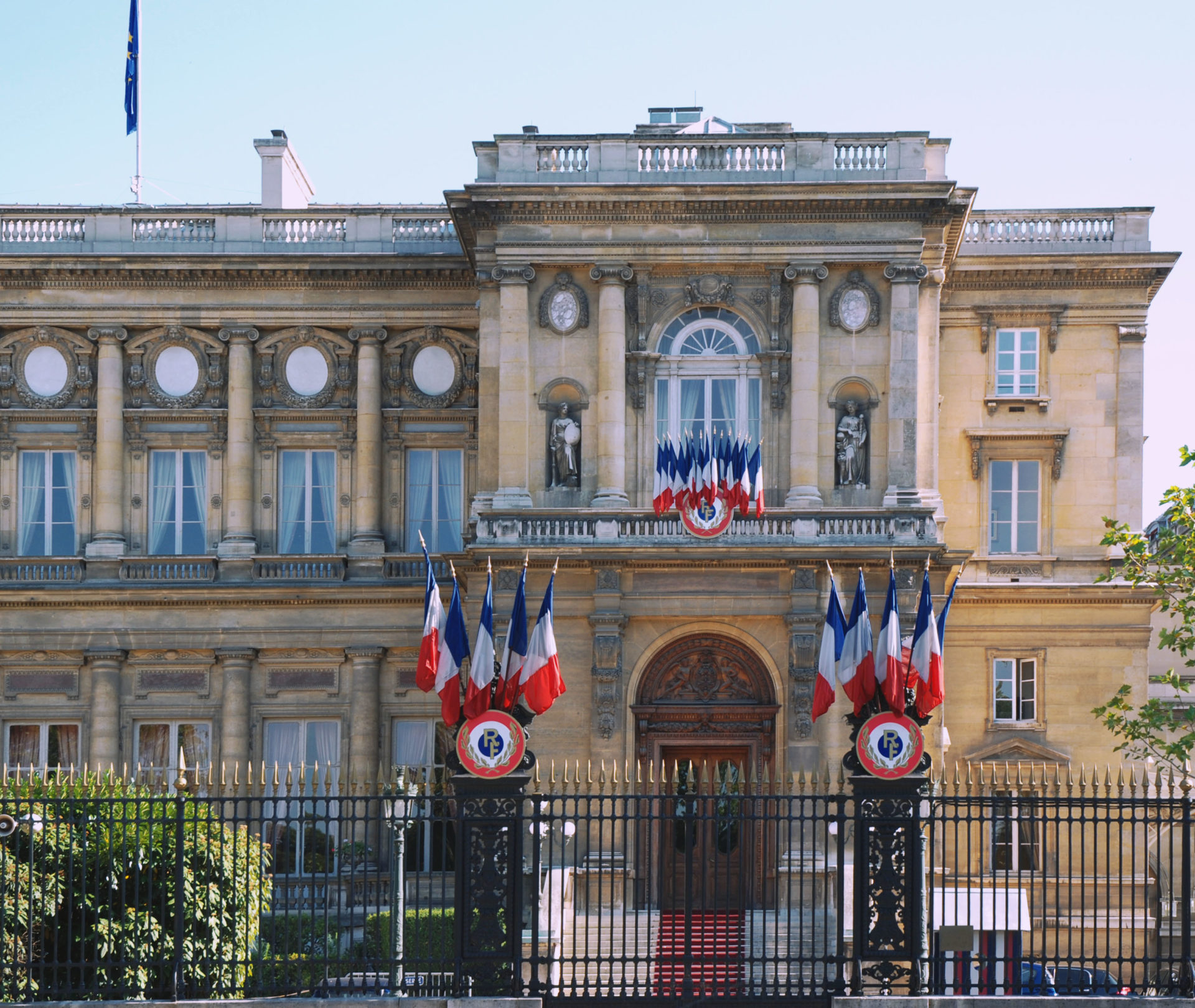
Between Gaullist continuity and the reduction of margins for manoeuvre: how Paris is trying to exert influence in a Middle East reshaped by war.
There are moments in international relations when good diplomatic intentions are no longer enough to mask the balance of power. Since 28 February 2026, when the United States and Israel launched their strikes against Iran, France has been living through one of those moments. The Strait of Hormuz has been blocked since early March. A French UNIFIL soldier has been killed in Lebanon. The war in the Middle East is costing the French economy some 6 billion euros. This is no longer abstract geopolitics: it is a concrete constraint, budgetary, strategic, and diplomatic.
Faced with this unprecedented sequence since the Gulf War, French diplomacy is trying to maintain a line that has been foundational to it since de Gaulle: neither an American vassal nor sterile neutrality, but a balancing power capable of weighing in on crises without dissolving into them. The question is whether this ambition still stands up to the test of reality.
Gaza: from a stance of balance to a major diplomatic act
For two years, the French position on Gaza was marked by calculated caution: support for Israel's right to defend itself, calls for the protection of civilians, and defense of the two-state solution. It was a fair line, but one that, for lack of concrete translation, looked more like a statement of principle than a policy.
The break came on 22 September 2025. Before the 80th United Nations General Assembly, Emmanuel Macron officially recognised the State of Palestine. «Yes, the time has come to stop the war in Gaza, the massacres, the death. Urgency demands it of us. The time has come to do justice to the Palestinian people,» declared the Head of State in New York. This announcement, prepared in advance with Saudi Arabia, was part of a broader diplomatic initiative: France and Riyadh had co-chaired a UN conference on the two-state solution in late July 2025, culminating in the «New York Declaration», adopted on 12 September by 142 member states.
By doing so, Paris crossed a threshold that London, Ottawa and Canberra crossed at the same time. With France and the United Kingdom, four of the five permanent members of the Security Council now recognised the Palestinian state, effectively isolating the United States on this issue. This is a major diplomatic act, not a posture. It reveals a genuine capacity for initiative, but also its limits: Israel and Washington refused to take part in the summit, and the reality on the ground in Gaza was not immediately changed.
Iran: from nuclear diplomacy to the management of an open conflict
The Franco-Iranian relationship underwent a profound transformation over the space of a few months. In late 2025, it was still a matter of traditional nuclear diplomacy. On 26 November 2025, Minister Jean-Noël Barrot held talks with his counterpart Abbas Araghchi in Paris, calling on him to resume negotiations and comply with IAEA obligations, while also raising the plight of French nationals detained in Tehran. Paris was thus maintaining a line of demanding dialogue, inherited from the E3 format (France, Germany, United Kingdom) which had co-negotiated the JCPOA.
Then war broke out. On 28 February 2026, US-Israeli strikes killed Supreme Leader Ali Khamenei and triggered a massive Iranian response: missiles fired at Gulf countries, the closure of the Strait of Hormuz from 1 March onwards, the laying of naval mines, and attacks on oil tankers. On 2 March, Barrot held a press conference to assert that France was «ready to take part in the defence» of its Gulf allies—Saudi Arabia, the Emirates, Qatar, Iraq, Bahrain, Kuwait, Oman, and Jordan—while explicitly refusing to take part in «any forceful opening of the Strait in the context of war operations».
This distinction is the very expression of the French line: solidarity with regional allies, refusal of the logic of belligerence, maintenance of a diplomatic window. On 19 March, Paris co-signed a communiqué with its G7 partners firmly condemning the blockade of Hormuz and calling for compliance with UN Security Council Resolution 2817. On 26 March, during the meeting of G7 Foreign Ministers at the Vaux-de-Cernay Abbey under the French presidency, Barrot was still attempting to build «negotiation channels» to encourage de-escalation.
The Strait of Hormuz: when systemic constraint becomes physical
The Strait of Hormuz is the empirical test of all diplomatic abstractions. Twenty per cent of global oil trade passes through it. Its de facto closure since the 1st of March 2026, with 150 ships blocked within the first few days, has caused an increase of over 15 % in oil prices and direct repercussions in France: soaring fuel prices, emergency aid for fishermen and «long-distance drivers», and agricultural tensions.
It is in this context that France deployed an active maritime diplomacy. It co-organised with the United Kingdom a 51-country summit on freedom of navigation in the strait. It took part in G7 discussions on convoy escorts. It has a presence in the eastern Mediterranean and has engaged within the framework of the European operation ASPIDES for maritime security in the Red Sea. But therein lies the structural limitation: it was Washington that ultimately structured the military response. It was Trump who announced that the US Navy would escort oil tankers «as soon as possible». It was also he who announced the ceasefire of 8 April 2026, followed by its extension to 21 April.
France exerted influence within the multilateral framework. It did not shape the outcome. That is a reality which must be stated without wrapping it in metaphors.
European strategic autonomy: concept or operational reality?
The March-April 2026 crisis constitutes a full-scale test for the notion of European strategic autonomy, which has been championed by Paris for years as a political horizon. The assessment is mixed.
On the one hand, Europe is not absent. The G7 under the French presidency was an active framework. The Europeans coordinated their positions on the Iranian nuclear issue, freedom of navigation, and sanctions. France used its G7 presidency to try to impose a logic of de-escalation where Trump was leaning towards confrontation.
On the other hand, the limitations are glaring. Security dependence on NATO and American power remains decisive as soon as the conflict shifts into the open military phase.
The fragmentation of European national interests, with some member states more aligned with Washington and others more cautious, reduces the capacity for collective action. And US extraterritorial measures continue to constrain European partners who would like to keep channels open with Tehran.
Strategic autonomy therefore remains more of a goal than an operational reality. It is making progress, France is working towards it, but it runs up against structures that neither Paris alone nor a united Europe yet has the means to overcome in a major crisis situation.
A power of initiative in a world of results
What is emerging through the Gaza and Iranian files is not a decline in French diplomacy, but a clarification of its function. France remains capable of structuring initiatives, of which the recognition of Palestine is proof, and of an active presence in multilateral fora. It managed, during the Hormuz crisis, to maintain a distinction between defensive solidarity and offensive participation, which is no small feat in the context of strong American pressure.
But the world no longer judges middle powers by their positions: it judges them by their results. On Gaza, despite the recognition of September 2025 and the New York Declaration, the conflict continues and humanitarian aid remains insufficient. On Iran, despite the diplomatic work, it was Trump who secured the ceasefire. On Hormuz, despite the summits, the shipping lane remains unstable.
The central question for French diplomacy is therefore not that of its legitimacy, which is recognised, nor even of its coherence, which holds up. It is that of effectiveness in a world where results depend less and less on the quality of analyses and more and more on the ability to mobilise coalitions of power. It is to this requirement that Paris must now respond, beyond rhetorical flourishes and opinion pieces.

 French
  English
  Chinese
  Arabic