
By Camilo Palasco Prophette and Martin Hébert
Understanding the decline of French influence requires, in the first place, measuring the cultural and moral gap that seems to be emerging between the West and Africa. The resurgence of the «desire for sovereignty» is now the basis for post-colonial ideals that are increasingly infusing African minds, contributing to the dismantling of the Western democratic and liberal value system imported.
The resurgence of the desire for sovereignty, a reflection of a desire for political self-determination by the African youth
Beyond their mere relationship to the former colonial power and the media-driven «anti-French sentiment,» the societies of Francophone Africa are actually imbued with a powerful sovereignist undercurrent, constituting the political rent of the military regimes. This desire for sovereignty can be interpreted as an aspiration to reappropriate the national political game, on two levels.
Although not democratic, coups d’état are paradoxically welcomed as moments of respite.
At the level of the relationship between the population and the state, first of all, a critical consensus regarding the political elites has gradually emerged in public opinion, against the backdrop of the failure of the Western democratic governance model. Largely perceived as authoritarian and corrupt, these elites would benefit from a false democratic facade in order to remain in power despite established constitutional provisions. The numerous, successful or unsuccessful attempts by current African presidents to circumvent the limitations of their term of office have largely contributed to weakening the population’s trust and governance(297). Although not democratic, coups are paradoxically welcomed as moments of political breathing space, as well as an opportunity to break with a governance system deemed dysfunctional. In Mali, this desire for rupture manifested itself as early as 2020 in the nationalist movement of protest against the regime of Ibrahim B. Keïta, through the slogan of «New Mali» (Mali Kura) on which the current military transition was built (298). Similarly, the demagogic discourse of the leader of the Guinean junta, delivered at the United Nations in September 2023, sets the tone for this change in era that a large part of the youth today aspires to: «The democratic model insidiously and cleverly imposed on Africa does not work […] this model has especially contributed to maintaining a system of exploitation and pillage of our resources and a very active corruption of our elites(299)».
The primary role of social networks
In the age of the Internet, this desire for reappropriation expressed by the new generations eligible to vote is also manifested at the level of militant practices and new forms of online civic expression, outside of traditional political and media channels (radio, television, newspapers). The explosive growth of mobile telephony and social media platforms over the last two decades (300) has shaped young, urban, connected citizens who are now able to inform themselves on their own. Applications like WhatsApp and Telegram play a major role in citizens reclaiming information and multiplying alternative narratives to the public discourse, which is drowned in a constant flow of information: «These new applications have revolutionized access to open participation in socio-political affairs, because all citizens […] are now able to listen to Facebook live streams, animate TikTok live videos, record voice notes, and share content(301)». Free and easy to use on a smartphone, they enable the creation of anonymous discussions that are both spaces for political counter-discourse and relaying of misinformation. This creates a particularly complex informational ecosystem, online and offline, where traditional media, social media platforms, and word of mouth (302) intertwine, contributing to blurring the boundaries between mere opinion, verified information, and deliberate disinformation (303). In this context, anti-systemic and deconstructivist discourses find a prominent place.
The influence of the postcolonial school in the deconstruction of the Western value system and the desire for the reappropriation of African cultural heritage
The reading grid of the postcolonial school
Often associated with the North American progressive academy, or denounced by some as a facet of the «woke movement,» the postcolonial school extends its foundations and implications well beyond. A specialist in postcolonial studies, Dr. Martin Bayly describes this school as «aimed at revealing the residual effects of the colonial era on the organization of the international system. It is about understanding the colonial biases in the world-view we and our governments use(304)».
Drawing its essence from contemporary philosophers such as Michel Foucault, Jacques Lacan, Edward Saïd and Aimé Césaire, this movement institutionalized itself in the 1980s on American campuses to question the perception of the West in relation to the «other». Some critical questions of the postcolonial school, notably regarding the destabilizing effects of interventions in the Middle East and the claim to cultural and moral superiority of developed countries, have encouraged a retreat of Westerners in their perception of the world.
This school also emphasized the importance of considering the cultures of the countries where external operations are conducted. Although still embryonic, the awakening brought by this trend would not be institutionalized until a generation replacement occurred (305).
Starting from a scientific approach, postcolonial theories have nevertheless been subjected to political repurposing, becoming counterproductive despite their intentions. Distorted by our strategic competitors and the rapid flow of information via the internet, these theories are now percolating into African public opinion in favor of external political agendas.
The political recovery of postcolonialist theories is found in the militant sphere of «neo-Pan-Africanism"
Xi Jinping’s China, for example, presents its presence in Africa as a form of cooperation between countries victimized by Western capitalist imperialism, playing on the memory of the wars of opium. Similarly, Vladimir Putin’s Russia inscribes its presence in Africa within the continuity of the «solidarity-based anti-imperialist» rhetoric pursued by the USSR during the Cold War.
At the same time, political recovery is also happening from within. For example, through certain positions taken by French opposition parties that use the postcolonial critical method to discredit the current government and its foreign policy. In 2021 in Burkina Faso, Jean-Luc Mélenchon claimed to be bringing an alternative voice to «imperialism, neocolonialism, and French paternalism» (306).
This political recuperation of postcolonialist theories is found in the militant sphere of the «neo-Pan-Africanist» movement. Indeed, there is an ideological continuum between postcolonialist theories and the historical movement of Pan-Africanism, spearheaded by figures such as Thomas Sankara or Kwamé Nkrumah at the time of the independence movements, notably in the conception of a fragmented – see racialized – world between dominant and oppressed peoples(307).
A political movement inherently anti-colonialist, Pan-Africanism promotes African cooperation with «emerging powers» and a total break with the systems of economic and political predation inherited from Western colonialism. This movement is currently experiencing a renaissance on the continent and in African diasporas under the influence of organizations such as Pan-African Emergency or La Chaine des Pan-Africains.
Their activists also rely on postcolonial theories to bring their popular fight to the African youth, mobilizing the idea of a «second independence from below», cultural and identity-based (308), often extremist and demonizing the West and France. These political movements are at the forefront of anti-French influence campaigns on the continent, capitalizing in particular on the negative sentiment of the populations towards the military presence, described as the ultimate symbol of French interference.
Anti-French resentment as a political resource
Having become in a few years the most attacked Western power in terms of information, France today faces a myriad of actors who are damaging its reputation and image. In Africa, three types of actors with sometimes convergent interests are mobilizing anti-French resentment as a primary political resource: neo-Pan-Africanist political entrepreneurs, existing military regimes, and foreign powers, especially Russia.
The Neopranafricanist movements, the living force of the anti-France mobilization
In the milieu of French political activism, followers of neopanafricanism stand out as the champions of anti-France mobilization. The most listened to of these neopanafricanists is undoubtedly the Franco-Beninois Stellio Gilles Robert Capo Chichi, aka Kémi Séba, founder of the NGO Pan-African emergency(in 2015 in Dakar) and author of several philosophical and militant works. A devotee of Kematism, He bases his argument on a critique of Western and African «oligarchies» and a historical denunciation of «Françafrique». He gradually built political legitimacy among the diaspora in France by developing a particularly virulent pan-African revolutionary rhetoric in the 2000s.
Received in 2018 by the channel Thinkerview, With a cumulative audience of 1.3 million subscribers on Facebook as of the end of January 2024, nearly 290,000 on Instagram, 240,000 on Twitter, and 217,000 on YouTube with 185 videos uploaded. He founded and runs a new media outlet in 2023, Africa Resurgence, He also assumes the idea of a convergence of struggles between Africa and Russia against the «Western oligarchy» and claims to be close to the theorist. Alexandre Douguine, a strong opponent of the Western presence in Africa.
The influence of the disposals
It is fundamental to measure the importance of the role of Francophone African diaspora in the digital breakthrough of pan-African «influencers.» This advantage is derived from two factors: benefiting from the European standard of living and having homogeneous access to the internet and information, the populations of the diaspora also benefit from a freedom of expression that is unparalleled compared to the populations remaining on the continent.
That is how the Cameroonian Swiss Nathalie Yamb or others like the French Franklin Nyamsi and Egountchi Behanzin, Paradoxically, they denounce the colonization of the minds and the imposition of European lifestyles on Africans from their places of residence in Europe. Within this militant galaxy, Nathalie Yamb emerges as the most-followed «YouTubeer», accumulating more than 360 videos in January 2024.
She is also distinguished by her particularly pro-Russian stance. She has been nicknamed «The Lady of Sochi» since her participation in the 2014 Winter Olympics. Russia-Africa Summit In 2019, she does not hesitate to praise the successive diplomatic rapprochements between the Saharawi juntas and the Russian regime on her social media platforms. She also systematically reports on geopolitical news in a way that suits the image of a Vladimir Putin, champion of the fight against the West and its values, in the light of the war in Ukraine.
Anti-Western rhetoric
On the continent, the rise of citizen opposition movements in several countries coincided with the development of organizations embodying a new pan-African radicalism. While the former emerged in opposition to local policies, the latter more directly mobilize anti-Western rhetoric at the heart of their political struggle.
As early as 2011 in Senegal, the movement I’m fed up with it It crystallized the criticism against President A. Wade and federated a network of organizations under the Pan-African banner. In 2021, the movement joined forces with the anti-French collective FRAPP – France Get Out by opposition MP Guy Marius Sagna, to denounce the alleged hand of France behind the regime of Macky Sall.
In Mali, the association Yerewolo-Standing on the Ramparts emerged in 2020 in opposition to President I. B. Keïta, under the leadership of Ben Diarra, He is called «Ben le Cerveau» and is currently imprisoned for calling for the end of the transition in February 2024. A leading figure in the demonstrations in support of the coup in August 2020 and demanding the departure of the foreign troops (Barkhane and MINUSMa), he nevertheless adopts a stance favorable to welcoming the Russian mercenaries from the private sector. Wagner.
The porosity between citizen movements and neo-Pan-Africanist movements is, however, less evident in Burkina Faso. The movement Citizen broom, A pacifist and pro-democratic, he opposed the transition authorities in October 2023, thus earning the hostility of the neopanafricanists who rallied to the captain. Ibrahim Traoré. These activists, like Nestor Podassé, They had a notable influence in the violent demonstrations against French cultural and diplomatic representations in October 2022.
The political communication game of the new Saharawi autocrats
Closeness to France is costly electorally
The control of information is a major issue in the preservation of power. For several decades now, some governments in francophone Africa in difficulty have used criticism of French policy to justify their own misdeeds, thus contributing to the idea of a «French conspiracy» behind all African ills, particularly security-related ones.
But in general, it is now fundamental to consider that for African leaders, the decision to engage in a close and assumed military relationship with France may appear costly. On the political level, they are indeed measuring the growing risk of being perceived by public opinion as beholden to the former colonial power, all the more prevalent in the context of one of the most ambitious French foreign operations.
This new situation is reflected in international cooperation and is pushing the majority of African states today to increasingly diversify their partnerships, especially military ones, in contrast to the exclusivity long reserved for France. Thus, from simple partnership diversification to rejecting the French presence, a more classic political calculation of costs and benefits is taking place, rather than a genuine visceral hatred of France.
In this context, the coup-mongering military of Mali, Burkina Faso and Niger have respectively put in place political communication strategies to legitimize their coups d’état, making France their scapegoat. The coup plotters thus constructed a sovereignist rhetoric based on the security failures of civilian governments, militarily supported by France.
Mali as a trigger
In this sense, the criticism of the inefficiency of French support, widely spread in Mali before the coup d’état in August 2020, constituted a political asset for the new strongmen of the country. The disagreement between Bamako and Paris over the status of Kidal, a Touareg stronghold recaptured in 2013, was notably instrumentalized by the Malian authorities to spread false accusations and thus convey the rumor of a «French plot» supporting the partition of Mali.
In disregard of any diplomatic convention and the truth of the facts, misinformation without evidence has become the trademark of the Malian regime to divert attention from the country's critical situation.
In the same way, in Burkina Faso, the second putsch by Ibrahim Traoré in September 2022 was accompanied by a shift in the use of anti-French propaganda. The military thus suspected France of harboring Lieutenant Colonel Damiba at the Kamboinsin base, before calling for the departure of the Sabre force and that of Ambassador Luc Hallade in January 2023.
The alliance between juntas and neo-Pan-Africanist circles and the media control
The new junta then embarked on a vast media control and disinformation campaign supported by Russia and marked by the ban, in March 2023, of the French media RFI and France 24, suspected of «manipulating» national opinion.
This account of the French plot has finally been taken up by the putschists in Niger, who accuse Paris of having freed terrorists, violated the country’s airspace and of preparing an offensive to restore President Mohamed Bazoum to power.
In these three countries, a reconfiguration of political power is taking place around an objective alliance between the juntas and the neo-Pan-Africanist sphere. Accepted as equal to heads of state, the «stars» of neo-Pan-Africanism represent powerful amplifiers for the juntas, in order to consolidate their sovereignist narrative and relay anti-French rhetoric.
After his tour in Mali and Burkina Faso in May 2022, Kémi Séba Thus, he traveled to Niamey in September 2023 in support of the general Abdourahamane Tiani, «, »to continue this work of deconstructing Francafrique and spreading Pan-Africanism".
In December 2023, it was their turn. Nathalie Yamb to be received in Niger by the local branch of the NGO Pan-African emergency and the head of the junta. The meeting was immediately relayed on the Twitter account of CNSP, On December 20, two days before a second tweet congratulating the departure of the last French military personnel.
In her video chronicle published following her week-long tour, Nathalie Yamb, for her part, strove to reassure her audience about the determination of the new Nigerian authorities to break with France, while also not hesitating to justify their retention in power for ten years.
On December 28, it is finally the activist Franklin Nyamsi who had the opportunity to travel to Niamey to «greet Niger’s pan-African leadership» and contribute to the regime’s communication strategy.
Yet despite their superficial sovereignist rhetoric, these juntas rely on the expertise of foreign powers in matters of influence.
Foreign influence operations hostile to the French presence in Africa
Recent upheavals in the African political landscape and the French military withdrawal have created a power vacuum that emerging powers are rushing to fill. Added to this is the youth and connectivity of the African population, with 70 per cent of its population under the age of 30 and the majority obtaining their news via social media and online platforms. These uncontrolled and globalised information flows provide fertile ground for our competitors’ influence campaigns.
For several years, Turkey has been pursuing an aggressive strategy of influence against French interests in Africa.
The crumbling of the Ottoman Empire left an open wound in Turkish national pride, which Recep Tayyip Erdogan intend to close with a policy of national rebirth.
Turkey is capitalising on the ebb of French influence in Africa through religious diplomacy and security cooperation. Despite being a secular republic, Erdogan's Turkey has reconnected with its Islamic identity and nostalgia for the Caliphate. It is through this channel that Ankara manages to position itself as a partner of choice by stirring the sympathy of African political elites.
In Mali, Ankara had notably had mosques built in Bamako intended for the High Islamic Council, as well as in President Keïta's hometown. Furthermore, Turkey is relying on its security offering to expand its influence, through the signing of defence treaties with certain countries and the conquest of the military drone market. Thus, the TB2 drone from the company Bayraktar, run by an ally of those in power, quickly became the flagship of Ankara's diplomacy in Africa.
In Libya, too, Turkish and French influence is clashing. Since 2011 and the fall of Colonel Gaddafi, Libya has been split between Al-Sarraj's government in Tripoli and Marshal [Haetar's/the Marshal's] government in Tobruk Haftar. Although officially aligned with Tripoli, Paris supports Marshal Haftar’s troops to fight against the expansion of terrorism.
However, these efforts are running up against Turkish support for the Tripoli government, which has already had concrete repercussions. In 2019, as Marshal Haftar was preparing to march on Tripoli and unify the country, Turkey deployed its troops in support of Tripoli, pushing back the troops allied with France.
Similarly, in 2020, a French Navy vessel tasked with inspecting a Turkish commercial ship suspected of carrying weapons to Tripoli was threatened with warning shots by a Turkish frigate.
The escalation of tensions in the Mediterranean Sea between the two countries immediately translated into the informational sphere, through the use of disinformation on the Turkish side, insisting on the «neo-colonial» nature of France's African policy.
China is developing a genuine strategy of influence based on an alternative path to the West
If geopolitical ambitions Chinese women in Africa are not explicitly directed against France, since the coming to power of Xi Jinping In 2013, China committed itself to a policy of «great national rejuvenation».
Highlighting its image as a Global South state that has risen from the «century of humiliation» for which the West is to blame, Beijing is playing on the narrative of a more egalitarian («win-win») cooperation without moral conditions in order to gain market share. Thus, China has integrated itself, like no other actor, into African regional security structures.
The funding and training of the military personnel of the Economic Community of West African States (ECOWAS) since 2016 is the most notable example, as is the financing of the African Peace and Security Architecture (APSA), which is notably responsible for the command of the African Standby Force.
Finally, it is in the arms sector that China is taking advantage of the lack of competitive French industries on the African market, an expansion of the Chinese arms market that can be explained by Beijing's «friendly prices». Today, two-thirds of African armies use Chinese weapons, of which the arsenals of Mozambique, Zambia and Tanzania are 90 % made up.
It is above all Russia that has for several years been deploying a particularly aggressive strategy of influence against France in Africa.
Ever since the resurgence of its post-Soviet inertia and Vladimir Putin’s rise to power, Russia has focused its attention on the African continent in the hope of capitalising on Africa’s natural resources and rapidly expanding human capital.
Capitalising on anti-French sentiment, Russian expansion in Africa relies, to a large extent, on the political co-optation of the aforementioned Pan-Africanist and post-colonial discourses, but also on the instrumentalisation of inconsistencies in French policy. The aim is to persuade African societies that Russia embodies a promising new model, replacing the Western presence, which is perceived as hypocritical.
In 2022, Vladimir Putin denounced the «economic and ideological colonialism of the West» and regularly plays on the opposition between Western progressivism and the traditionalism characterising African social structures to fuel anti-Western controversies. He notably denounced the «moral crisis» of the West and the «loss of its Christian values», calling for a response to the «guilt of colonisation».
However, it is through the Wagner Group that Moscow is advancing its geopolitical agenda in Francophone Africa. Due to its officially private status, Wagner serves as a grey zone for Russian military projection in Africa.
Present to date in four French-speaking African countries (Mali, Burkina Faso, Libya, Central African Republic) and very likely soon in Niger, the Wagner Group has succeeded in establishing itself at several levels.
In the Central African Republic, Wagner set about stoking anti-French sentiment in order to extend its influence over the Touadéra regime. Thus, in 2018, Wagner launched the radio station Longo Songo to continuously broadcast anti-French and pro-Russian propaganda and boast about waging a war «against the colonial system».
Furthermore, social media is where the most virulent pro-Russian propaganda is hosted. This is evidenced by Wagner-designed cartoons, shared on WhatsApp or Telegram channels, in which the «rat Emmanuel» wearing a beret and a tricolour flag, metaphorically plundering Africa, is driven out with sledgehammer blows by a Wagner soldier.
Similar scenario, Wagner soldiers coming to annihilate Macron's «demons» catching Malian soldiers in a pincer movement. More explicitly, Wagner trolls had shared photos showing alleged French soldiers looting Malian gold bars, which turned out to be photos of American soldiers in Iraq posing with copper bars.
Since the murky death of Yevgeny Prigozhin, following his threat of a putsch in the summer of 2023, the presence of Russian mercenaries has been split between several labels such as Redoubt, Convoy or also Afrika Corps, continuing even today to relay narratives against the French presence, the military presence in particular.
The French army on the front line of the information war
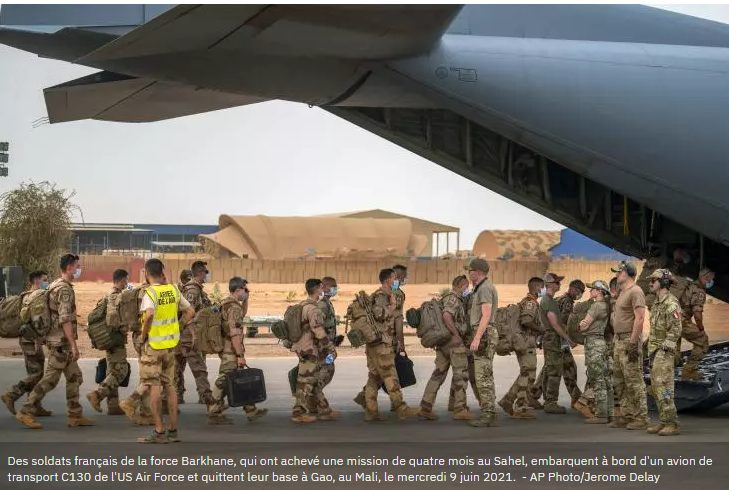
Faced with the constraint of managing «urgency and history at the same time», France gradually found itself at the centre of the war of perceptions in the zones where it was militarily engaged. For many years, French military interventionism has significantly crystallised accusations of neo-colonial interference. It is upon this discontent, amplified in the context of Operation Barkhane, that anti-French disinformation campaigns have proliferated.
French military interventionism as a point of contention in African imaginaries
Despite a drastic reduction in its troop numbers over 50 years, the French army carried out more than fifty external operations (OPEX) between 1960 and 2014, helping to forge the image of France as the «gendarme of francophone Africa». This interventionism is at the heart of the frustrations sometimes felt towards France, ranging from simple disappointment regarding the record of French military action, which is largely misunderstood by both African and French publics, to the most virulent mobilisations challenging the French tendency towards political and military interference.
Since Operation Turquoise (Rwanda, 1994), France has become the target of accusations of complicity in the mass crimes committed by the Rwandan government at the time. While it does not attest to any complicity on the part of the French state in the genocide, the Duclert report concludes on the «overwhelming responsibilities» of the Mitterrand system, through its blindness in politically supporting the «racist, corrupt and violent» regime of President Habyarimana.
President Emmanuel Macron’s desire to «shed light» on the French state’s role in the Rwandan genocide has led to the legitimisation of a grounds for condemnation against France’s critics
In terms of political communication, this desire has resulted in the legitimisation of grounds for condemnation for detractors of France, starting with the current Kigali regime.
With the Licorne operations (Côte d’Ivoire, 2002-2015) and Harmattan (Libya, 2011), France has exposed itself as a player in the political crises in Côte d’Ivoire and Libya, giving weight to the accusations of interference.
The Ivorian case illustrates, in this regard, the phenomenon of anti-colonialist mobilization in an interventionist context, revealing the many grievances of the young Ivorian protesters against the former colonial power. Indeed, although their mobilization was largely instrumentalized by the supporters of Laurent Gbagbo’s regime, these patriotic young people «found in the anti-colonialist cause a vector of empowerment: the discourse of national liberation served as a vehicle for a different form of emancipation: a generational, familial, community, economic, and ultimately political struggle.».
In other words, the rural mobilization on the register of national liberation used by the Gbagbo regime was not only opportunistic, but also a reflection of the emancipatory aspirations of a new generation, amplified by the context of the French military intervention.
The consequences of the Harmattan operation were equally damaging to the French image. In the same way that President Gbagbo was ousted with the support of the French army, the elimination of the «guide» Muammar Kadhafi was largely presented as a punitive expedition by NATO led by President Nicolas Sarkozy.
Ultimately, it was the prolonged commitment to the Sahel (2013-2022), through Operation Serval and then Barkhane, that crystallized, until the political rupture.
As early as January 2013, the French tactical choice of allowing the Tuareg separatists to remain in Kidal in exchange for their support in the fight against jihadists sparked incomprehension in Bamako. Despite the stabilization efforts undertaken at several levels (G5 Sahel, MINUSMa, Takuba), diplomatic tensions between Paris and its partners escalated, fueled by a worsening security situation, casting doubt on the usefulness of Western aid.
Concurrently, the peak of violence in 2019 – the deadliest since 2012 – was followed by a flood of false information and anti-French publications relayed on social media. Thus, regardless of the debate over the legitimacy of the French operations, launched at the request of the partners and based on agreements, France is now paying a heavy price in the field of perceptions.
A French army accused of all the evils
France is therefore operating in an informational context conducive to manipulation regarding its military presence. As early as November 2019, the French army became the target of massive online disinformation targeting African imaginaries already susceptible to conspiratorial narratives.
Without claiming to be exhaustive, three main messages structured the disinformation campaigns against Operation Barkhane.
The first message focused on the neo-colonial nature of the French army and its alleged predatory ambitions. In Mali, waves of misinformation on Facebook, Twitter, and TikTok were indeed spread, sometimes in local languages, to denounce the Barkhane operation as an occupation force aimed at plundering the resources of the host countries.
Since 2013, however, the French armies have intervened at the request of African states and in full respect of their sovereignty, precisely by focusing on promoting the empowerment of their partners.
A second message that was widely relayed was to portray the French army as the instrument of a large-scale destabilization policy. In Mali, several narratives could convey the idea of a French army «supporting the partitioning of the country,» taking as an example the special status of the city of Kidal.
In Niger, it is also alleged that it attacked the Diffa military base in November 2019, without any evidence of such an attack being presented.
In contrast, stabilization was at the heart of the French strategy, which included, in conjunction with the French Development Agency (AFD), a component of civil-military actions in favor of the populations.
More in a criminalization logic, the third message widely disseminated aimed at convincing the populations that the French army was financially and materially supporting the jihadist groups.
This was notably the case in Mali, where France was accused of supplying motorcycles, weapons, and intelligence to the Qaidist groups, in order to divert attention from Bamako’s security failures.
On the contrary, between December 2014 and June 2022, it is important to recall that the tactical successes of the Barkhane force have enabled the neutralization of about twenty jihadist leaders from al-Qaeda and the Islamic State.
The bumbling nature of these various examples demonstrates how much the virality of false information does not depend on its credibility.
The robustness of the engaged narratives actually has little impact on individuals who are already familiar with criticism, or even clearly hostile.
It is therefore primarily the non-objectivity of the target audiences that is exploited in disinformation campaigns based on the instrumentalization of individual cognitive biases.
It is indeed the cognitive biases, these «unconscious deviations» of the human brain, that shape individuals’ relationship to information and, in doing so, their relationship to reality. In other words, in the absence of systematic rationality in the processing of information, the objectivity of the facts does not necessarily constitute a driving force for an individual to adhere to it.
This is evidenced by the limitations of fact-checking companies (fact-checking) against massive disinformation, which continues to grow despite the launch of several African initiatives (Africa Check, Factoscope, AfricistsIn addition to this, in sub-Saharan Africa, there is little public investment in scientific and journalistic research on the phenomenon of disinformation.
The Gossi case, an information victory in a low-key manner
The most significant episode of disinformation campaigns against the French army in the Sahel remains without a doubt the Gossi massacre case. On April 21, 2022, two days after the handover of the Gossi base to the Malian Armed Forces (FAMa), a fake Twitter account named Dia Diarra broadcasts images showing buried human bodies, with the comment: «That’s what the French left behind when they left the base in #Gossi (…) we can’t keep quiet about this!».
The next day, the French headquarters immediately responded by releasing captured and declassified drone footage, revealing the staged scene of Wagner’s mercenaries burying and filming the bodies three kilometers from the Gossi base.
According to several sources, this mass grave was formed with the bodies of the victims massacred by the FAMa and Wagner on April 19, in the locality of Hombori, located 70 km from Gossi.
The responsiveness regarding the Gossi affair has illustrated the French capacity for anticipation and response in the information field. In fact, the management of information risk is now fully integrated into the operational maneuvers of the French armies.
Air assets were thus deployed to monitor the perimeter during the evacuation of the base. Gossi is in this respect an example of the rapid exploitation of tactical intelligence at the strategic level, which helped to limit the effects of an accusation of war crimes against France.
But in an information war where the initiative of the attack prevails, sowing doubt among the populations and sometimes even among our partners, the only response seems insufficient.
In this case, the counter-influence operation regarding Gossi was not complete and had limited effects on the ground, due to the absence of local media relay after the suspension of RFI and France 24 in Mali.
The media interventions on the French channels aimed at restoring the facts actually had only a very limited effect at the local level and on social media, where misinformation had already done its work.
The Gossi case reminds us, in this regard, of the essentially offensive nature of the information battle and the importance of the «first impact» in the digital field.
Asked about the strategic lessons of the Barkhane operation in terms of information warfare, the Chief of Staff of the Land Army emphasized the importance of considering today the legitimacy of action as a fourth principle of war, in the spirit of Marshal Foch (economy of forces, concentration of means, freedom of action).
The Barkhane operation was, in this sense, the laboratory of modern information warfare for the French armies.
As a recent analysis rightly pointed out, «our competitors» strategies are less the cause than the accelerator of our loss of speed in Africa.”.
The future of our influence on the continent will depend on our ability to anticipate the structural changes in African societies, even when they seem to be at odds with ours. This, secondly, involves defining a clear strategy whose contours are gradually taking shape, considering the need to maintain local and regional means to assert our influence.
Camilo Pallasco-Prophette and Martin Hébert
Original article published: «The Influence Campaigns against the French Armies in Africa». Published in the spring of 2024 for the annual magazine of the Youngs of the Institute of Higher National Defense Studies. https://www.jeunes-ihedn.org/wp-content/uploads/2024/09/SENGAGERPARLAPLUME_5.pdf
Martin Hébert holds a degree in international relations history from the University of Paris 1 Panthéon-Sorbonne. He is particularly interested in the political and security dynamics in West Africa and in French military cooperation with the countries of the South. He is currently in charge of supporting academic research on security and defense issues at the Ministry of the Armed Forces.
References
(297) SIEGLE, Joseph and COOK, Candace. «In Africa, circumvention of mandate limits undermines governance». Centre d’études stratégiques de l’Afrique [en ligne], 14 septembre 2020.
(298) RICARD, Maxime. « Mali Kura, Mali Fanga. The political trajectory of Mali under military rule ». IRSEM [online], November 23, 2022.
(299) DOUMBOUYA, Mamadi. Speech by Colonel Mamadi Doumbouya at the United Nations tribune. Official portal of the government of the Republic of Guinea [online], September 21, 2023.
(300) Measuring Digital Development: Facts and Figures 2023. International Telecommunication Union Publications [online], 2023. While 85 % of the Africans owned a mobile phone in 2018, % 37 now have access to the internet, despite limited digital penetration in rural areas.
(301) SOTO-MAYOR, Guillaume, MARE, Admire, and ONANIMA, Valdez. «Understanding disinformation in Africa». Le Grand Continent [online], October 26, 2023.
(302) Ibid.
(303) Here we can distinguish disinformation, as a deliberate act of subversion, from opinion, potentially erroneous, but expressed freely and without the intention of harming.
(304) Interview with Dr. Martin Bayly at London School of Economics and Political Science, January 2024.
(305) Ibid.
(306) BENSIMON, Cyril and DOUCE, Sophie. «Jean-Luc Mélenchon, the other discourse from Ouagadougou». Le Monde [online], July 22, 2021.
(307) DABIRÉ, Stéphane Kader. « Pan-Africanism: an analysis of the history of a federalist movement ». Université du Québec à Montréal [online], April 2017.
(308) SAMBE, Bakary. «French withdrawal from Niger: The dawn of a new African geopolitical era». Timbuktu Institute [online], 2023.
(309) VANTHOURNOUT, Charles. « Debate: Is the Black Egypt a fake? ». The Conversation [online], March 6, 2023.
(310) Expression originally used by the Ivorian president Félix Houphouët-Boigny to describe the virtuous interdependencies between France and its former colonies; later détourned by the militant journalist François-Xavier Verschave (cofounder of the association Survie) in a derogatory sense.
(311) PREMAT, Christophe. « Decolonizing African youth: the political message of the diasporic Kémi Séba ». Languages, Cultures, Communication [online], Vol. 4, No. 1, 2020, pp. 113-126.
(312) Thinkerview. «Kémi Séba: Pan-Africanism 2.0?» [online video]. Thinkerview, November 21, 2018, [accessed January 16, 2024].
(313) Published on June 8, 2023, the video with the most views to date (2.5 million views) denounces the supposed lies imposed by the West through the Mercator projection of the Earth globe, in order to deliberately minimize the size of the African continent and, in this way, its geopolitical importance.
(314) DABO, Ibrahima. « Influence war and rapprochement between Russia and Africa: the role of pan-African activists in serving Russian influence on the African continent ». Thucydides Center [online], February 1, 2023.
(315) Originally from Cameroon and became a French citizen in 2002, F. Nyamsi is a philosophy professor at the University of Rouen. The Togolese-born Frenchman E. Behanzin, whose real name is Sylvain Dodji Afoua, is, in turn, the founder of African Black Defense League dissolved in 2021 by Minister Gérald Darmanin.
(316) POLET, François. « Africa: from citizen mobilizations to neo-Pan-African mobilizations ». AOC [online], January 10, 2024.
(317) Front for an Anti-Imperialist, Popular and Pan-African Revolution (FRAPP).
(318) SY, Abou. « Y’en a Marre, Pastef, Frapp sees the hand of France behind the wave of recent arrests ». Seneplus [online], March 3, 2021.
(319) BEGANSSOU, Prince. « Mali : Assimi Goïta a appelé Wagner parce qu’il comprend la guerre asymétrique (Adama Ben Diarra)». Afrik Soir [online], February 14, 2023.
(320) POLET, François. op. cit.
(321) NANA WENDPOUIRÉ, Michel. « In Burkina Faso, who are the leaders of the anti-French movement? ». Young Africa [online], 22 January 2023.
(322) VIRCOULON, Thierry, ANTIL, Alain and GIOVALUCCHI, François. « Thematics, actors and functions of anti-French discourse in Africa ». Studies by the IFRI [online], June 2023, p. 22.
(323) HAIDARA, Boubacar. «Why Malian public opinion has a negative view of the Barkhane operation». The Conversation [online], February 10, 2020.
(324) «How France prevented the armed reconquest of Kidal». MaliJet [online], August 25, 2015.
(325) BEN AHMED, Lassaad. « Mali : Choguel Maïga accuse la France d’avoir formé et entraîné une organisation terroriste à Kidal ». Anadolu Agency [online], October 10, 2021.
(326) MORIN. « From Burkina Faso. Mali’s accusations against France: Bamako must produce its evidence! ». International Courier [online], October 19, 2022.
(327) SAVOYE, Laureline. «“Fake news” in Burkina Faso: an investigation into a manipulation system». Le Monde Afrique [online], July 6, 2023.
(328) REGNY, Diane. « Coup d’État au Niger : mais que reproche Niamey à la France ? ». 20 Minutes [online], August 10, 2023.
(329) GLEZ, Damien. «The “unusual support” of General Tiani for Kémi Séba». Young Africa [online], October 3, 2023.
(330) National Council for the Safeguarding of the Fatherland (CNSP), a body of the transition from the July 26, 2023 coup.
(331) Video published on Nathalie Yamb's YouTube channel on January 4, 2024: « Nathalie Yamb – General Tiani: The undercurrents of a meeting ».
(332) MULIKITA, Jason J. Office of the High Representative for the Least Developed Countries, Landlocked Developing Countries and Small Island Developing States. « The potential of young people, the key to sustaining Africa’s sustainable development ». UN Press [online], 2023.
(333) ARMSTRONG, Hannah. « Turkey in the Sahel ». International Crisis Group [online], July 27, 2021.
(334) YILDIRIM, Göksel. « Burkina Faso equips itself with Turkish defense equipment and vehicles for the fight against terrorism ». Anadolu Agency [online], September 17, 2021.
(335) PERIA-PEIGNÉ, Léo. « TB2 Bayraktar. The grand strategy of a small drone ». IFRI briefings [online], April 17, 2023.
(336) FORESTIER, Patrick. « French weapons in Libya: this support that Paris can no longer hide ». Le Point [online], July 12, 2019.
(337) WINTOUR, Patrick. «Turkish troops deploy to Libya to prop up embattled government». The Guardian [online], January 5, 2020.
(338) France 24. «France blasts “extremely aggressive” Turkish intervention against NATO missions targeting Libyan arms. France 24 [online], June 17, 2020.
(339) GULGNER, Sophie. «The escalation of tensions between France and Turkey: between economic war, influence games, disinformation, and geopolitical rivalries.». School of Economic Warfare [online], October 6, 2020.
(340) SCHAEFFER, Frédéric. «Xi Jinping praises the “great renaissance” of China and denounces the “foreign forces”. Les Échos [online], July 1, 2021.
(341) ReliefWeb. «China supports ECOWAS standby force with military equipment». [online], 24 March 2016.
(342) SIBIRI, Hagan. « Demystifying China’s involvement in African Peace and Security Architecture ». World Scientific[online], June 21, 2021.
(343) GRIEGER, Gisela. « China’s growing security role as a security actor in Africa ». Briefing, Europarl [online], 2019.
(344) ENCARNATION, Luke. « Assessing the Impact of Chinese Arms in Africa ». Georgetown University [online], April 20, 2021.
(345) TONEY, Nicolas. «Putin’s speech: summoning history, anti-Western rhetoric, and a reversal of the situation». Europe 1 [online], September 30, 2022.
(346) ROUSSELIN, Pierre. «Vladimir Putin, crossed with “Christian values”». Le Figaro [online], September 20, 2013.
(347) AUDINET, Maxime and HARDING, Benjamin. « In Central Africa, Russia externalizes its media influence ». INA [online], 13 October 2013.
(348) LCI. «Wagner releases a propaganda clip against France in Africa» [online video], YouTube, January 20, 2023.
(349) RFI. «The infox about gold trafficking by the French army in Mali is back again» [online video], December 17, 2020.
(350) The Wall Street Journal. «How Russia is restructuring Wagner's Africa operations» [online video], November 2, 2023.
(351) LE CAM, Morgane and BOBIN, Frédéric. « Africa Corps, the new label for Russian presence in the Sahel ». Le Monde Afrique [online], December 15, 2023.
(352) SAMBE, Bakary. « Niger: The great difficulty for France in the Sahel is having to manage the emergency and history at the same time ». Timbuktu Institute [online], August 2, 2023.
(353) GERMAIN, Valentin and REY, Nicolas. «50 years of OPEX in Africa (1964-2014)». Cahiers du RETEX, Ministry of Defence [online], September 2015.
(354) Survie, a French association involved in the issue of genocide in Rwanda.
(355) DUCLERT, Vincent et al. France, Rwanda and the Tutsi genocide (1990-1994). Armand Colin, March 2021, 993 p.
(356) BANEGAS, Richard. «France’s intervention policy in Africa from below – Reflections based on the case of Côte d’Ivoire». The Modern Times [online], vol. 2, no. 693-694, 2017, p. 290.
(357) ABOU EZ, Eléonore. « Terrorism killed more than 4,000 people in 2019 in the Sahel ». Franceinfo [online], January 10, 2020.
(358) GUICHAOUA, Yvan. « The Bitter Harvest of French Interventionism in the Sahel ». International Affairs [online], No. 96, July 2020, pp. 895-911.
(359) JANUARY, Grégory and MALIBEAUX, Sophie. « Mali: the misinformation against Barkhane persists after the withdrawal ». The underside of infox, RFI [online], September 9, 2022.
(360) National Schools Network with Regional Focus (ENVR), Ministry of the Armed Forces, France.
(361) KABOUL, Mohammed. « Fact checking : these fake news about the Barkhane operation in the Sahel ». lefaso.net [online], December 17, 2019.
(362) Ministry of the Army. «Civil-military actions of the French armies», report 2023.
(363) JANUARY, Grégory and MALIBEAUX, Sophie. op. cit.
(364) Press dossier of the Barkhane operation, Ministry of the Armed Forces [online], 2022.
(365) DAMGÉ, Mathilde. «Cognitive biases, entry points to misinformation.». Le Monde [online], August 14, 2023.
(366) BATHILY, Farid. «Disinformation is gaining ground while fact-checking struggles to keep up.». VOA Africa [online], June 23, 2023.
(367) International Organization of the Francophonie. Mapping of structures and research capacities on disinformation in the Francophone space [online], March 21, 2023.
(368) NASR, Wassim. «Mali : l’armée française affirme avoir filmé des mercenaires russes en train d’enterrer des corps». France 24 [online], April 22, 2022.
(369) All Eyes on Wagner. One Year of Wagner in Mali – Human Rights Report [online], 2022, p. 23.
(370) BALLAND, Camille. « Charnier de Gossi : la France répond au Mali ». TV5 Monde [online], April 28, 2022.
(371) Interview with an officer seconded to the Barkhane force (January-July 2022), November 2023.
(372) Interventions by journalist Wassim Nasr (22 April 2022) and Colonel Pascal Ianni (28 April 2022).
(373) FELTEN, Olivier, JORIS, Aurore, MARREC, Stefan and LUCCISANO, Guillaume. Introduction to the information war through content. School of economic warfare [online], December 2021, p. 44.
(374) Chief of Staff of the Land Army, reported in National Defense Review, 2023.
(375) Strategic study: “Perceptions and influence in Africa”, Institute of National Defence Studies, 2023.
(376) Ministry of the Armed Forces, Influence strategy and regional presence – Africa 2030, internal note, 2024.

 French
  English
  Chinese
  Arabic