
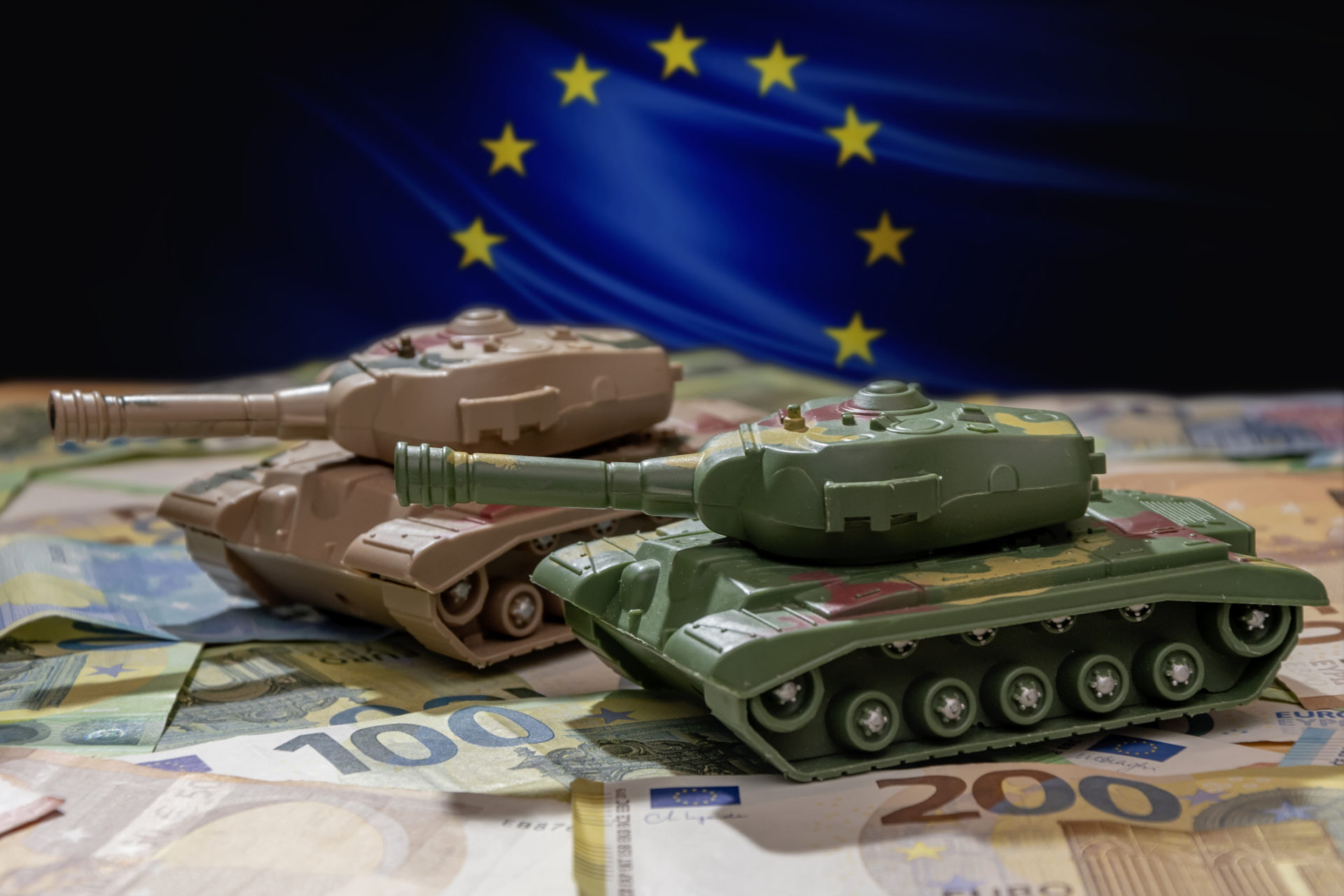
The «ReArm Europe» plan»
In March 2025, the European Council and the Commission launched the «ReArm Europe» plan, a strategic initiative designed to modernise, unify and make operational the continent's defence capabilities. With a potential budget of €800 billion by 2030, this programme is mobilising budgetary exemptions, European loans and joint financing to revive weapons production, stimulate technological innovation and establish genuine industrial sovereignty in the field of defence.
The objective is clear: to equip Europe with a force capable of responding flexibly, rapidly and coherently to emerging crises — whether hybrid, conventional or cyber — while scrupulously respecting international legal frameworks. To achieve this, legislative reforms have been initiated to simplify procurement, deployment and industrial cooperation procedures, thereby reducing lead times, costs and bureaucratic inertia. This strategy embodies a demanding synthesis: combining budgetary rigour, geopolitical ambition and fidelity to the principles of multilateralism.
Concrete measures already taken
Along the eastern borders, the Union is adapting its defensive posture to a changing security environment. Poland, due to its strategic position, has deployed around 40,000 troops to its borders with Belarus and the Kaliningrad enclave, in response to the «Zapad-2025» Russo-Belarusian manoeuvres. This deployment aims to reinforce deterrence without provocation, marking a turning point in the perception of the EU's external borders: no longer as administrative lines, but as zones of collective responsibility.
At the same time, the European rapid reaction force, a multinational unit of 5,000 service personnel, is seeing its capabilities accelerated. Supported by targeted investments in strategic ammunition stockpiles, command systems and logistics infrastructure, it embodies a pragmatic approach: anticipating without alarming, preparing without militarising. The aim is not to fuel a confrontational mindset, but to ensure that Europe can protect its citizens and values from the very first hours of a crisis.
Industrial cooperation, a pillar of the «ReArm Europe» plan»
Rather than multiplying redundant national programmes, the EU is focusing on pooling resources: cost-sharing, equipment standardisation, and the integration of value chains. The European Defence Fund (EDF) plays a central role here, financing research, development and the collaborative production of innovative equipment, with a particular focus on SMEs and mid-caps, which are true laboratories for strategic innovation.
These advances are accompanied by major institutional reforms, notably the Omnibus package, which streamlines joint procurement procedures and clarifies responsibilities between Member States, European institutions and industrial actors.
By eliminating redundancies and speeding up decision-making, this framework enhances supply chain agility while ensuring better traceability of transfers. It also makes it possible to harmonise — without standardising — arms export policies, with a view to transparency and shared responsibility.
In short, «ReArm Europe» is not merely a simple effort at rearmament. It is a strategic reaffirmation: Europe now intends to take full responsibility for its security, not through withdrawal, but through capability, coordination and credibility.
She does so without renouncing what defines her — the primacy of law, dialogue and the pursuit of a more stable international order.
A financial framework supporting strategic autonomy
To bring its ambitions to life, the European Union has established an ambitious and structured financial framework. The European Defence Fund (EDF), with a budget of nearly 8 billion euros, supports collaborative research and development projects, with co-financing of up to 100 % for strategic activities. By bringing together member states, SMEs, and major industrial players, it helps to forge a European defence ecosystem that is both innovative and resilient.
This fund is supplemented by the SAFE (Strategic Autonomous Financing Envelope) instrument, which enables the Commission to raise up to 150 billion euros on the financial markets to fund member states' military acquisitions. Open to partners such as Norway, Japan and the United Kingdom, this mechanism broadens cooperation while maintaining strict control over sensitive technologies — ensuring that European sovereignty is not compromised by external dependencies.
Towards managed technological sovereignty
The objective is unequivocal: to reduce vulnerability to third-party actors. By consolidating an integrated industrial chain and boosting local innovation, the EU is securing its critical supplies. Mechanisms such as the «kill switch», capable of remotely neutralising equipment in the event of use contrary to European commitments, embody this cautious approach — where strategic firmness and respect for international law reinforce one another.
A strengthened regulatory framework for arms exports
This quest for autonomy is accompanied by increased responsibility.
Adopted in April 2025, Decision (CFSP) 2025/779 profoundly modernises the European arms export regime. Integrated into the Common Foreign and Security Policy, it redefines the responsibilities of Member States and requires the professionalisation of national authorities, which are now required to conduct a rigorous analysis of the geopolitical and humanitarian risks associated with each transfer.
The Omnibus package introduces a differentiated typology of licences:
– Individual, for one-off operations subject to comprehensive review; ;
– Global, for repeated deliveries to the same country, under strict conditions; ;
– General, for low-risk equipment, in order to streamline procedures without weakening vigilance.
This grading adapts the level of control to the sensitivity of the transfer, while ensuring enhanced traceability. The EU also applies a rigorous destination policy, based on case-by-case assessments, targeted embargoes and scrupulous compliance with international resolutions — vigilance that is extended to dual-use technologies.
Enhanced traceability, transparency and cooperation
In addition to authorisations, the EU has set up an integrated traceability system based on shared electronic platforms. Each transfer can now be tracked from the initial application through to final delivery. This transparency also facilitates cooperation between Member States, enabling the rapid exchange of information in the event of an emerging risk.
By combining regulatory rigour, operational flexibility and advanced control mechanisms, Europe is establishing a system of arms export governance that is both principled and agile in its implementation.
This is an essential lever for establishing the credibility and coherence of European defence policy on the global stage.
Between strategic convergences and geopolitical divergences
European defence is not built in unison, but through a polyphony of national intentions, each shaped by historical legacies, specific vulnerabilities and world views. Yet this diversity is driven by leading states whose commitments, whilst distinct, converge towards a shared ambition: that of a Europe capable of protecting its citizens without delegating its security to others.
France embodies this commitment with strategic consistency. Its defence industry, its nuclear deterrent and its resolute support for the «ReArm Europe» plan are aimed not only at strengthening its own sovereignty, but also at ensuring that the entire continent achieves technological and operational autonomy in the face of an increasingly fragmented world.
Germany, long held back by the lessons of its history, has crossed a decisive threshold. The «Zeitenwende» is not merely a change of doctrine: it is the acceptance of greater geopolitical responsibility, reflected in massive investment and active participation in collective defence initiatives. This shift, however, remains a delicate one — caught between a new strategic posture and a pacifist culture deeply rooted in public opinion.
In the East, Poland embodies another aspect of this transformation. Its defence efforts, amongst the most intensive in Europe, go beyond a mere reaction to the threat: they affirm its role as a sentinel, a logistical hub and a laboratory for resilience.
This dynamism is redefining the continent's strategic geography, where the eastern borders are becoming the heart of a renewed defensive solidarity — proactive, integrated, and deeply European.
Outside the Union but never far away, the United Kingdom remains an essential partner. Its operational capabilities, industrial expertise and transatlantic ties afford it decisive influence. Its commitment serves as a reminder that European security cannot be conceived in isolation. It is part of a constant dialogue with allies sharing the same vital interests.
Dissonant voices: between diplomatic caution and political resistance
However, this reinforcement dynamic is not universally shared. Hungary, under the leadership of Viktor Orbán, embodies an alternative vision: that of a Europe which must avoid escalation at all costs, in the name of diplomatic realism and de facto neutrality. By warning against a militarisation perceived as provocative, Budapest highlights a fundamental tension — between the need to defend oneself and the risk of oneself becoming a factor of instability. Its reservations, often expressed through vetoes, are not merely a matter of political tactics; they reveal a deeper fracture over the very nature of European power.
Beyond Budapest, other voices – more discreet but just as significant – are voicing similar reservations. Ireland, Malta and Austria, committed to their historical neutrality, emphasise the primacy of dialogue. Still others, faced with complex economic or energy dependencies, fear the consequences of aligning themselves too rigidly with a bloc-based approach.
Everywhere, one question keeps cropping up, like a nagging thought: should Europe aim for total strategic autonomy, or strengthen its complementarity with NATO, whose role is evolving against a backdrop of transatlantic uncertainty?
Europe facing its geopolitical destiny
The European Union stands today at a historic crossroads. What it has been building since 2025 — through «ReArm Europe», the EDF, the Omnibus package or the rapid reaction force — is not simple rearmament, but the first stone of an asserted strategic sovereignty, in a world where peace is no longer passed down: it is conquered every day.
The challenge goes beyond budgets, tanks or drones. It is a challenge to civilisation itself: will it be able to defend the peace it has created through cooperation, without betraying its principles? Its credibility will depend less on its ability to project power than on its willingness to regulate it — through the rule of law, transparency and dialogue.
The challenge is twofold: to protect without enclosing, to deter without provoking. And to transform internal divergences not into obstacles, but into resources for forging a strategy that is both firm and nuanced, capable of reconciling security urgency with diplomatic patience. Every veto, every agreement, every investment outlines the contours of a future Europe: either fragmented by the centrifugal forces of history, or united into a thoughtful power, offering the world a model where strength serves peace, and not the other way round.
Europe has no vocation to dominate the world. But it has a duty to stabilise it. And it is in this demanding humility — this measured yet unshakeable ambition — that it will be able to become once more what it has always dreamed of being: not a fortress, but a beacon.

 French
  English
  Chinese
  Arabic