
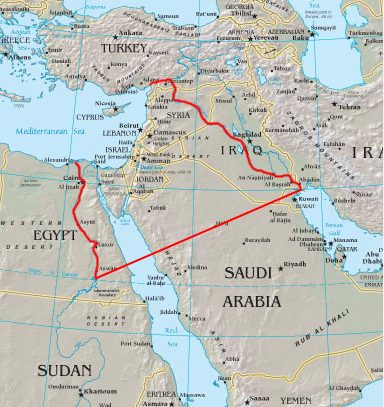
In the discourse of the extremist Israeli government, Greater Israel is presented as a form of vital space for Jews, especially after October 7, 2023.
The concern of the extremist fringe for hating the coming of the Mashiah leads to a lot of confusion.
But we must understand the origin of the great Israel. And that is in Genesis 15:18
On that day the Lord made a covenant with Abram, saying, “I give this land to your descendants, from the river of Egypt to the great river, the river Euphrates.”.
The «river of Egypt» is generally understood by commentators as the Nile. Wadi el-Arish, and not the NIL. The Wadi el-Arish is located in the Sinai. .
The mention of two major landmarks («the river of Egypt» and Euphrates) works like a Geopolitical hyperbole which frames the «entire space between», a common practice in treaties and “Royal grants” (the gift of land by a great king to a servant) from Antiquity. Several biblical scholars see in Gen 15 a grant covenant : a unilateral and generous commitment that is not an administrative formality. Recent studies speak of « Ideological cartography » of deutéronomist authors. ( https://www.thetorah.com/article/mapping-ideologies )
The memory of the reign of Salomon talks about a hegemony « from the river [Euphrates] to the Egyptian border » (tributes from vassal kingdoms), which fits with a Symbolic meaning of promise rather than with continued annexation.
The verses 15:19-21 continue with one List of peoples (Kenites, Hittites, etc.), which refocuses the promise on the Canaanite country and its cités—an indication that the discourse is not a precise imperial outline but a theological donation applied to a regional space.
In other words, Genesis 15:18 Magnifies the promise (God gives “great”) through a language of royal treaties and of one Ideal card familiar to ancient audiences. Whatever some activists do today, the text, placed in its literary genre and historical context, does not prescribe Nor does modern political expansion establish contemporary national boundaries.
It should be recalled that the Kingdoms of Israel and Judah were modest and relatively short on the scale of the ancient Near East:
- The Unified kingdom (Saul, David, Solomon) approx. 1020–922 BC.
- The kingdom of Israel (North) falls into 722/721 under Assyria.
- The kingdom of Judah (South) survives until the end 587/586, Conquered by Babylon. We are far from an Empire of the Nile along the Euphrates
The expression « Greater Israel » (Greater Israel, Eretz Israel has a shlema – « Land of Israel entire ») has no unique meaning. She served:
- among some people Revisionist Zionists before 1948 (Irgun, Jabotinsky) to claim The two banks of the Jordan ; Their emblem also showed a map including Transjordan.
- especially after 1967, To designate movements (e.g. the «Movement for the Land of Israel as a Whole», Then, Gush Emunim) opposed to any withdrawal of Territories conquered in 1967 (Cisjordania, East Jerusalem, sometimes Gaza), in the name of a historical/biblical right. Likud program of 1977 he thus stated:« Between the sea and the Jordan, There will be only Israeli sovereignty.»
Note: In the current Israeli usage of these terms, « Eretz Israel has a shlema » does not return at a distance of up to’Euphrates ; it is rather the entire country west of the Jordan (West Bank/Judea and Samaria).
So, in the Near East, from the river to the sea, it is used by extremists on both sides….and this spiritual vision of Greater Israel is much more literary than political.

 French
  English
  Chinese
  Arabic