
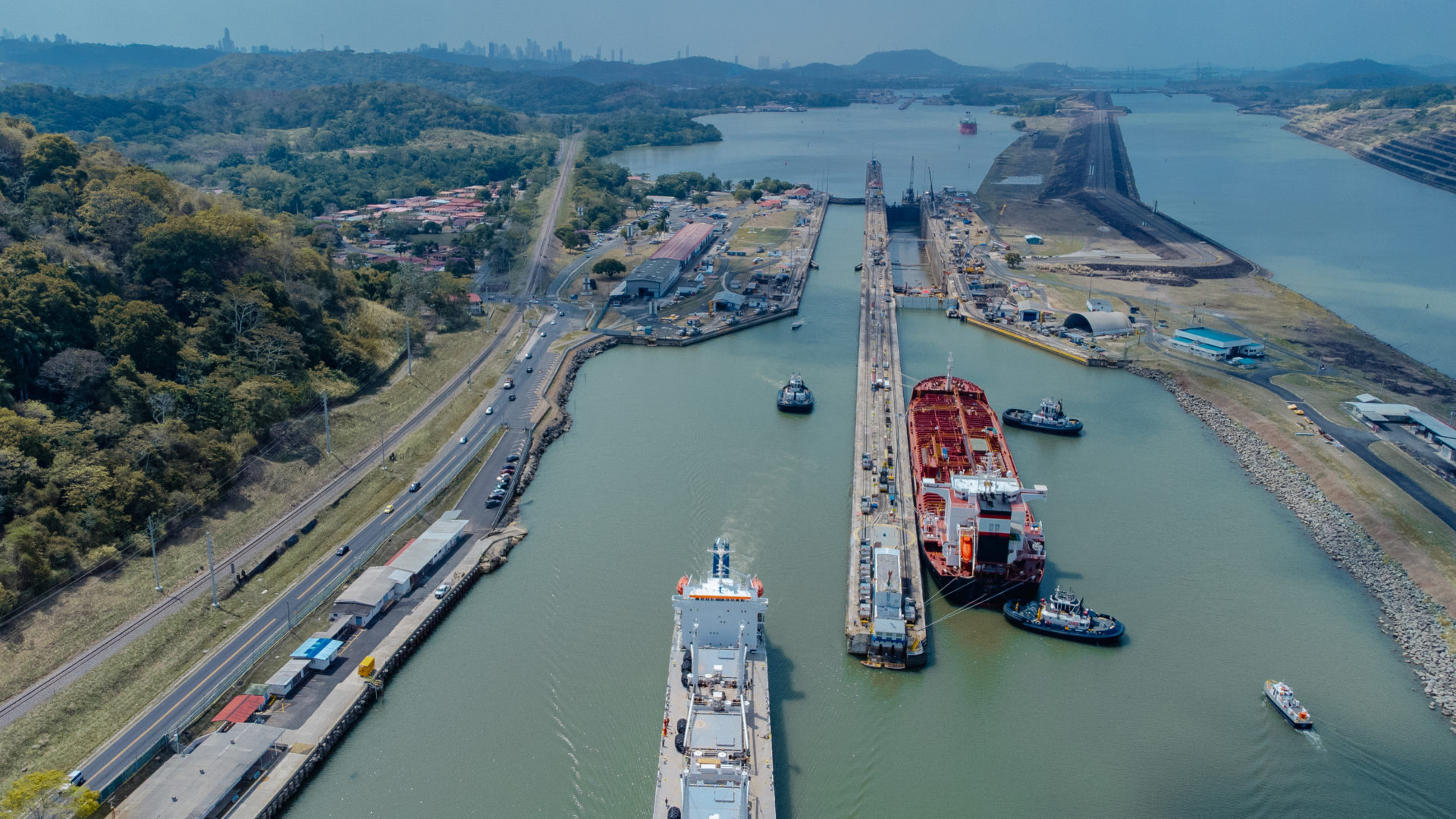
«China exploits the Panama Canal. We didn't give it to China... we will take it back!» This striking formula, attributed to Donald Trump, vividly illustrates the growing tensions surrounding an essential strategic passage. More than just a simple maritime corridor between two oceans, the Panama Canal now stands as a major geopolitical issue at the heart of the Sino-American rivalry..
Beijing is investing heavily in ports, free zones, and infrastructure — while Washington is concerned about the increasingly visible Chinese presence in an area historically perceived as falling within its sphere of influence. Between games of influence, Panamanian sovereignty, and strategic balance, the Canal crystallizes global dynamics that redefine the balance of power.
From then on, a series of questions arise: What is the American response to the Chinese economic offensive? What developments are shaping the future of this crucial region? And how can Panama preserve its control over this global asset?
A strategic infrastructure at the service of global trade
With its 80 kilometers connecting the Pacific Ocean to the Atlantic, the Panama Canal is the second most frequented maritime passage in the world. A true shortcut between Asia and the Americas, it played a key role in international trade in 2024, with more than 423 million tons of goods passing through its waters. By avoiding the perilous circumvention of Cape Horn, it significantly reduces distances, offering shipowners time savings and substantial savings.
The United States are the primary beneficiaries: nearly 70 % of the shipments passing through the Canal originate from or are destined for their ports., Against 21.4 % for China. For Panama, this infrastructure represents much more than an economic engine – it is also a major diplomatic lever on the international stage.
Beyond trade flows, the Canal plays a pivotal role in global supply chains. Containers, agricultural raw materials, hydrocarbons and LNG flow through it continuously, ensuring the fluidity of trade and contributing to the balance of global markets.
Aware of these challenges, Panama has modernized its Canal, completing a major expansion in 2016 that allows the passage of new-generation vessels, known as «Neo Panamax», capable of carrying up to 14,000 containers. This technical adaptation strengthens the Canal’s competitiveness against other strategic routes, such as that of Suez, and confirms its central position in the global maritime economy.
A strategic lever and a marker of sovereignty
More than just a commercial route, the Panama Canal embodies a military asset of first-order importance, particularly for the United States. A true strategic mobility corridor, it allows the U.S. Navy to quickly deploy its forces between the Atlantic and the Pacific. In a context of growing tensions in the Indo-Pacific – whether in Taiwan or the South China Sea – this projection capability takes on crucial importance. Washington could thus deploy a war fleet there in the event of a crisis, while Beijing would have the means to monitor, or even hinder, its movements..
But this strategic function also makes the Canal a potential target. American authorities are increasingly concerned about hybrid threats – cyberattacks, logistical sabotage, or disguised interference – that could paralyze navigation and compromise the responsiveness of their operations. At the crossroads of deterrence, defense, and maritime security, the Canal is therefore at the heart of a geopolitical game in which every passage counts.
Historically, the Canal was for a long time a symbol of American presence and influence in Latin America. Its construction in the early 20th century and its management for nearly a century contributed to anchoring Washington’s hegemony in the region. The transfer of the Canal to Panama in 1999, following the Torrijos-Carter treaties, marked a major turning point. It was received as a strong act of sovereignty, while preserving a form of institutional balance: the neutrality of the Canal is guaranteed, but the United States retains the right to intervene in the event of a serious threat to its proper functioning.
This clause continues to raise questions, particularly in a context where China’s growing economic presence in Central America is perceived in Washington with increased vigilance. Beijing, for its part, does not recognize the additional provisions of the treaties, thus fueling concerns about a possible re-examination of the existing strategic balances.
China in Panama: a skillfully woven influence
Since resuming their diplomatic relations in 2017, China has been deploying a strategy of influence in Panama that is as subtle as it is effective.
By combining targeted investments, the development of key infrastructure, and strategic economic partnerships, Beijing has integrated Panama into the architecture of its «New Silk Roads», capitalizing on its geographical position to strengthen its presence in Latin America and structure corridors of influence for the long term.
The achievements reflect this commitment to lasting success: ultra-modern conference centers, high-tech port terminals, competitive free trade zones, not to mention exploratory studies for a possible fourth canal route. Far from being limited to trade, these projects outline a web of logistical and technological interdependencies designed to perpetuate China’s footprint in the region. The discreet but growing presence of Hutchison Ports, which manages a substantial portion of the Canal’s container traffic, symbolizes this methodical progression.
This expansion is not without raising serious concerns. Strategic concessions like Balboa, or ambiguous projects like the «safe city» of Colón – perceived as a digital Trojan horse – alarm both Panamanian society and American observers alike. While Beijing presents these initiatives as mere contributions to development, their potentially dual nature – both civil and military – is scrutinized with growing distrust, amid Sino-American tensions.
Behind this strategy lies a broader ambition: securing supply routes, strengthening access to the US and Latin American markets, and ultimately exerting influence in a region historically considered part of the US sphere of influence. Beijing’s persistent refusal to adhere to the Panamanian protocols of Canal neutrality fuels concerns, heightened by the scale of the resources deployed.
Thus, the Panama Canal no longer limits itself to its function as a maritime passage. It has become the barometer of the power dynamics of the 21st century. It is a strategic space where economic issues, security considerations, and power struggles intertwine. For Panama, preserving its sovereignty while taking advantage of the opportunities offered remains a delicate balancing act, in an international environment marked by renewed power dynamics.
The American response: preserving influence and containing Chinese progress
Facing Chinese expansion in Panama, the United States is launching a multifaceted counteroffensive: diplomatic, economic, and security-related measures are all being taken to preserve this traditional bastion of American influence.
The challenge? Containing what Washington perceives as a systemic threat to the regional order.
The turning point occurred with the advent of the Trump administration, which adopted a more direct discourse, openly mentioning the need to «reclaim» the initiative around the Canal. While this rhetoric is part of a positioning strategy, it also reflects a deeper desire to contain what is perceived as a strategic Chinese breakthrough. This stance was concretized in early 2024 with a diplomatic move: Panama’s withdrawal from the New Silk Roads, followed by the announcement of a key transfer of the Balboa and Cristóbal terminals to a consortium led by BlackRock.
But Beijing counterattacks in the shadows: an unexpected antitrust investigation delays the signing, revealing the intensity of this hidden war. Every American advance is met with a Chinese counterattack, turning every contract into a geopolitical battlefield.
On the military front, Washington is playing the card of silent deterrence. While reaffirming its right to intervene via the Torrijos-Carter treaties, it is deploying advanced technological capabilities – intelligence, surveillance – to lock in the status quo.
This reconquest also involves strengthening regional alliances in an effort to create an environment less favorable to Chinese ambitions. The goal: gradually asphyxiate Chinese leeway. Behind these maneuvers lies a deeper anxiety: the fear of irreversible decline in the face of a rival that makes the Canal the symbol of its rise to power.
Panama, the geopolitical balancer
At the heart of a power game that transcends it, Panama dances on a tightrope. Its Canal, a vital artery of global commerce, has become the silent theater of a battle for influence between Washington and Beijing. With no army since the fall of Noriega in 1990, the country navigates in a fog between its historical security dependence on the United States and the economic siren songs of China.
The recent release of the New Silk Roads has shown the limits of the Panamanian strategy: a subtle balance game in which each concession to one of the big powers provokes the wrath of the other. Endemic corruption, social fractures, and security challenges further complicate this already dizzying diplomatic equation.
Three perilous paths
1. Maintaining a precarious status quo, based on a pragmatic management of tensions, could allow the country to preserve its flexibility, but at the cost of a permanent exposure to external rivalries and a prolonged climate of uncertainty.
2. A more marked alignment with the United States would undoubtedly strengthen Panama’s political and security anchor, but could risk a decline in Chinese investment, with tangible economic consequences.
3. A strategic shift towards Beijing would pave the way for new financial and technological partnerships, while also raising the ire of Washington and fueling regional suspicions.
The absolute nightmare? To see its territory transformed into a battlefield of the new Cold War, whether economic or strategic.
In this explosive context, Panama must reinvent its role: neither vassal nor pawn, but a full-fledged player in a geopolitical game whose rules are changing before our eyes.
Without an army, caught between China and the USA, Panama is playing its future in a geopolitical game of lies. Its secret weapon? To make everyone believe that they are on its side… while keeping their hands free.
The Panama Canal, a mirror of a changing world
More than just a simple engineering feat, the Panama Canal now stands as a discreet yet eloquent revelation of contemporary geopolitical tensions. Through its waters, not only goods pass, but also the signs of an international order in the process of being reconstructed, where the balance of power is being reshaped quietly.
80 kilometers long, this strategic passage embodies several of the paradoxes of our time:
– Increased economic interdependence, faced with increasingly pronounced geopolitical rivalries; ;
– National sovereignty subject to multiple logics of influence; ;
– A regional stability exposed to the pressures of global competition.
Panama faces a major challenge, shared by many other strategically located countries: how to maintain its independence while working with the major powers? And how to take advantage of its unique position on the map without becoming the arena for a global rivalry between China and the United States?
The canal offers a valuable insight into global dynamics in this regard:
– Its trade flows reflect the trends of global trade; ;
– Its infrastructures signal the new routes of influence; ;
– Its vulnerabilities highlight the weaknesses of the international system.
In this maritime crossroads, issues that go far beyond the Panamanian borders are crystallizing. The canal becomes the mirror of a world in transition, where each strategic node simultaneously concentrates opportunities for cooperation and risks of confrontation. It is in this tension between openness and caution that one of the dominant traits of the 21st century may be emerging.

 French
  English
  Chinese
  Arabic