
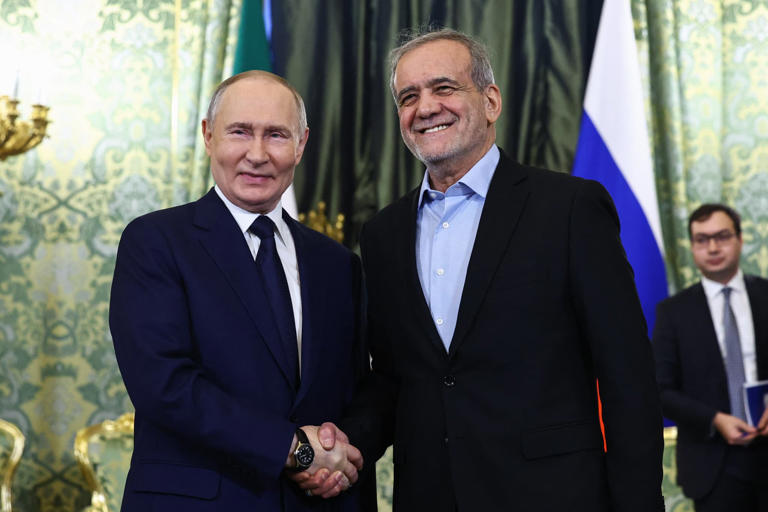
Russian President Vladimir Putin received his Iranian counterpart at the Kremlin, where the two leaders notably announced a strengthening of their military cooperation.
Russian President Vladimir Putin and his Iranian counterpart, Masoud Pezeshkian, signed a strategic partnership agreement at the Kremlin on Friday 17 January, aimed notably at strengthening their «military cooperation» as part of their alliance intended as a counterweight to any Western «dictat».
Subject respectively to heavy international sanctions which are affecting their economies, Moscow and Tehran are thus accelerating their rapprochement initiated in recent years, in particular since the start of the conflict in Ukraine.
Ambitious objectives announced
Indeed, in December the two countries had still not come to terms with their shared failure, which felt like a loss of influence with the flight from Syria of their ally Bashar al-Assad. On the 17th of that month, therefore, Vladimir Putin and Masoud Pezeshkian ratified a «comprehensive strategic partnership agreement», a pact covering numerous civil and military topics.
« This is a text with ambitious objectives », the master of the Kremlin has already boasted, asserting that « Moscow and Tehran were jointly opposed to any diktat from outside »Massoud Pezeshkian for his part expressed satisfaction with an agreement that will open up «horizons between the two countries», end of quote.
The agreement that geopolitics has been able to consult, provides in particular for «developing military cooperation», as well as mutual support in the face of «security threats», according to the content of this 47-article pact published by the Kremlin as soon as it was signed.
Upon reading the document, it nonetheless transpires that should Russia or Iran face and be the subject of an «aggression», the other country would not provide any aid to the aggressor. This point, which is potentially open to interpretation, nevertheless in no way provides for the signatory countries to render military assistance to each other in such a scenario.
A collaboration on the installation of nuclear power under consideration
Let us remember that Moscow concluded a text with the same name with North Korea last year. Furthermore, an article in that document at the time provided for «immediate military assistance» in the event of armed aggression by a third country.
However, seeking to be «reassuring», Iranian diplomacy chief Abbas Araghchi, quoted by Russian media, claimed this week that the treaty with Tehran was not aimed at «creating a military alliance» similar to the one forged between Moscow and Pyongyang.
North Korea is regularly accused by the authorities in Kyiv, backed by several Western powers, of having sent soldiers to take part in the fighting alongside the Russian army against Ukrainian forces. Moscow and Pyongyang have neither confirmed nor denied this.
For its part, Tehran has been pointed the finger at by Western nations for supplying explosive drones and short-range missiles to Russia, thereby acting as an ally to the Russian military in Ukraine. Here too, these accusations have been brushed aside by Iran.
Furthermore, the agreement signed this Friday also provides for exchanges «in the field of the peaceful uses of atomic energy», notably «the construction of nuclear energy facilities». On the face of it, there is nothing new under the sun, as Tehran and Moscow, alongside Beijing and Pyongyang, seek to act as a counterweight to US influence. Thus, the partners are strengthening their close ties while supporting one another on numerous international issues, from the Middle East to the conflict in Ukraine.
And on the Gaza side?
This signing took place a few days before the return to the Oval Office in Washington of Donald Trump, a proponent of a so-called «maximum pressure» policy towards Iran during his first term between 2017 and 2021.
During his campaign, and with the heavy backing of media outlets, the US president also promised to swiftly bring an end to the conflict in Ukraine, without specifying how.
Last Friday, Massoud Pezeshkian, for his part, called for «negotiations and peace» between Moscow and Kyiv during his joint press conference with Vladimir Putin, three years after the start of the assault launched by the Kremlin.
A previous Russian translation of his remarks referred to a «political settlement» of this conflict.
The two leaders also stated that they had discussed the truce agreement between Israel and Hamas, with Vladimir Putin expressing hope for «long-term stabilisation».
« We hope that a permanent ceasefire will be established in Gaza and that the aggression against this land will cease », said Massoud Pezeshkian. « Iran and Russia, conscious of their historical responsibility, are building a new order », added Iranian head of diplomacy Abbas Araghchi in an article published this week by the Russian news agency RIA Novosti, claiming that it was about replacing «hegemony» (Ed: meaning Western hegemony) with «cooperation».
Upon his arrival in Moscow on Friday morning, Massoud Pezeshkian sought to signal his friendly presence by laying a wreath at the Tomb of the Unknown Soldier, before meeting Russian Prime Minister Mikhail Mishustin.
The last meeting between Massoud Pezeshkian and Putin dated back to last October, during the BRICS summit in Russia. Vladimir Putin had then expressed the wish for a consolidation of the «positive momentum», particularly regarding economic cooperation.
Indeed, it is no longer a secret that the Kremlin wishes to develop a logistics corridor project, both rail and maritime, between Moscow, Baku and Tehran, along a north-south axis.
For his part, Vladimir Putin had last visited Iran in July 2022, whilst the head of Russian diplomacy, Sergey Lavrov, was received in Tehran last autumn in order to initiate several strategic discussions with various leaders in the region.

 French
  English
  Chinese
  Arabic