
Macron wants to succeed where his predecessors have failed: what to expect from the Algerian president's visit to France?
Tribune
By Erwan Davoux
Published on 17/07/2024 at 11:16
The multiple postponements of this visit have earned it the label of a «will-o»-the-wisp'… These are due to the thorny issue of the property to be returned as part of a settlement. Indeed, on 27 May, the joint commission of Algerian and French historians published a document summarising the results of its fifth meeting, held in Algiers from 20 to 24 May. The Algerian side submitted an open-ended list of historical and symbolic items to be returned by France to Algeria. The French response is favourable. The second stumbling block stems from a blunder by the Élysée: inviting President Abdelmadjid Tebboune while he is at the end of his term of office was interpreted in Algeria, quite logically, as interference in internal affairs. For Algerian public opinion, this is an unacceptable accusation.
Abdelmadjid Tebboune officially announced his candidacy on 11 July. He is the clear favourite in an election that will nevertheless feature a plethora of candidates. If he is re-elected, he is likely to visit France next September or October. On the French side, the situation has changed considerably as a result of the snap legislative elections: the current political paralysis does not favour the holding of a highly symbolic and particularly sensitive visit.
In Algeria as in France, the bilateral relationship is not immune to domestic political contingencies. While the appointment of a new French government is a prerequisite, it remains to be seen which political forces it will rely on. The departure of Éric Ciotti, for whom disparaging Algeria was a Pavlovian reflex, is a factor to be taken into account. Nevertheless, his position was not isolated within Les Républicains, a party that no longer has the slightest foreign policy line and views international affairs solely through the prism of pseudo-domestic political fallout.
FIGURE OF THE EMIR ABDELKADER
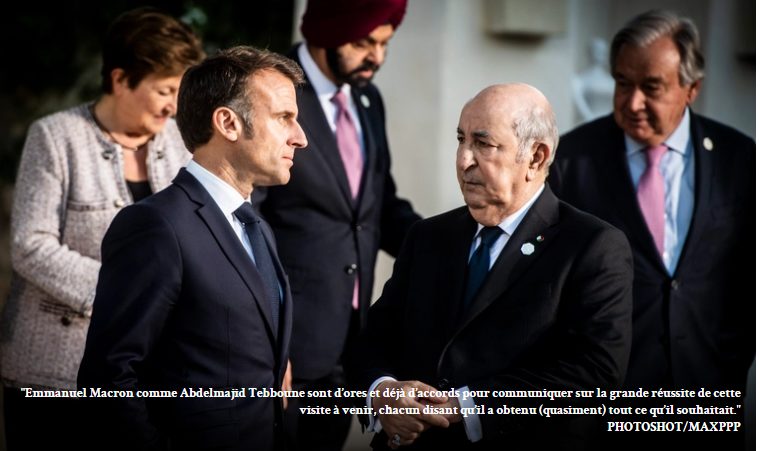
The personal relationship between Emmanuel Macron and the Algerian president is friendly. Photos from the G7 on 15 June suggest that body language does not lie. So, what can be expected from this visit? On the Algerian side, Abdelmadjid Tebboune is pursuing two main objectives. The first is to obtain the guarantee that there will be no change to the 1968 agreement which regulates the movement, employment and residence of Algerian nationals in France. Indeed, numerous French politicians from the centre-right to the far-right have spoken out in favour of its revision. However, this would cause Algerians to lose a special, derogative status that is more advantageous than standard law.
The second objective relates to memory. The Algerian president stated on Tuesday, 7 May, that the memory dossier with France regarding the colonial era «cannot be the subject of concessions or compromise» and had to be treated in a way «bold», on the occasion of Remembrance Day, marking the anniversary of the 8 May 1945 massacres in Sétif.
For his part, Emmanuel Macron wants to communicate the fact that he has obtained satisfaction regarding consular passes. Above all, the French president wants to succeed where his predecessors have failed: true reconciliation with Algeria. He wants his «Élysée Treaty» with Algeria, according to a senior French diplomat. Symbolically, the figure of Emir Abdelkader (1808-1883) is expected to play a key role, especially since his personal belongings are among the items to be returned.
THIRD ECONOMY ON THE CONTINENT
It was with Jacques Chirac that Abdelaziz Bouteflika wanted to move past the past. The French president of the time offered two advantages: he belonged to the Gaullist movement and had fought with honour during the Algerian War. The Arab policy being pursued was then greatly appreciated. But the whole process that had been set in motion failed during the adoption of the «Vanneste amendment» in the National Assembly, in February 2005, regarding «the positive role of colonisation». It is from this date that the Algerians' requests for recognition regarding the memorial became more insistent.
Both Emmanuel Macron and Abdelmadjid Tebboune have already agreed to present this upcoming visit as a resounding success, with each claiming to have obtained (virtually) everything they wanted. However, there are also economic stakes involved. Algeria's economy is now the third-largest on the African continent and is fully benefiting, within the gas sector, from the high demand from European countries that are still seeking alternative energy sources to Russian gas.
We are witnessing a proliferation of liquefied natural gas investment projects. Several contracts have thus been signed between the Algerian oil group Sonatrach and Italy's Eni, France's Total and American firm Occidental Petroleum, with the aim of increasing gas production and supplies to Europe, notably via the Transmed pipeline which transports gas from Algeria to Italy.
Abdelmadjid Tebboune reaffirmed the immutable socialist character of the Algerian economy in his address to the nation in December 2023. And the implementation is massive. Thus, the government has funded a progressive 50 % increase in public sector workers' salaries by the end of 2024, an increase in retirement benefits for the poorest, as well as the revaluation of the unemployment allowance.
Diplomatic and economic diversification
This year, Algeria has adopted the largest budget in its history: 113 billion dollars in public expenditure, representing an increase of 6 %. It plans to maintain social spending to support household purchasing power. Businesses will also benefit from tax cuts. Public investment is expected to increase and will be primarily directed towards housing, infrastructure projects and defence.
However, the government has implemented incentive measures to attract foreign investment. The removal of the so-called «51/49» restriction in non-strategic sectors (the rule of partnership with a local resident holding a majority of at least 51 % to 49 % for the foreign party was the principle until 2020), the improvement of tax conditions and contract flexibility in the hydrocarbon sector are all signs pointing in this direction, as is the creation of a new investment promotion agency.
However, diplomatic and economic diversification is taking place at the expense of France. Russia remains its primary arms supplier. President Tebboune's visit to Russia in June 2023 reaffirmed the privileged relationship between Algiers and Moscow. Furthermore, Algeria and China continue to develop their bilateral cooperation within the framework of the «Belt and Road» initiative. In this context, France is only the third-largest investor in Algeria behind the United States and Italy – though it nevertheless appears to remain the leader outside the hydrocarbons sector.
RAFFARIN MISSION BIS
Certainly, the Algiers Declaration, signed between the Presidents of the Algerian and French Republics on 27 August 2022, defines the overall framework for economic relations and investment priorities: « France and Algeria […] intending to foster a revival of their economic exchanges and encourage the development of partnerships between their companies as well as research for innovation. These efforts will focus as a priority on future sectors: digital technology, renewable energies, rare metals, health, agriculture and tourism. Both parties agreed to cooperate on the energy transition – notably through cooperation in the fields of gas and hydrogen.» Yet in reality, this statement is slow to materialise and the bilateral economic relationship remains dependent on major disputes.
The potential for a strengthened win-win partnership is substantial, particularly in the pharmaceutical and digital sectors. Both the French and Algerian sides retain very fond memories of the «Raffarin mission», the President's special envoy for Algeria from 2010 to 2014. Coordinating economic cooperation, developing French investment in Algeria and Algerian investment in France, and overcoming any political and administrative difficulties: these were the challenges. His counterpart was Mohamed Benmeradi, Minister of Industry and SMEs, with whom the former Prime Minister maintains friendly relations.
Remember that the «Raffarin mission» successfully unlocked around a dozen major files. More than half, meaning 60 % of the twelve pending files on the National Investment Council's table, had been resolved. Why not call upon Jean-Pierre Raffarin to return to service within a well-defined framework? Coming from the private sector, the former Prime Minister has always attached major importance to the international development of French businesses. Furthermore, having served as Prime Minister under Jacques Chirac opens many doors abroad, as this period is associated with a now bygone golden age of French diplomacy. This option deserves to be studied.
 By Erwan Davoux

 French
  English
  Chinese
  Arabic