
With Kouchner and most of his successors, the Atlanticists take control of the Quai d'Orsay to the detriment of the Gaullists
It was a masterstroke of an error. By appointing Bernard Kouchner to head the Quai d’Orsay, Nicolas Sarkozy thought he would curry favour with the left. It was nothing of the sort and none of his «cabinet ministers from the opposition» would call for a vote for him in 2012. Some got unimportant ministerial portfolios. But the appointment of Bernard Kouchner to the Quai d'Orsay marked a turning point. Indeed, in the long struggle between the Gaullo-Mitterrandist-Chiracian establishment and the Atlanticists, the latter were winning for the first time. Bernard Kouchner will, alas, not be an isolated episode. Fabius, Le Drian (with the added military tropism which would each time turn out to be a losing gamble), Séjourné are completely in line with this tradition. The same men in key positions, in ministerial offices applying the same policy, promoted for their partisan affiliation to this neoconservative left without having the required background and experience. France will then abandon grand diplomacy for partisan diplomacy, which will mean it no longer plays any significant role in major world affairs.
The marginalisation of the Quai d'Orsay's relative
Admittedly, Nicolas Sarkozy will make up for this mistake with another move: the gradual sidelining of the Quai d'Orsay in favour of the Elysée's diplomatic cell. An institutional dysfunction that will continue under subsequent presidencies and lead to a considerable loss of expertise.
Nevertheless, it is at the Quai d'Orsay Whatever number of appointments are decided upon, it is the spokesperson for the Quai d'Orsay who sets the official tone of French diplomacy, and the Minister for Foreign Affairs remains the chief representative of French diplomacy, failing to be the real decision-maker.
With Kouchner began a process of infiltrating key positions. He would place all his associates and those of the Atlanticist movement in key roles. For them, there is no French diplomacy exception. France is merely a component of the Western camp, must be the United States« best ally (whilst never gaining any influence in return), divides the world between »the camp of good and the camp of evil", and views the Arab-Muslim world as a dangerous archaism that must be controlled and muzzled under the guise of spreading democracy.
BHL spearheading the burial of the Gaullist path
Bernard-Henri Lévy will whisper in Nicolas Sarkozy's ear the necessity of recognising the Libyan National Council as a state, which the President will do during a meeting that followed the one with BHL. Nicolas Sarkozy's diplomatic adviser, Jean-David Lévitte, will try in vain to explain to him the risks of such a position. As for Alain Juppé, Minister for Foreign Affairs, in Brussels that day, he would learn of this diplomatic foolishness through an AFP dispatch. The mad Libyan adventure could begin!
Once attributed to Xavier Chatel (a fellow student of Emmanuel Macron at the ENA), it now seems highly likely that this same BHL, never short of bad inspirations as long as they serve his «forces of good», reportedly behind the idea whispered to Emmanuel Macron of an international coalition on the anti-Daesh model to fight Hamas. This proposal would be met with indifference (on the part of Israel) and mockery from most capitals.
However, BHL's long track record of diplomatic catastrophes is not limited to these two episodes a supporter of the war in Iraq as early as 2002, a supporter of Operation Cast Lead (2008-2009) in Gaza already... Already war crimes too and the use of white phosphorus bombs.
It is high time we found Presidents who give no credence to what is whispered to them by this warmonger, who has been systematically wrong about everything. Or who listen to him only to do the exact opposite of his recommendations, which have no connection whatsoever with «a certain idea of France» and «a certain idea of humanity».
A partisan and subservient diplomacy that leads to a massive loss of influence
The return to NATO's integrated command decided by Nicolas Sarkozy without obtaining any concessions in return will symbolically mark the turning point of the new French diplomacy which then abandoned the Gaullist legacy. Although Nicolas Sarkozy was able to keep up appearances through his capacity for leadership, his two successors will never manage to hide France's isolation on the diplomatic stage and its loss of influence.
France will intervene alone in Mali. It will also find itself alone and in a pitiful position when announcing that it was going to strike the Syrian regime before backing down. François Hollande will not even be consulted on the appointment of Jens Stoltenberg to lead NATO. France will no longer be in a position to push through the slightest resolution at the Security Council, contenting itself with supporting initiatives taken by others. It will absolutely no longer be a mediator between the North and the South, having been driven out of Africa[1], hated by the «Arab street»[2] and considered an unreliable, second-rate partner by Israel. France has lost on all fronts.
The Gaullist achievements sold off
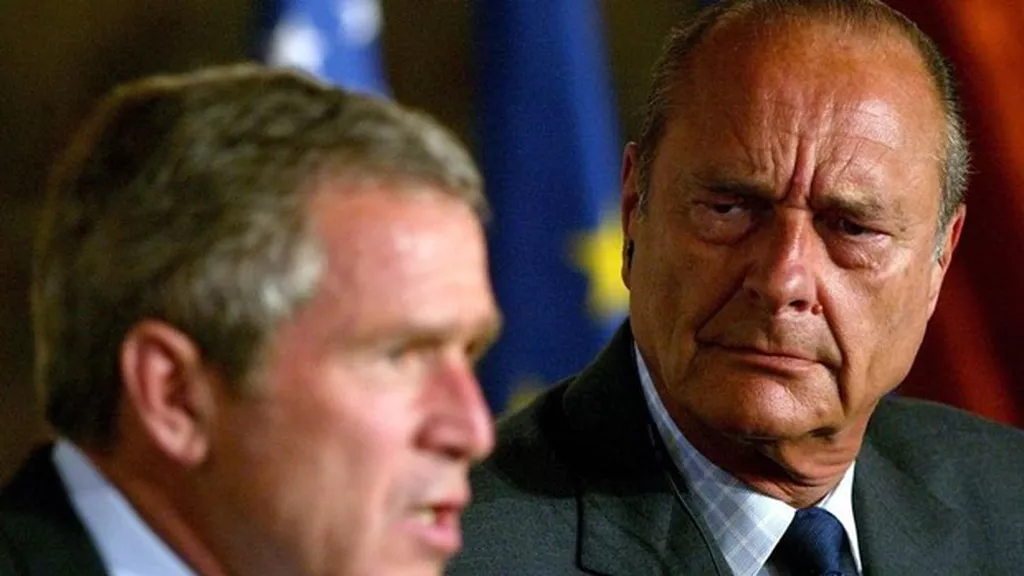
This alignment with the United States and the reduction of France to the Atlanticist camp will lead our «dear old country», which was so brilliant under Jacques Chirac to threaten to use its veto to outlaw the war in Iraq, and thus force the evangelicals' puppet to step outside international law and fall into line. Whilst the destabilisation of the Near and Middle East is the direct or indirect result of the murderous folly of George W. Bush in Iraq, France has given up on making international law the alpha and omega of its foreign policy. It is not only a moral failing but also a mistake that ruins his influence. It is to General de Gaulle that France owes the two assets it has left in the diplomatic game: its seat as a permanent member of the Security Council and the nuclear deterrent.
As General de Gaulle used to say, «It is because we are no longer a great power that we need a great policy, because, if we do not have a great policy, since we are no longer a great power, we will be nothing anymore.". »If we reduce it to a simple balance of power, this inevitably puts us at a disadvantage, as France accounts for 1% of the world’s population and 0.4% of the world’s landmass. By condoning the massacres in Gaza and proving incapable of ensuring compliance with international and humanitarian law, France is shooting itself in the foot; it is squandering the influence inherited from its rich and glorious history.
The other legacy of history, nuclear deterrence, Emmanuel Macron is ready to sell off. By proposing to share nuclear weapons with other European states (and having had this idea tested to detoxify it by journalists taking their orders from the Élysée), Emmanuel Macron is pursuing his line of dissolving French identity into a leaderless and identityless Euro-Atlanticist magma, a juxtaposition of states with profoundly divergent strategic interests. This President runs France like a soulless corporation with no past.
By threatening to send troops on the ground to Ukraine, Emmanuel Macron has not only incurred the wrath of all his Atlanticist partners, but he has also exposed France to a direct conflict with another nuclear power, leading to an escalation. who «normalised» the use of nuclear weapons, at least in rhetoric.
This neoconservative left that has taken over French diplomacy is finding prominent allies in the press, among left-leaning journalists who have forgotten all republican values, acting as complacent mouthpieces for the United States, Netanyahu, NATO or the European Commission. For them, national interest is not a factor. Sometimes, their alliance with the extreme right or far right is perceptible because most neoconservatives and evangelicals also belong to that camp, the one of self-proclaimed «good».
Everything will have to be rebuilt in 2027
It is an understatement to say that French diplomacy is in ruins. In 2027, a painstaking reconstruction will have to begin by instigating a genuine human resources policy at the Quai d’Orsay that prioritizes expertise over partisan affiliation. The Ministry of Foreign Affairs must return to the heart of the French diplomatic apparatus. Once this internal adjustment is made, it will be time to begin gradually rebuilding trust on the international stage. This undertaking will be long, since it is so easy and quick to break trust, but infinitely more difficult to rebuild it.
[1] After its expulsion from the Sahel region, France is on the verge of war with Senegal | Geopolitics.fr
[2] Foreign policy: «How Hollande and Macron killed De Gaulle» (marianne.net)

 French
  English
  Chinese
  Arabic