
By Valérie Morales Attias, Morocco resident, journalist and author, and lecturer at the École Supérieure de Journalisme de Paris.
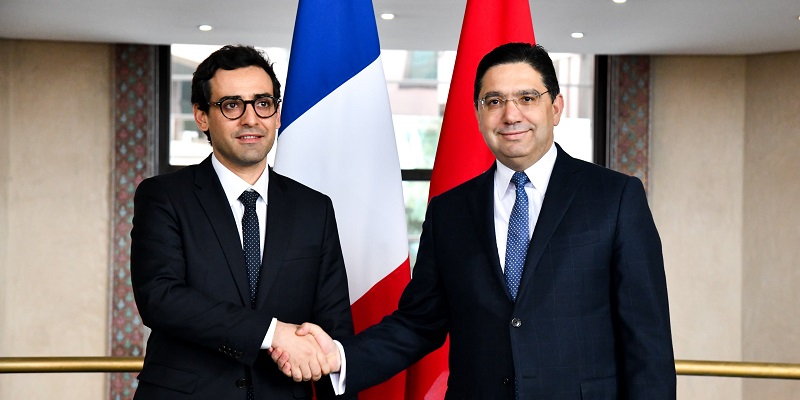
French Minister for Europe and Foreign Affairs Stéphane Séjourné was received in Rabat at the end of February by his Moroccan counterpart, Nasser Bourita. The desire for a diplomatic thaw between the two countries seems assured. There remains the thorny issue of Western Sahara. On this front, nothing has yet been won.
Yet Stéphane Séjourné dragged behind him a disastrous past with Morocco. At the time, he chaired the Renew group in the European Parliament, a political grouping that led an intense European campaign of disparagement against the Kingdom. At that time, the Élysée was obviously not unrelated to it. Yet it was Stéphane Séjourné whom Emmanuel Macron chose to build the foundations of a new, pacified relationship with the Kingdom. No one on either side of the sea has forgotten the tensions that undermined relations between the two countries: the restrictions imposed by France on the granting of visas, the European Parliament vote condemning the deterioration of press freedom in Morocco, the Pegasus affair, the failed attempts at reconciliation with Algiers, and so on, represented so many reprimands from France towards Rabat. Worse still: the French refusal to align itself with the United States and Israel, which officialised their recognition of the Moroccanness of Western Sahara—an essential national cause for Rabat, which now seems to define its foreign diplomatic relations in light of each party's position on the subject. Stéphane Séjourné, whose trip to Morocco is his first official visit to the Maghreb, has well understood the message. As proof of the desire to pursue this rapprochement, the new Minister for Europe and Foreign Affairs reiterated Paris's support for the 2007 Moroccan autonomy plan for Western Sahara. But the United Nations Security Council resolution is no longer enough for Morocco, which fully intends to take advantage of the failure of Paris's recent attempts at rapprochement with Algiers.
Is Emmanuel Macron's Algerian «tropism» unravelling?
Despite Emmanuel Macron’s special attentions over the past two years, Algeria has remained unmoved. It is now annoying the Élysée, which considers that it cannot be relied upon. Over the last two years, France has tried virtually everything to strengthen its ties with Algiers. The cajoling in this regard is probably over. Today, this country is asserting its rapprochement with Russia, China, the BRICS (Brazil, Russia, India, China and South Africa) and, more recently, Italy. “Algeria wants investment, but does not wish to hand over its markets to France on a plate”, notes a local observer. This French disappointment could well benefit Morocco, which has had no diplomatic relations with Algeria since 24 August 2021, against a backdrop of discord not only over Western Sahara, but also regarding the Kingdom's recognition of the State of Israel.
Paris therefore appears to have changed its tune by favouring Morocco for French Minister Stéphane Séjourné's first official visit to the Maghreb. During the press conference in Rabat with his Moroccan counterpart Nasser Bourita, he recalled that there is “between France and Morocco an exceptional bond and [Emmanuel Macron] wants this bond to remain unique and to deepen further in the coming months”. His Moroccan counterpart, who was also very warm, considered that the bilateral relationship had not “second to none”. An almost perfect harmony between the two parties, which the Moroccan editorialist Aziz Boucetta comments on without irony: « France's position is important because Europe's position depends on it (...) We can therefore anticipate even stronger pressure from Rabat on Paris than there already is. »
This is not the time to get carried away
For the Moroccan political scientist, Mustapha Sehimi, it is always a good idea to temper one's enthusiasm: «This meeting is part of an effort to seek normalisation with a view to a thaw in relations between the two countries (…); we will have to wait for concrete actions, particularly on the Western Sahara issue.». The opinion of political scientist Luis Martinez is different, he having recently declared to the Moroccan press that « if France and Morocco are growing closer, it is because they have no choice», This specialist on the Maghreb and research director at the CERI of Sciences Po explains that the two countries need each other to avoid finding themselves isolated in the region. It is true that recently France has encountered certain difficulties across the African continent, shunned by the Sahel countries, unwelcome in Tunisia and powerless in the Libyan conflict.
As for Morocco, the Abraham Accords are no longer really relevant due to the war in the Middle East. Gaza has changed the game and Moroccan public opinion is in solidarity with the Palestinians. That being said, Israel has recognised Morocco's sovereignty over the territory of Western Sahara, just as the United States and Spain have. Morocco expects no less from France. On this front, the question remains: did Stéphane Séjourné come to Rabat on 26 February to reiterate the French position in favour of a political solution in accordance with the United Nations Security Council resolutions of 2007? That would be a snub for Rabat, which is heavily invested in the development of the Sahara. According to Moroccan political scientist Hassan Aourid, this position « would now be considered by Rabat as outdated«. And economic interests come first. The kingdom is an important territory for French businesses. More than a thousand SMEs and almost the entire CAC 40 have operations there. Not to mention the presence of a large Moroccan diaspora in mainland France. Paris is well aware of this, announcing that it is time to move forward on the Sahara issue: Stéphane Séjourné stated this clearly: »The Sahara is an existential issue for Morocco. We know it», insisted the Minister. «We have said it and I say it again today, perhaps with greater force: it is now time to move forward. I will personally ensure this happens».
Unless at the same time...

 French
  English
  Chinese
  Arabic