
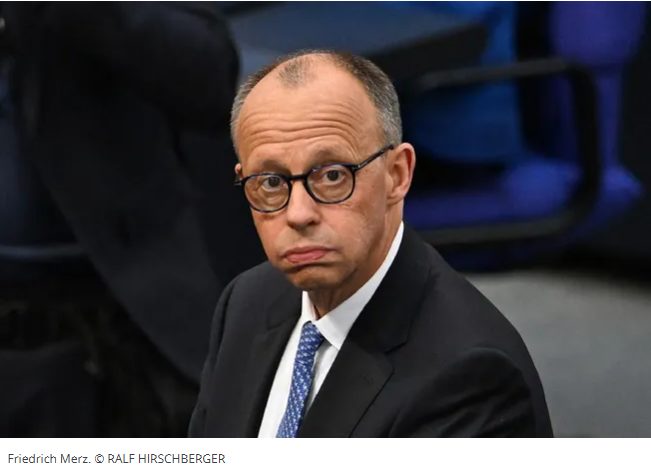
Berlin is wavering. The difficult election of Friedrich Merz marks a historic turning point for Germany — and for the European Union. This close contest reveals much more than a simple change of government: it ushers in a profound political realignment, where internal divisions, the rise of populism and economic challenges are calling into question Germany's traditional role as a major power. What should we expect now? And what will the repercussions be for the European balance of power?
An unprecedented political crisis in the Bundestag
6 May 2025 will go down as a landmark date in German political history. For the first time since the founding of the Federal Republic in 1949, the designated candidate for the chancellor, Friedrich Merz, failed to secure an absolute majority in the first round. The expectations of the CDU/CSU-SPD coalition collided with a less forgiving reality: out of the 328 anticipated votes, only 310 were actually cast in his favour.
It was only after a tense second round and intense negotiations that Merz was finally invested with 325 votes — an extremely narrow majority, exceeding the minimum required constitutional threshold by only nine seats. A margin so slender that it places the new government in an unusual position: one of a vulnerability rarely observed in the recent history of the German executive.
An examination of the votes that questions
A detailed examination of the results reveals an even more worrying picture. Eighteen MPs belonging to the outgoing coalition refused to back their own candidate in the first round of voting. Seven blank ballot papers, nine abstentions and two invalid votes are all signs of internal unease that is difficult to ignore.
These disagreements are not trivial. They reflect a growing lack of cohesion among the coalition partners, fuelled by profound divergences over political direction. The atmosphere within the parliamentary groups is now marked by palpable tension, where every decision could exacerbate existing fractures.
A tense partisan climate
The CDU/CSU is going through a troubled period, particularly on budgetary issues. Its stances oscillate between traditional austerity and the need to respond to new social expectations.
Meanwhile, the SPD is struggling to justify its participation in the coalition after receiving a historically low 16.4 % of the vote in the last federal election. Concessions on social policies are generating growing discontent among some activists, for whom this shift towards the centre marks a departure from the party's founding values.
This instability is occurring against the backdrop of a transformed national landscape. The AfD, having secured 20.8 % of the vote in the last election, has consolidated its presence on the political scene. The established parties are gradually losing their exclusive hold on public debate, giving way to new ideological divides that are still taking shape.
Immediate market reactions
The political instability triggered by these events quickly had economic repercussions. As soon as the results were announced, the DAX index dropped by 1.4 %, reflecting investors' anxiety about the government's ability to effectively drive urgent reforms. This volatility illustrates just how much political stability remains a central pillar of economic confidence.
A critical moment for Europe
This crisis comes at a sensitive time for the European Union, which is facing growing geopolitical challenges and an uncertain economic climate. Germany's historical role as a stabilising pillar could be called into question, which would have implications far beyond German borders.
These internal tensions are part of a broader movement transforming the German political landscape, where traditional benchmarks are being progressively redefined. German democracy, long exemplary in terms of stable governance, now finds itself at a crossroads.
A German government tested by its divisions
The 6th of May 2025 will remain etched in German political memory. After hours of tense discussions, lasting until dawn, Friedrich Merz was swept into the chancellery with an extremely narrow majority: 325 votes, which is just nine more than the required constitutional minimum.
This fragile mandate paints an unstable political landscape, where every decision risks becoming a perilous balancing act between divergent forces within the coalition. In the hushed corridors of the Bundestag, negotiations have taken on the appearance of strategic bartering.
Faced with the imminence of an institutional vacuum, some hesitant elected officials finally gave in, less out of conviction than out of fear of a political void that the AfD, solidly established with over 20 % of voting intentions, could have exploited.
This hard-won victory plunges the country into a period of uncertainty. The new Chancellor will have to contend with a weakened coalition, in which the CDU/CSU conservatives and the SPD Social Democrats are struggling to conceal their deep disagreements. Urgent issues are piling up: the debt brake, the €500 billion budgetary stimulus plan, and reforms to pensions and housing are among the most sensitive tasks. Each of these topics could reignite tensions within an already fragile majority.
In Europe, the concern is palpable
In Brussels as in Paris, Berlin is being watched closely. Germany, long considered the quiet pillar of the Union, is facing an unprecedented internal crisis at a strategic moment. How will a country that has historically been the driving force behind the European project be able to meet the major current geopolitical and economic challenges, even while its government lacks cohesion?
The coming months will be crucial. Either the coalition manages to overcome its divisions and restore positive momentum to the executive, or it sinks into paralysis, offering the radical opposition fertile ground for further expansion.
Whatever the scenario chosen, Germany’s political future — and, by extension, a large part of the European landscape — will henceforth be played out at the margins, amid precarious compromises and power struggles within a Bundestag more divided than ever.
A decisive choice for Germany and for Europe
Friedrich Merz is beginning his term in a climate marked by internal distrust. His main challenge will be to restore a stability that is currently largely compromised, in a context where every decision could tip the country towards a complete reconfiguration of its political landscape.
Two scenarios are emerging:
– Either Merz succeeds in overcoming these divisions, forging difficult compromises to restore cohesion to a weakened coalition.
– Either the fractures will deepen, paving the way for prolonged instability, which the AfD could exploit politically.
This historical moment presents Germany with a crucial choice: to rediscover the unity that was long its strength… or to yield to divisions capable of permanently reshaping its destiny.
Whatever happens, one thing is certain: Europe is watching Berlin with restraint, aware that the future of the shared project also rests on the stability of the country that was long one of its major foundations.

 French
  English
  Chinese
  Arabic