
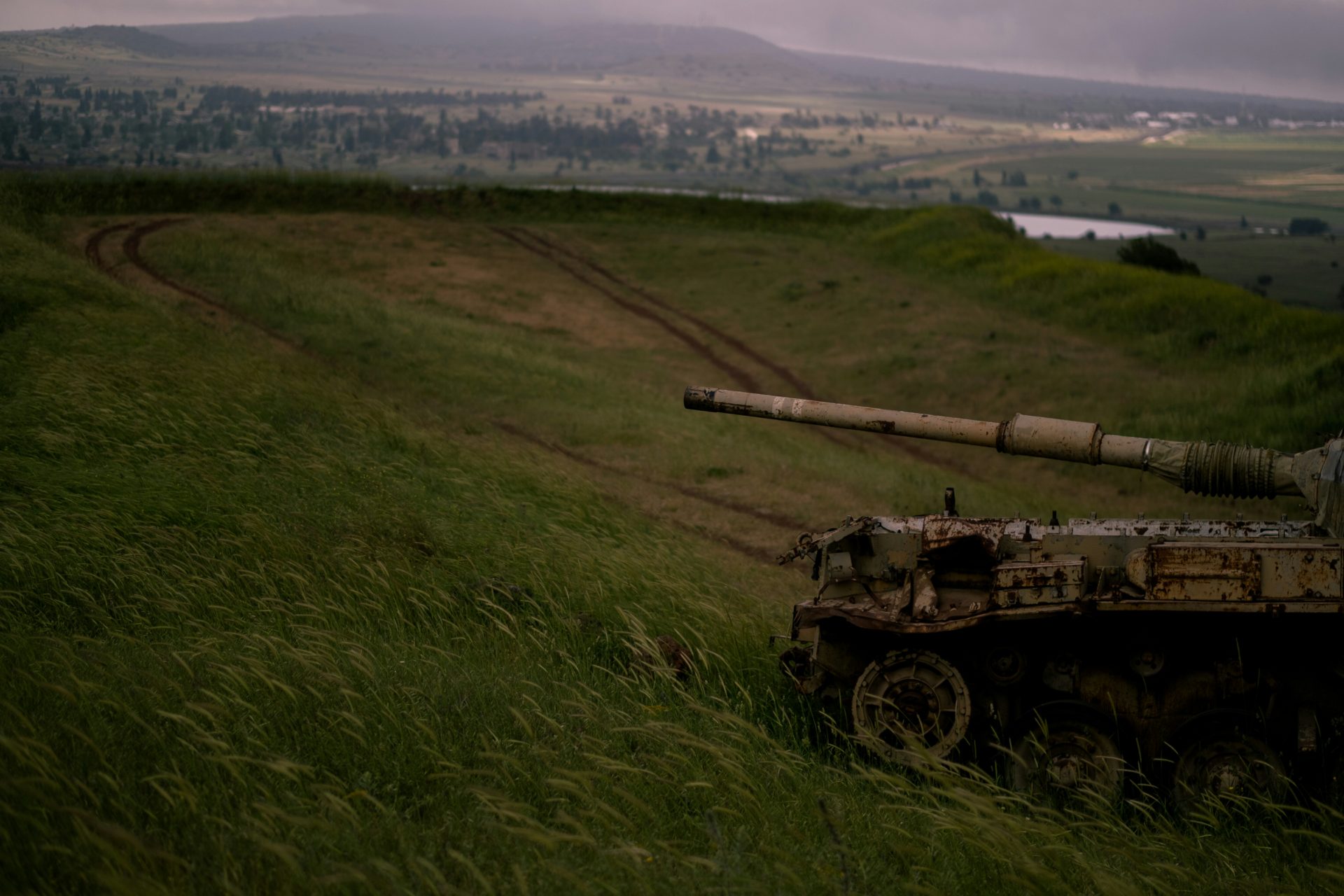
As Damascus celebrated the end of the Assad clan's rule last December, the inhabitants of Quneitra Governorate in the Syrian Golan saw the Israeli army move into several villages. Daily raids harass the population, who fear that the temporary occupation of the demilitarised zone established in 1974 will become permanent.
At the entrance to the village, concrete blocks block the end of the main street. A few hundred metres further on, a wide black strip of landfill stands out against the horizon. And the incessant noise of diggers. « They are digging a trench three metres wide and six metres deep. They started four months ago, as if they knew Bashar (al-Assad) was going to fall », explains Ahmed Ali Tahar, mayor of Al-Hurriyah in the Quneitra Governorate, in the heart of the Syrian Golan.
Massive engineering works now place the last house of this small village on the Golan Heights a mere 500 metres from the border with Israel, compared with two kilometres previously. In October 2023, the Israeli authorities announced their intention to fortify the Alpha Line separating the Jewish State from Syria, in order to prevent any terrorist attacks, similar to the one on 7 October 2023 perpetrated by Hamas from Gaza.
Fall of Assad, very short-lived joy
On 8 December 2024, joy gave way to another worry. Then everything changed for the inhabitants of Al-Hurriyah. « We were so happy about the fall of Bashar, but Israel ruined our joy. They arrived two days later with their tanks and bulldozers » tells the mayor of the village of 1,000 inhabitants.
Just hours after Hayat Tahrir al-Sham (HTS) seized power, Israeli Prime Minister Benjamin Netanyahu ordered the army to «take control» of the demilitarised buffer zone in the Golan Heights, a strategic, water-rich territory overlooking northern Israel. Yet since 1974, this 80-kilometre-long strip has been delimited by a ceasefire agreement between Israel and Syria, compliance with which is ensured by the UN Disengagement Observer Force (UNDOF). Despite this, the Jewish State occupies part of this mountainous territory, which it annexed arbitrarily in 1981 and which the international community, with the exception of the United States, considers to be occupied.
« The soldiers arrived and asked the imam to make an announcement telling everyone to leave. They gave us until 3 pm. We got the women and children to leave, but the men stayed. » reports the village councillor, pointing out that it was the first time he had seen Israelis since his arrival in 1978.
Maha* will never forget that day. « We weren't even given time to get our things, barely enough to get dressed. I stayed for five days in Khan Arnabah with the children before coming back », recalls the latter. The sixty-year-old, terrified at the idea of reprisals, explains that in twenty-five years she had never seen Israeli soldiers in the village. « How would you feel if someone came and told you to leave your home from one day to the next? », she asks, explaining that she lives in fear that the IDF will drive them from their home for good.
Several hundred villagers from Al-Hurriyah remain displaced
In just a few hours, in Al-Hurriyah, women and children are fleeing. Despite the end of the ultimatum, it was only the following day at around 10 am that Israeli soldiers came and knocked on the door of the local mayor. « They have me asked why we hadn’t left with the imam. I told them I didn’t feel like it and had nowhere to go. They then threatened me, pointing a gun: next time, we’ll blow your head off!, Tell the story of Ahmed counting the wooden beads of his misbaha. «We told them that we were only herders and farmers, that they could search our houses, that we had no weapons to hide. They only looked for mine and that of a bread vendor" », he added.
Ahmed has no choice but to comply and abandon the village. Three days later, he receives a call asking him to return to Al-Hurriyah. « When I got home, there were about twenty armed soldiers. They told me to get everyone back, but they didn't say why. »Since then, some 600 residents have returned to the village. The other 400 are still displaced in the surrounding towns, notably in Khan Arnabah.
This is where Bilal* comes to work every day. The sixty-year-old lives in Jubata al-Khashab, a village where green fatigues have been an everyday sight since 8 December. No outsiders are allowed to enter.
« The soldiers are constantly coming and going in the village, he says, asking once again for his anonymity to be guaranteed. I'm afraid they'll take my house. I have no trust in the enemy », he explains, specifying the need to return early given the danger.
Bilal is terrified at the thought of reprisals, but above all of the future. He keeps touching his hands, no doubt to curb tremors caused by stress. « I do not speak to them. I do not know how they might react. I could be arrested », he continues, repeating that the soldiers are terrorising the villagers.
A «temporary» occupation to secure Israeli borders
In a month, the Hebrew State has carried out hundreds of strikes aimed at destroying the Syrian military arsenal, arguing that it is seeking to prevent it from falling into the hands of the new authorities, who «might be hostile». Several raids have also been carried out across a vast area of the Quneitra province, again justified by the search for weapons that might have been abandoned following the rout of the regular Syrian army.
« They say we have weapons but we don't. There is no armed group here, they are preventing people from moving around freely », continued the witness.
That is why Fatima Mansour made the forced choice not to return to Jubata al-Khashab. « I have been living in Khan Arnabah for twelve days because I was afraid I wouldn't be able to come and open my shop every day », she explains, sitting behind the counter of her clothing shop. « They are only a kilometre from my house ».
While Benjamin Netanyahu insists that the presence of IDF troops is temporary, residents of the Quneitra Governorate remain convinced that it could become permanent. And examples of such claims are numerous. Too numerous. For instance, nearly 30,000 Israelis and 23,000 Druze, enjoying the sacrosanct status of Israeli residents, now live permanently in the annexed Golan. As early as 15 December 2023, the Netanyahu government approved a project aimed at doubling the population, allocating a budget of 40 million shekels (€10.6 million) for this purpose.
« We believe they want to take our land but we won't let them. We will stay in our homes », says Fatima. « They want to expand, to take as much land as possible in Lebanon, Palestine and Syria, rich Bilal. I am scared but I want the world to know the true face of our enemy. They masquerade as victims but they are the aggressors ».
As Syria attempts to rebuild, the new strongman in Damascus, Ahmed al-Charaa, better known by his nom de guerre Abu Mohammed Al-Joulani, has stated that after years of armed struggle, the country's «state of exhaustion» does not allow it to «enter into new conflicts». This is enough to fuel the anxiety of the inhabitants of the fertile lands of the Golan Heights.« God willing (Ed. note: If God is willing), the new government will discuss keeping our lands within the 1973 borders. I do not want to leave my land in exchange for peace », hopes Maha.
*Some identities have been anonymised for security reasons

 French
  English
  Chinese
  Arabic