
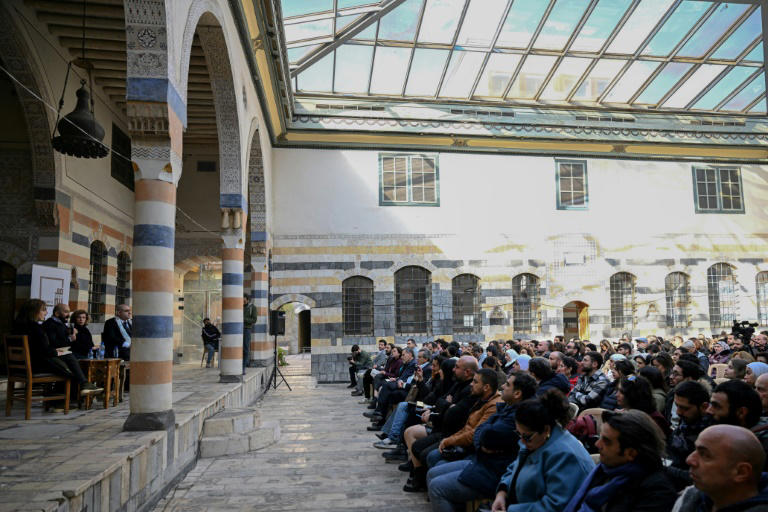
In the courtyard of a traditional Damascus house, activists gather and discuss the role they intend to play at the heart of the «new Syria.» For many of them repressed under Bashar al-Assad, civil society is determined to assert itself in this turn in Syria and to prevent any return to authoritarian rule.
Since the overthrow of Bashar al-Assad by a radical Islamist movement on December 8, following an armed offensive, Damascus is bustling with discussions and public gatherings that were once forbidden, leading to emotional reunions between activists who remained in the country and those who returned from exile, sometimes under duress.
The first sign of a return to relative calm came on January 4, when the leaders of a community platform bringing together dozens of civil society organizations, titled «Madaniya,» met with the new Syrian leader, Ahmad al-Chareh, to present their grievances.
« We emphasized the essential role that civil society must play in the political transition »," assures Madaniya Sawsan Abou Zainedin, the executive director, summing up this meeting during a press conference of the collective.
« We emphasized the need not to designate people from just one camp. within the transitional authority »," she added, while the new strongman of Syria has already appointed his loyalists to key positions in his transitional government.
Sawsan Abou Zaineddin, who met the new Syrian leader alongside the founder of Madaniya, the Syrian-British businessman Ayman Asfari, indicates that they even discussed the «problem» of the «appointment of foreign jihadists» within the key Ministry of Defense.
Although the profile of the new judge has already turned the wheels of the world over, no one is fooled: Ahmad al-Chareh is the armed leader of a radical Islamist group, Hayat Tahrir al-Sham (HTS). Of course, the surprise comes more from the one who claims to have broken with jihadism. And he has done so.
However, on the other hand, and after donning the respectable state-man’s tie, the latter did not tremble in the least and even less conspired to appoint at least six foreign jihadists to command positions within the future army, which he intends to form after the dissolution of the armed groups in the country, fragmented by a civil war that has claimed more than half a million lives in 13 years.
The absence of constitutional rules providing for a transition
The head of Madaniya also emphasizes that they have demanded «absolute transparency» in the preparation of the national dialogue conference that the government intends to hold, and in particular in the selection of the participants.
In response and apparently in a conciliatory tone, the new Foreign Minister Assaad al-Chaibani, on the other hand, assured that an expanded commission would be created to prepare for this conference, the date of which has not yet been announced.
« We are in a situation of constitutional vacuum, in a period of transition after 62 years of rule by the Baas party »", explains the lawyer Abdulhay Sayed to AFP, the new authorities having frozen the Constitution and the Parliament.
And for the more seasoned jurist, caution is the order of the day. He is also one of the more than 300 signatories of a petition calling for free elections in the Bar Association, where, without much consultation, the new authorities have already appointed a new president of the bar, replacing the one imposed by the former regime.
He emphasizes that the dialogue conference will be «crucial» provided that civil society organizations and trade unions are invited to it, which would enable the establishment of a «counter-power» and prevent a return to authoritarianism. In clearer terms, but not daring to say it too loudly: a democratic regime.
« The conference is to establish a roadmap for an electoral law to elect a constituent assembly within a year. This assembly will be tasked with drafting a permanent Constitution and may subsequently transform itself into a parliament. », he recommends.
Two rooms, two atmospheres: after the episode of the handshake refused to the German emissary during the first visit of a European delegation, recently the new Syrian leader stated in an interview given to the al-Arabiya channel that the holding of elections could take no less than four years! While the country is thirsting for freedom and renewal on all levels, time may seem very long...
Women also want to participate in the emerging society
The government, however, seeks to reassure Syrians and the international community regarding the respect of minority rights in a multiethnic and multi-confessional country.
The same call for participation is echoed by women who gathered on January 8 in Damascus at a congress of the «Syrian feminist political movement».
« We want and dream of a state of law »one of the participants, the lawyer Joumana Seif, who works on war crimes in Syria, told AFP.".
This lawyer whose father, MP Riad Seif, was imprisoned by Bashar al-Assad, emphasizes that women «have a great role to play» in the new Syria and want «an active participation in the national dialogue conference.".
« We do not want a new oppressor »That's what I want," launched Wajdan Nassif, a militant and writer, who had gone into exile after being detained.
« We no longer want to see prisons. Syrian women want to participate fully (…) in the new era in Syria and we do not want the re-emergence of the terrible past. ».

 French
  English
  Chinese
  Arabic