
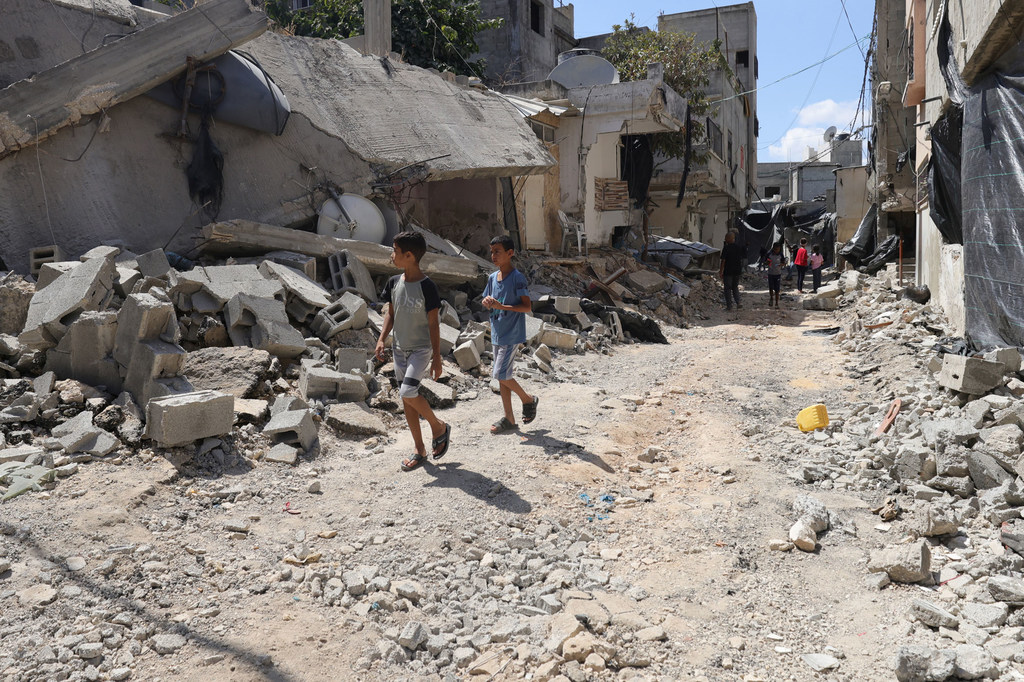
As humanitarian agencies and organisations witness the «collapse of public order and the systematic armed looting of aid» by local gangs in Gaza, the United Nations Emergency Relief Coordinator is calling on the international community to intervene in order to «break the cycle of violence» in the Palestinian enclave.
According to the UN Office for the Coordination of Humanitarian Affairs (OCHA), Gaza is currently the most dangerous place in the world, with the highest number of aid workers killed ever recorded in a single year.
This plea by the Under-Secretary-General for Humanitarian Affairs is issued as Israeli airstrikes in densely populated areas continue relentlessly, including on areas where Israeli forces have ordered the population to flee, causing untold destruction, mass displacement and thousands of deaths.
« Schools, hospitals and civil infrastructure have been reduced to ruins », reported Tom Fletcher in a recent press release, upon returning from yet another mission to the Middle East and after meeting with his humanitarian teams in the heart of the Occupied Palestinian Territory.
According to the UN representative, the south of Gaza is suffering from increasingly unbearable overcrowding, resulting in inhumane living conditions and generating humanitarian needs that are close to impossible to meet as winter approaches. At the same time, the north of the Gaza Strip has been subjected to a near-total siege for over two months, making [or creating]« loom over the spectre of famine unprecedented ».
Blockades and the impossibility of providing aid to besieged northern Gaza for over two months
At the same time, humanitarian missions in the North Gaza Governorate have been severely disrupted, particularly those seeking to reach Jabalia, Beit Lahiya and Beit Hanoun. Between the 1st and 16th of December, the United Nations was prevented from reaching these besieged areas on 40 occasions; 38 of these attempts were outright refused and threatened, and two were hindered by arbitrary armed checks.
In the areas of the Rafah Governorate, which have been subject to an Israeli military operation and occupation since early May, international aid missions coordinated by the international community, under the auspices of the United Nations, have faced incessant violations of international conventions. The 20 coordinated requests submitted to the Israeli authorities between 1st and 16th December were all met with a categorical refusal accompanied by threats of retaliation.
« Despite the scale of the humanitarian needs, it has become almost impossible to provide even a fraction of the urgently required aid », lamented the head of OCHA, noting that more than 100 requests for access to northern Gaza have been rejected since 6 October.
Generally speaking, and drawing on their experience, agencies and non-governmental organisations know how to adapt to the most perilous and risky terrains in order to provide appropriate humanitarian aid. According to OCHA as of 17 December, approximately 80 % of Gaza was subject to an active evacuation order issued by Israel against them.
Meanwhile, at least 1.9 million people, or around 90 % of the population, are displaced and concentrated in the Gaza Strip. Many of them have already been displaced multiple times, some ten times or more.
Destruction of essential infrastructure and settler violence in the West Bank
On the West Bank side, the situation continues to deteriorate and « the death toll is the highest we have ever recorded », laments Tom Fletcher. Over the past year, Israeli military operations have led, not without a macabre intent, to the destruction of essential infrastructure such as roads and access routes for the population, water networks and overall the scarce energy resources, particularly in refugee camps where displaced families are forcibly gathered.
We can never say it enough: the escalation of settler violence and home demolitions have generated ever-more massive exoduses and, consequently, exponential humanitarian needs. Here too, movement restrictions are hindering people's livelihoods, as well as access to essential services, particularly healthcare.
Faced with these ever-growing security challenges, the United Nations and the international humanitarian community remain present and are trying nevertheless to make their contribution, despite obstacles and, above all, increasingly significant dangers for their personnel.
« I call on the international community to uphold international humanitarian law, to demand the protection of all civilians, to insist that Hamas releases all hostages, to defend the vital work of UNRWA and to break the cycle of violence », urges Tom Fletcher.
World Food Programme (WFP) condemns Israeli attack on aid convoy
Israeli airstrikes continued with tenfold intensity in the Gaza Strip on the night from Sunday to Monday, while the World Food Programme (WFP) had reported that one of its aid convoys in the war-ravaged enclave had been targeted by Israeli gunfire on Sunday.
WFP issued a press release on Monday condemning the attack, insisting that its vehicles were« clearly identified »No fewer than 16 bullet holes hit the three-vehicle convoy carrying eight staff members who came under fire near the Wadi Gaza checkpoint.« Fortunately, no members of staff were injured », added the agency further.
While all necessary authorisations had been obtained from the Israeli authorities, the WFP stated that it was « simply from the last example of the complex and dangerous working environment »which its teams face.
Strike personnel, strike equipment and supplies
These new criminal acts under international law come as, at the same time this weekend, a missile struck a flour distribution warehouse in central Gaza, the latter run by a UN humanitarian partner, leaving three humanitarian workers seriously injured.
Teams from UN agencies near the warehouse reported, beyond shouts after the strike, looting and numerous small arms shots on the ground following Sunday's explosion, notably on the premises of the MA'AN development centre.
As the situation in the region worsens dramatically and slips off the media radar, it is worth recalling here that it has been 15 long months since the war broke out in Gaza, following the terrorist attacks carried out by Hamas against Israel, which admittedly resulted in some 1,200 deaths in October 2023 and more than 250 people taken hostage.
The endless talks for a hypothetical ceasefire between Palestinian officials and Israel are drifting a little further away each day. Even more so for a lasting agreement to end the violence or free the remaining hostages.
As we publish this, so as not to forget, Israeli air, land and sea bombardments continue to accelerate in the Gaza Strip, where a harsh winter has set in.
Over recent days, eight infants have reportedly died from hypothermia, and to date, more than 45,300 Palestinians have been killed and over 107,700 injuries have been recorded. And the figures are more than alarming for anyone seeking a future for the conflict: one in five of them has suffered irreparable injuries resulting in severe disabilities since 7 October 2023, according to the authorities.
Tensions that are also escalating in the Levant
In Lebanon, the UN peacekeeping force has urged all parties to the conflict to renounce any action that could jeopardise their fragile ceasefire, following the «deliberate and direct destruction» by the Israeli army of a withdrawal marking line in southern Lebanon.
In a statement condemning this decision, the United Nations Interim Force in Lebanon (UNIFIL) recently described perfectly, in a note submitted to the Security Council, how peacekeepers observed the hard work of an IDF bulldozer « destroying a blue barrel marking the withdrawal line between Lebanon and Israel in Labbouneh, as well as an observation tower belonging to the Lebanese Armed Forces immediately adjacent to a UNIFIL position at that location ».
This development constitutes « a flagrant violation of Resolution 1701 and international law », insisted the UN Mission with reference to the Security Council resolution adopted following the 2006 war in Lebanon between Israel and Hezbollah, aimed at ending their conflict.
Dangerous and provocative movements that violate all agreements
In recent days, UNIFIL has also observed, reported and alerted the Security Council regarding ongoing Israeli army operations north of the UN-patrolled Blue Line, despite a 60-day ceasefire agreement signed on 27 November 2024 by the governments of Israel and Lebanon.
More specifically, the organisation called on the Israeli state to withdraw from southern Lebanon and Hezbollah to end its armed presence in the region within the same timeframe.
For collective memory, the agreement was specifically drafted and concluded in order to put an end to the hostilities between Israel and Hezbollah, which broke out once more in October 2023, as an extension of the conflict in the Gaza Strip.
In a daily situation update, UN humanitarian agencies regularly reiterate that complex humanitarian needs also persist in Lebanon, notably linked directly to the forced and completely chaotic displacement of populations. Round trips included.
According to IOM, the UN migration agency, over 860,000 people uprooted in Lebanon by the recent conflict have now returned to their former communities, but nearly 124,000 remain displaced.
Since 8 December last, when the Assad regime collapsed, tens of thousands of people have also arrived in the land of the cedar from Syria. Lebanese nationals hoping to return to their homeland, and many Syrians seeking a little rest. And the bitter realization is that all of them are facing « widespread destruction of homes and vital infrastructure, disruption of essential services, risks from scattered and abandoned explosive devices, limited livelihoods and exhaustion of coping mechanisms », warned the UN Refugee Agency, UNHCR.
The populations that remained in the conflict-affected areas during the escalation of hostilities« are facing disastrous conditions as essential services have been severely limited for an extended period », laments the UN agency, in an appeal to « immediate humanitarian aid and long-term recovery support ».

 French
  English
  Chinese
  Arabic