
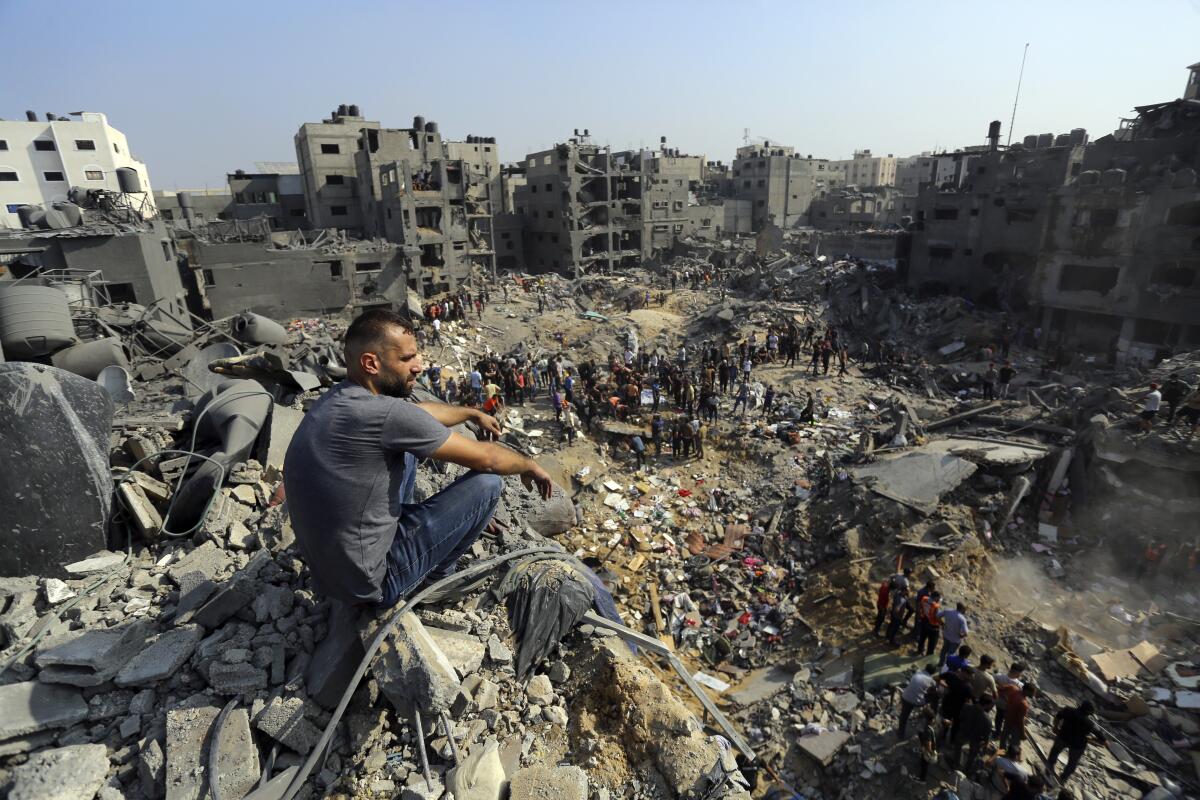
As the war has been raging since October 2023 and the human toll grows heavier by the day, another issue of the conflict is coming to the surface: that of an environmental disaster with multiple consequences, particularly health-related ones, which weighs heavily on the daily lives of Gazans. Affected by the destruction of infrastructure, pollution and an acute water crisis, their daily lives are all the more aggravated.
Gaza is not only hit by rockets and suicide drones. As a consequence of the destruction of infrastructure, the city is going through an unprecedented environmental crisis. A fragment of Palestine, the strip is a cramped territory of 360 square kilometres, barely three times the surface area of intra-muros Paris, characterised by significant demographic growth.
With a population of around 2.3 million, it is one of the most densely populated regions on the planet, relative to its surface area. Even from the outset, and notwithstanding the current conflict, the population was placing pressure on the environment that was all the more severe because the former authorities were struggling to cope with the exponential rate of population growth against a backdrop of extreme poverty. It should be noted that GDP per capita is less than $2,000 a year, and that, inevitably, 46% of the population were living below the poverty line in 2022.
A wave of new scourges
Whilst the lack of infrastructure such as drinking water networks and sanitation plants had already reached a critical level, they are now largely devastated by the deadly and destructive conflict, intensifying an increasingly marked environmental crisis. This is leading to deplorable health consequences.
By the end of September 2024, more than 66% of buildings in the Gaza Strip had been destroyed or damaged, including at least 60% of hospitals, schools and universities, according to the UN, which bases its figures on satellite data. The international organisation estimates that the war has already generated 39 million tonnes of rubble, equivalent to ten large pyramids at Giza (Egypt). This rubble often contains human remains or unexploded ordnance, whilst the collapses and fires caused by the bombardments produce enormous quantities of dust, leading to breathing difficulties.
Based on expert findings, the United Nations also denounces the fact that several munitions used by the Israeli army contain hazardous chemical substances such as phosphorus or toxic heavy metals (arsenic, cadmium, chromium, lead, mercury), with obvious consequences for health, but also implications for the immediate environment. Added to this established fact is the destruction of half of the agricultural land (mainly olive and orange groves), threatening a food supply that is already extremely limited and dependent on external sources. Beyond the damage to soils rendered uncultivable by the bombings, the last plots that offered a glimmer of hope for self-sufficiency, however limited, are now dangerously polluted.
Additionally, with garbage collection made impossible by the fuel shortage and unpredictable waves of strikes, waste is piling up in numerous informal and improvised dumpsites, thereby contaminating the soil and groundwater through seepage, or else it is being burned, worsening an already particularly high level of air pollution. And as if that were not enough, the drinking water distribution and sanitation networks are practically at a standstill.
On numerous occasions, the UN and the rare humanitarian organisations remaining on the ground have denounced the use of water as a «weapon of war» in the context of the siege of Gaza, which also drastically limits the amount of food entering the territory (UN 2024, Oxfam 2024).
An unprecedented health catastrophe
It is war of course. But a war that respects none of the international rules. The health consequences, both short and long-term, are such that they make the territory uninhabitable as living conditions become unsanitary. In the first three months of the conflict, the UN was already recording cases of diarrhoea (caused by drinking contaminated water) 25 times higher than pre-conflict levels. The near-total lack of sanitation combined with high densities in refugee camps is now raising fears of an outbreak of cholera, while cases of scabies and hepatitis A have already been recorded. NGOs are also observing a resurgence of polio, a disease that had disappeared from this territory for twenty-five years, justifying a brief «humanitarian pause» aimed at carrying out a vaccination campaign. Another aggravating factor is that population displacement facilitates the spread of epidemics, all the more so as Palestinians are rendered more vulnerable by malnutrition and the disorganisation of a health system overwhelmed by treating the injured. Controlled by Israel, humanitarian aid is only trickling into this enclave, which is slipping away from the gaze of the international media.
Adding to the «genocidal characteristics» of the conflict, noted by the UN Security Council in March 2024, this «ecocide» takes on all the new characteristics of a war crime. Indeed, ecological damage during times of conflict is condemned by international law (the Additional Protocol to the Geneva Conventions as well as the Rome Statute of the International Criminal Court, which demonstrated its willingness in this regard in February 2024).
Such a situation raises the question of the reconstruction and resilience of this territory… once the fighting has stopped. There will also come a time to see who or where this hypothetical rescue will come from.

 French
  English
  Chinese
  Arabic