
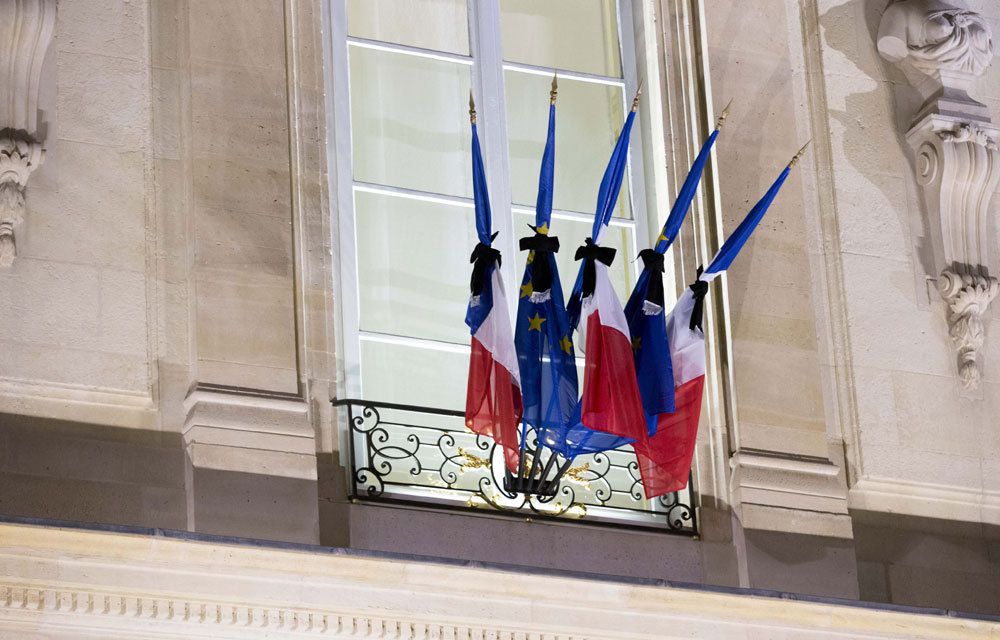
This Monday, 23 December, marks another day of national mourning in France. Probably the last of the year. Is this a French exception? Not really. Explanation: a period of national mourning consists of one or more days officially designated by a country's leaders during which, amid everyday activities, the population and public opinion are marked by mourning and the memory of one or more victims. This generally concerns prominent figures, individuals who have performed acts recognised as heroic, or victims of an act of barbarism or a natural disaster, for example.
Even though the frequency and decision regarding this type of special day vary from country to country, these commemorations almost all share the same features: flags at half-mast on official buildings, minutes of silence, the suspension of certain political activities, and so on. Sometimes, these days may be accompanied by state funerals, particularly when they involve the death of heroic individuals or figures who have played an important moral, political or social role in the country.
Sometimes the initial national mourning for a major event gives rise to regular commemorations on each anniversary of the death or funeral of the victims, or indeed of the event that marked the nation.
Practising in France, the conditions and a few key dates
In France generally, national mourning marks the nation's tribute to the victims of a significant event such as a natural disaster or terrorist attacks, or more rarely the death of a President of the Republic, whether in office or not.
This national day is declared by decree of the President of the Republic (editor's note: or the President of the Senate who is acting as interim in the event of the death of the incumbent President), accompanied by the opinion of the Prime Minister.
In mainland France, this national mourning has no codified or established protocol. Consequently, the measures implemented can vary, but generally consist at the very least of flags being flown at half-mast on public buildings, frequently accompanied by minutes of silence in both the public and private spheres. Previously limited to 24 hours, the practice of decreeing several days of national mourning was introduced by former president François Hollande in 2015.
France, as a particularly sensitive homeland, is very grateful. This Monday, 23 December 2024, will mark no less than 15th presidential decree declaring a day of national mourning. The main dates to remember include:
- Sunday 9th March 1930, following the deadly floods in the South of France
- Saturday 7th March 1942, the day of the funeral for the victims of the allied night-time bombing on 3rd March over the west of Paris and its suburbs, which resulted in 623 civilian casualties
- Wednesday 7 April 1943, the day of the funerals for the victims of the Allied daytime bombing on 4 April in the west of Paris and its suburbs, which left 380 civilian victims. A major French State propaganda ceremony is to take place at Place de la Concorde
- Wednesday 24 August 1949, following the great Landes forest fire which caused the death of 82 people and burned 52,000 hectares
- Thursday 12 November 1970, following the death of the former President of the Republic, Charles de Gaulle, on 9 November
- Saturday 6 April 1974, following the death of Georges Pompidou, the sitting President of the Republic, on 2 April
- Thursday 11 January 1996, following the death of the former President of the Republic, François Mitterrand, on 8 January
- Friday 14 September 2001, following the 11 September attacks in the United States
- Thursday 8 January 2015, following the attacks against Charlie Hebdo on 7 January
- Sunday 15th, Monday 16th and Tuesday 17th November 2015, after the terrorist attacks of 13th November
- Saturday 16, Sunday 17 and Monday 18 July 2016, following the 14 July attack in Nice
- Monday 30 September 2019, following the death of former President of the Republic, Jacques Chirac, on 26 September
- Wednesday 9 December 2020, following the death of the former President of the Republic, Valéry Giscard d'Estaing, on 2 December
This Monday, 23 December 2024 will likely mark the final day of national mourning of the year, in tribute to the victims of Cyclone Chido in Mayotte on 13 and 14 December.
A near-universal meaning, albeit a different usage
While France is one of the European countries that makes the most use of this day of recognition, Southern European countries are not far behind when it comes to these commemorations. Of course, the reasons may also differ. Thus, by way of example:
In Brazil:
1994: three days after the death of Ayrton Senna during the San Marino Grand Prix
2005: seven days following the death of Pope John Paul II
2009: three days of tribute to the victims of the «disappearance» of the Air France flight 447 aircraft
2010: three days of national mourning were decreed following the death of Néstor Kirchner
2013: three days of national mourning were decreed following the death of Hugo Chávez
2013: a week of national mourning was decreed following the death of Nelson Mandela
2014: three days in tribute to the victims of Eduardo Campos' plane crash
2016: three days of tribute to the victims of the LaMia Flight 2933 crash
2022: a day of national mourning following the death of Prince Luiz de Orleans e Bragança
2022 : three days following the death of Queen Elizabeth II of the United Kingdom
2022: three days following the death of footballer Pelé
In Argentina:
1974: three days of national mourning were decreed following the death of Juan Perón
2005: three days of national mourning were announced following the death of Pope John Paul II
2010: three days of national mourning were decreed following the death of Néstor Kirchner
2013: three days of national mourning were decreed following the death of Hugo Chávez
2020: three days of national mourning were declared following the death of Diego Maradona.
In Egypt:
1970: on 29 September forty days of national mourning were decreed following the death of the President of the Arab Republic of Egypt Gamal Abdel Nasser
1981: On 7 October, forty days of mourning were announced for the assassination of Egyptian President Anwar el-Sadat
2004: three days after the death of the President of the State of Palestine, Yasser Arafat
2005: three days of national mourning were announced following the death of Pope John Paul II
2013: three days of national mourning were decreed following the death of Nelson Mandela
2016: three days after the attack on the Saints Peter and Paul Church in Cairo
2020: three days of national mourning were decreed following the death of Hosni Mubarak
Further north or in Eastern Europe:
In Serbia:
2024: on 2 November following the collapse of the Novi Sad railway station canopy which left fourteen dead the previous day
In Canada:
2022: 19 September, National Day of Mourning on the day of the funeral of Queen Elizabeth II of Canada
In Poland:
2005: six days of national mourning were announced following the death of Pope John Paul II
2010: a week of national mourning was decreed following the death of President Lech Kaczyński in his plane crash near Smolensk (Russia).

 French
  English