
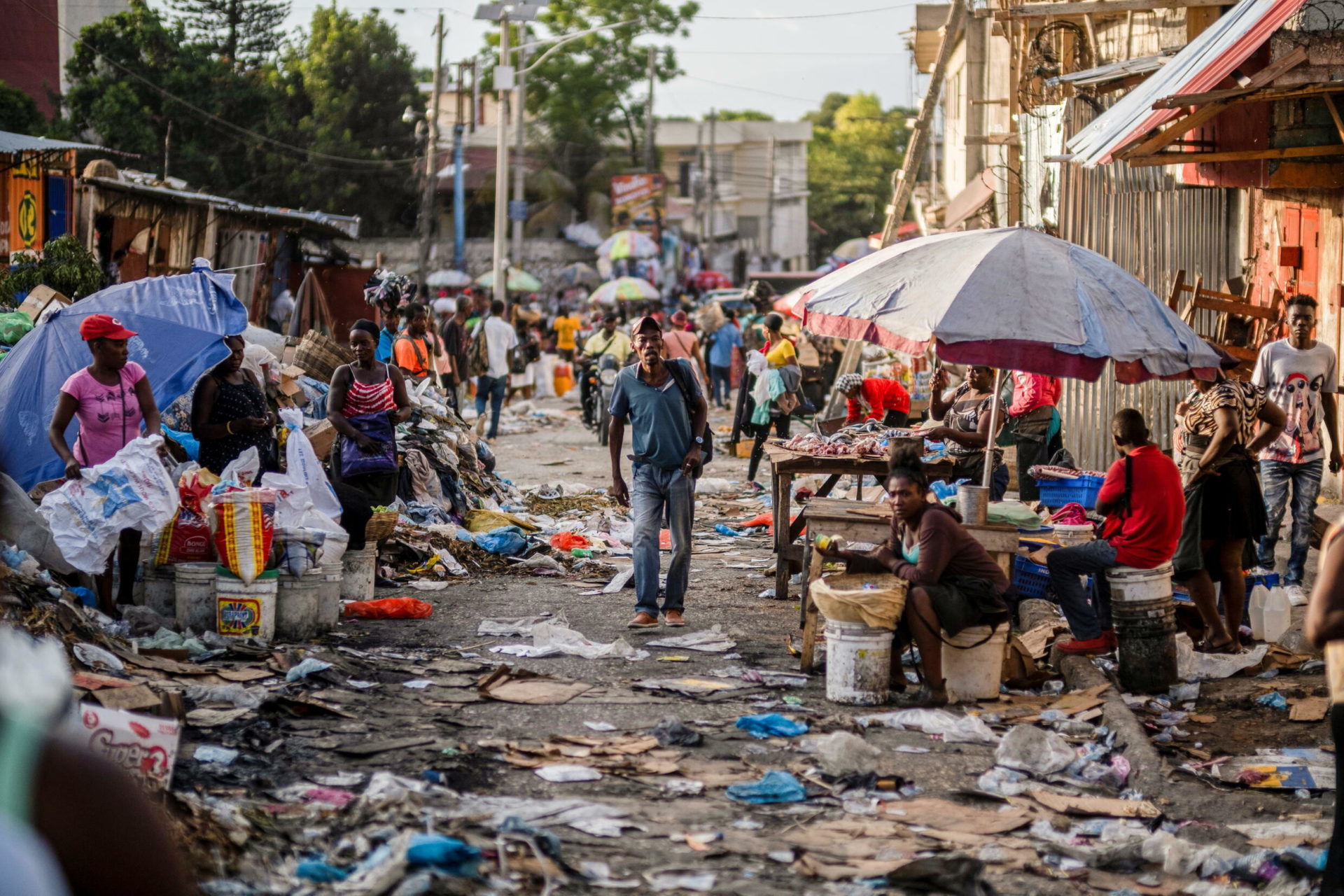
More than 20,000people have andit's aÉplacare in the Haitian capitalïtienne Port-au-Prince in just four days, as gang violence s’intensifies, tries to alert the’International Organization for Migration (IOM) in a recent press release. For its part, the UN is urging the international community not to look away.
« The crisis is preventing essential supply chains and isolates the city», warns the IOM in a press release published last Friday.
These thousands of Haitians are now facing multiple displacement, forced to flee the escalating and continuous violence while leaving behind the little they had managed to build. Such a scale of displacement has not been seen since the country erupted in August 2023.
Civilian air traffic at a standstill
The closure of air traffic following targeted shots at three commercial planes flying over Port-au-Prince, combined with restricted access to the country's main seaport and unsafe roads controlled by armed groups, have left the metropolitan area in a state of near-total paralysis, worsening the living conditions of populations already naturally in a situation of extreme economic vulnerability.
IOM notes in its alert to the international community «that criminal groups in the capital are continuing their expansion, taking control of new neighbourhoods and further isolating communities». Formerly rival mafia factions that used to clash in territorial disputes have now joined forces by forming circumstantial alliances aimed at an increasingly violent confrontation against the national security forces. These same forces, facing a lack of human and material resources, remain completely overwhelmed while trying to cope with the escalation of urban violence.
According to the Office of the United Nations High Commissioner for Human Rights, gang-related clashes resulted in nearly 4,000 casualties in 2024. Gender-based abuses, including sexual violence used as a weapon of terror, have reached alarming levels. Women and children are affectedare you maddisproportionate eraeh, 94 % of women and girlsÉplacease being exhibitedease at risk unprecedented abuses.
« L’the isolation of Port-au-Prince is amplifying a humanitarian situationnightto ddisastrous », said Grégoire Goodstein, IOM Chief of Mission in Haiti.Our abilityé to be provided by the’Help is stretched to the limit of his abilitiesis. Without immediate international aidédiate, les souffrances s’will worsen the manexponential era. With only 20 % from Port-au-Prince accessible, humanitarian workers are facing to d’immense defforts to reach the affected populationsease», he continues.
In a climate of high insecurity, highly exposed humanitarian workers
Despite these local security difficulties and beyond the multiplication of global conflicts, IOM and its partners remain determined to provide life-saving aid to the Haitian population. Specifically, the UN agency is actively assisting displaced persons by providing them with housing allowances, as well as by deploying mobile clinics in an attempt to guarantee basic medical care, medicines and protection services such as psychosocial support, family reunification and assistance to survivors of gender-based violence.
Thus, amid a deafening silence from the international community, IOM continues in Haiti to coordinate site management and water trucking for the benefit of displaced persons. Numerous other operations continue across the rest of the country, including support for migrants deported to the border, the rehabilitation of migrant protection centres, and various community stabilisation projects. But all of this comes at a high cost.
IOM stresses «the critical importance of respecting humanitarian principles in the context of escalating crisis» in Haiti too! Obviously, it is essential to ensure the safety of humanitarian personnel and involved civilians. To anyone willing to listen, notably through diplomatic channels before the United Nations Security Council, the UN agency is asking «everyone to respect the neutrality and impartiality of humanitarian operations, by allowing unhindered access to people in need while preserving the integrity of humanitarian aid». A message in a bottle?
The lifeblood of any operation, IOM also calls in its advocacy for an urgent increase in funding and support for humanitarian operations in Haiti. In November, the United Nations response plan amounting to 674 million dollars was only 42 % funded by member states!
In one year, the number of children recruited by armed groups increased by 70 %
An unprecedented rise, which bears witness to a worsening of the child protection crisis observed in this Caribbean country, ravaged by the violence described above.
At a time when GEOpolitics.fr echoing this forgotten corner of the world, children make up as much as half of the ranks of potential armed groups!
Interviewed by our editorial team, the Executive Director of UNICEF and Principal Advocate for the Humanitarian Situation in Haiti within the Inter-Agency Standing Committee Catherine Russell replies: « Trapped in a vicious circle, a growing number of children in Haiti are joining the armed groups directly responsible for the desperate situation in which they find themselves ».
Indeed, the recruitment of children into armed groups has accelerated as a result of intensifying clashes and widespread poverty, about the lack of education and the near-collapse of infrastructure and essential social services in Haiti.
For a pittance, children are very often forced to join armed groups in order to support their families, or else out of fear for their own safety. A great many of them are thus recruited after being separated from those supposed to look after them, in the absence of other means of survival or of receiving any pseudo-protection.
« It is imperative to reverse this unacceptable trend by ensuring that all parties make the safety and well-being of children a top priority », adds Catherine Russell.
At the same time, surviving children in the few areas still outside the control of armed groups frequently arouse suspicion and thus run the risk of being regarded as spies, or even of being killed by self-defence movements.
In the event of defection or refusal to take part in the acts of violence that have become tragically routine, their lives and safety are immediately threatened.
« In many regions of the country, children are victims of atrocities that none of them should ever experience and which threaten to leave them with indelible psychological and emotional scars, Explain Catherine Russell. «Chaos and horror are an integral part of their daily lives amidst general indifference », she added.
In the capital, Port-au-Prince, it is estimated that 1.2 million children are living under the shadow of armed violence. According to these hard-to-quantify estimates, 25 % of the 703,000 internally displaced people (note: among whom 365,000 children are recorded) are currently living in scattered slums across the capital, where they face extremely difficult living conditions, as well as various daily threats of intimidation.
This is the brutal message received during a special session organised this Monday by the United Nations Economic and Social Council (ECOSOC) by UN Ambassadors, UN officials, humanitarian workers and what remains of Haiti's political leaders, thereby recalling the disastrous situation prevailing in Haiti and calling for immediate action by member states.
With nearly 5.4 million people facing overt food insecurity (editors« note: half the population, half of whom are children) and 700,000 displaced people, an urgent international intervention is more than necessary in order to cope with a crisis aggravated by the rising and boundless violence of armed groups, economic instability and insufficient humanitarian funds while the »world looks the other way".
«Why is it easier for a young person to get a gun than a meal in Haiti?»
Kicking off this extraordinary assembly, the Canadian diplomat and current President of ECOSOC, Bob Rae, made a point of sharing the words of a 17-year-old Haitian youth surviving in Cité Soleil, one of the neighbourhoods hardest hit by gang violence in the country's capital, who had been asked to send a message to the conference.
So this youth replied by simply asking a question: « Why is it easier for a young person to get a gun than a meal in Haiti? »It seems quite obvious to think about this question, which far too many journalists and other international analysts fail to ask!
« What must be done now to prioritise the needs of children, the needs of young people? What should we be working on in the medium and long term to tackle the root causes of the Haitian crisis? How can we deploy all these tools and resources that we collectively have at our disposal to support the next generation in Haiti so that they can live a life of dignity, free from violence, poverty and discrimination? How can we ensure the coordination of our support for Haitian efforts to promote security, stability and prosperity in Haiti? », launched the diplomat as a tentative response, opening the proceedings of this hypothetical conference.
In one year, ten times as many children exposed to sexual violence
Haiti is furthermore facing a surge in sexual assaults and rapes perpetrated against minors. In the course of this investigation GEOpolitics.fr furthermore, a regular at the corridors of power and other UN offices, and by consulting the Office of the Special Representative of the Secretary-General for Children and Armed Conflict, it turned out that the number of children exposed to sexual violence was multiplied by ten during that year alone, across all conflicts!
Thus in 2024, UNICEF (editor's note: a United Nations organisation and agency) provided assistance and support related to sexual and gender-based violence (multisectoral care, psychosocial support, community awareness-raising, among others) to over 25,000 people.
In response to the protection crisis facing children recruited by armed groups in Haiti (or at risk of being so), UNICEF has, among other things, provided training for government security forces and civil society organisations on the measures to be taken to protect children and thereby attempt to safeguard their most fundamental rights.
The UN agency has also ensured the temporary care of children previously recruited into armed groups by providing them with psychosocial support, food and services aimed at tracing their families in order to reunite them.
In his/her reply to GEOpolitics.fr, UNICEF urges all parties in Haiti, including the security forces and the Government, to:
- Prioritise ensuring the safety and protection of all children, and ensure that they are treated first and foremost as children, taking all necessary measures to prevent other children, including those recruited by armed groups, from being killed or injured;
- Support the immediate release of children recruited by armed groups, who must be handed over without delay to civilian child protection actors with a view to their recovery and reintegration;
- Place the rights and protection of all children in Haiti at the heart of current and future action programmes. It is imperative to protect children from recruitment attempts and violence, whether sexual or of any other nature, and to ensure that they have access to basic services, notably in education, health, nutrition and child protection.
A call for international solidarity, in this part of the world too
Naturally, the speakers at this extraordinary session of ECOSOC did not fail to stress the need for immediate, coordinated international action, particularly to bridge funding gaps aimed at protecting Haitian children from all forms of exploitation and to rebuild essential services for the population. Point taken.
For her part, the Special Representative of the Secretary-General for Haiti, María Isabel Salvador, who also heads the United Nations Integrated Office in Haiti (BINUH), urged the international community to tackle the root causes of the regional crisis: « The challenges facing Haiti are immense, but one truth is undeniable: no progress can be made without tackling the omnipresent insecurity caused by armed gangs ».
UNICEF, along with other representatives of humanitarian organisations in unison, also called on the Multinational Security Support (MSS) mission, an organisation backed by the UN Security Council, and the Haitian authorities to prioritise the protection of minors during operations, ensuring the safe reintegration of children recruited by armed groups.
Finishing this investigation, your humble servant geopolitics tried to question the sacrosanct French Ministry of Foreign Affairs on this matter. In this highly troubled national period, the latter has not yet responded regarding the French position on Haiti, at the time of publishing this article.

 French
  English
  Chinese
  Arabic