
Munich 2025, a Geopolitical Barometer
The Munich Security Conference 2025 was the echo chamber of the profound upheavals shaping the international order. Between the rebalancing of strategic balances and the realignment of major powers’ priorities, it highlighted transatlantic tensions and the growing uncertainties surrounding the future of European security in a changing diplomatic landscape.
In this context, Europe faces major strategic choices between the need to adapt its alliances and the need to assert greater autonomy in its ability to act. Relations between traditional partners are evolving under the influence of new geopolitical realities, redefining interactions and power relations.
But beyond rivalries and repositioning, Munich 2025 illustrated a world undergoing a full reconfiguration, where the certainties of yesterday give way to new lines of division. In this uncertain environment, each actor seeks to protect its interests while adapting to changing alliances.
The Highlights of the Conference
Ukraine at the Heart of Transatlantic Tensions
Ukraine has crystallised the debates in Munich, exposing a growing transatlantic rift. While Europe reiterated its unwavering support for Kiev, signals from Washington hinted at a willingness to explore direct diplomatic options with Moscow. General Keith Kellogg’s stark statement as Donald Trump’s envoy – «Europe is not indispensable to a future negotiating table» – resonated like an earthquake, reviving the spectre of a realignment of the US dictated by pragmatism, or even unilateralism.
In the face of this prospect, European voices have risen to remind of the EU’s indispensable role in any resolution of the conflict. «There can be no peace without Ukraine and without Europe,» insisted Portuguese President António Costa, emphasizing the requirement for European involvement commensurate with the stakes.
But beyond the statements, Munich highlighted a growing gap between Washington and Brussels. While Europe places Ukraine at the heart of its strategic vision, the United States seems to be redefining its own global priorities, casting a cloud of uncertainty over the outcome of the conflict and the balance of the continent.
Towards a multipolar world: redefining alliances and challenges for Europe
Beyond the Ukrainian issue, the Munich Conference vibrated to the rhythm of a world undergoing a profound reconfiguration. American hegemony is gradually fading away, giving way to a geopolitical chessboard where China and Russia intend to establish themselves as major players. In this uncertain dynamic, one question arises: is NATO, the historical pillar of Western security, still up to the challenges of a multipolar order in the making?
Aware of these upheavals, European leaders have called for a common strategic vision, the only one capable of guaranteeing Europe a place commensurate with its ambitions in a world in flux.
A Transatlantic Thrill: The Rifts of an Alliance
The Munich Security Conference not only exposed global challenges; it also revealed a growing gap between the United States and Europe, where the promises of cooperation and shared values are gradually fading away.
A Speech That Shocks the Established Order
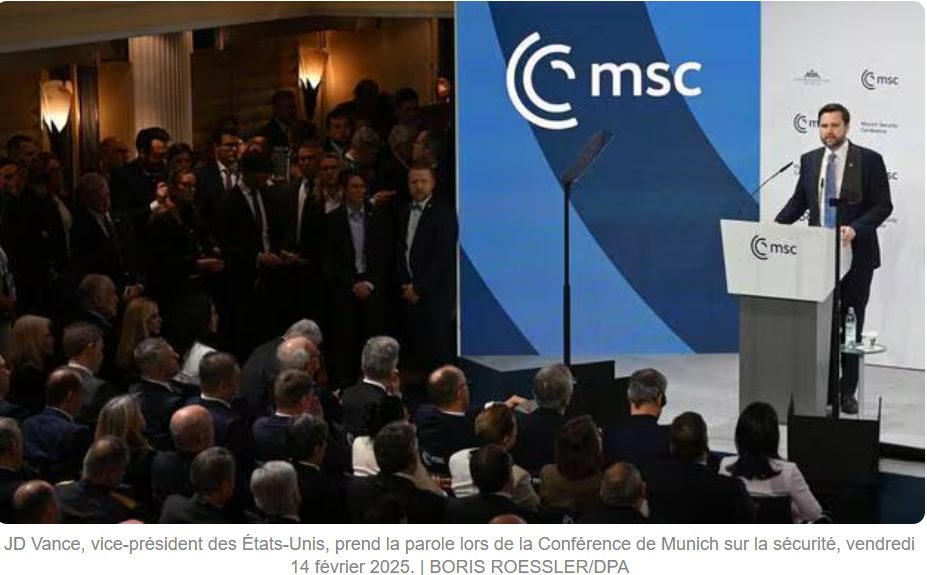
The intervention of US Vice President J.D. Vance marked a turning point in this 2025 edition, highlighting increasingly deep differences between Washington and its European allies. Breaking with the traditionally conciliatory tone of transatlantic cooperation, he pointed to Europe’s strategic priorities, calling on its leaders to focus on their own challenges: sluggish growth, a lack of innovation, and contested migration management.
While his speech divided the audience, it mainly exposed the latent tensions that undermine the transatlantic partnership. In response, European leaders reaffirmed their commitment to cooperation rooted in common values and a multilateral approach to major global issues. Polemical and uncompromising, Vance’s speech revealed the fractures of an alliance in the midst of a re-composition.
Ukraine: A Two-Speed Strategy
The Ukrainian issue has further deepened the transatlantic divide. While Europe shows unwavering support for Kiev, Washington now seems inclined to explore diplomatic avenues with Moscow, even if this means leaving its allies on the sidelines of the negotiations. This divergence fuels concerns in Europe: an agreement reached without it would not only compromise Ukrainian interests but also undermine the continent’s security.
The Test of Numbers: Defense and Commerce, on the Lines of Fracture
Tensions between Europe and the United States are not limited to diplomacy; they extend to the military and economic spheres, where disagreements are multiplying.
- Defence Despite NATO’s directives to devote % 2% of GDP to defense, only 11 European countries reached this goal in 2024. Washington, which shoulders nearly 70 % % of the Alliance’s military spending, is urging its partners to share the burden more.
Ursula von der Leyen’s proposal to increase this effort to 5 % is proving difficult to win over Europeans, already constrained by budget pressures.
- Commerce : US customs barriers and massive subsidies to domestic industries fuel Brussels’ exasperation. The European Commission estimates that these protectionist measures could cost the continent’s businesses billions, thus hindering a still fragile recovery after successive crises.
Between strategic adjustments and economic tensions, the transatlantic relationship seems more than ever to be at a turning point.
The Spectre of Yalta: Does History Repeat Itself?
Beyond the verbal skirmishes of Munich 2025, an insistent question persisted: are we witnessing the return of a world shaped by the logics of the past? The apparent rapprochement between Washington and Moscow, relegating Europe to the sidelines, has revived the spectre of Yalta – a time when great powers, confident of their supremacy, reshaped the destiny of the world without consulting those who would suffer the consequences.
Riyadh: Diplomacy of the Shadow, European Frustration
Behind the scenes of the official tensions, a meeting in Riyadh between the heads of the Russian and American diplomatic services has sown discord. These discreet exchanges, marked by bilateral connivance, have heightened the unease of a Europe kept out of the negotiations that are crucial for its own security. More than a simple dialogue, this aside was perceived as a signal: global balances are shifting, and Europe is struggling to assert itself in this new power game.
Trump-Putin-Xi Summit: Is Europe relegated to a spectator role?
The possibility of a trilateral summit in May 2025 between Vladimir Putin, Xi Jinping, and, according to persistent rumors, Donald Trump, has revived the spectre of a marginalized Europe in major strategic maneuvers. A disturbing reminder of Yalta, where the fate of the world was decided far from the concerns of the nations directly affected.
Scheduled for May 9 in Moscow to mark the 80th anniversary of the Soviet victory, this summit could be the scene of decisive agreements with profound repercussions on the future of Ukraine and the global balance of power. If the official confirmation is still delayed, rumors of a possible participation by Donald Trump, at the invitation of Vladimir Putin, fuel growing concern in Europe. The spectre of a compromise to the detriment of Ukraine, or even of an imposed «Finlandization», looms with increasing urgency, threatening the European security architecture and opening the door to upheavals whose scope remains incalculable.
Conclusion: A World in Change, Europe Facing the Unknown
Munich 2025 not only exposed transatlantic disagreements; it revealed a world in full metamorphosis, where traditional markers fade in the face of the emergence of new power dynamics. Alliances are being reshaped, ambitions are asserting themselves with unprecedented clarity, and the geopolitical balance seems to be slipping away before our eyes.
In this accelerated reshuffling, decision-making centers are moving away, relegating Europe to the role of spectator of negotiations conducted elsewhere, often without its participation. The Munich Summit confirmed a profound trend: the fragmentation of blocs, the rise of bilateral strategies, and the gradual erosion of the frameworks inherited from the Cold War.
From this point onwards, a question arises: will the emerging new order bear the seeds of a restored stability, or will it herald an era of heightened rivalries? History teaches that every geopolitical transition is accompanied by uncertainties and tensions. The only certainty remains: in this world undergoing a full transformation, nothing is predetermined.

 French
 English
 Chinese
 Arabic