
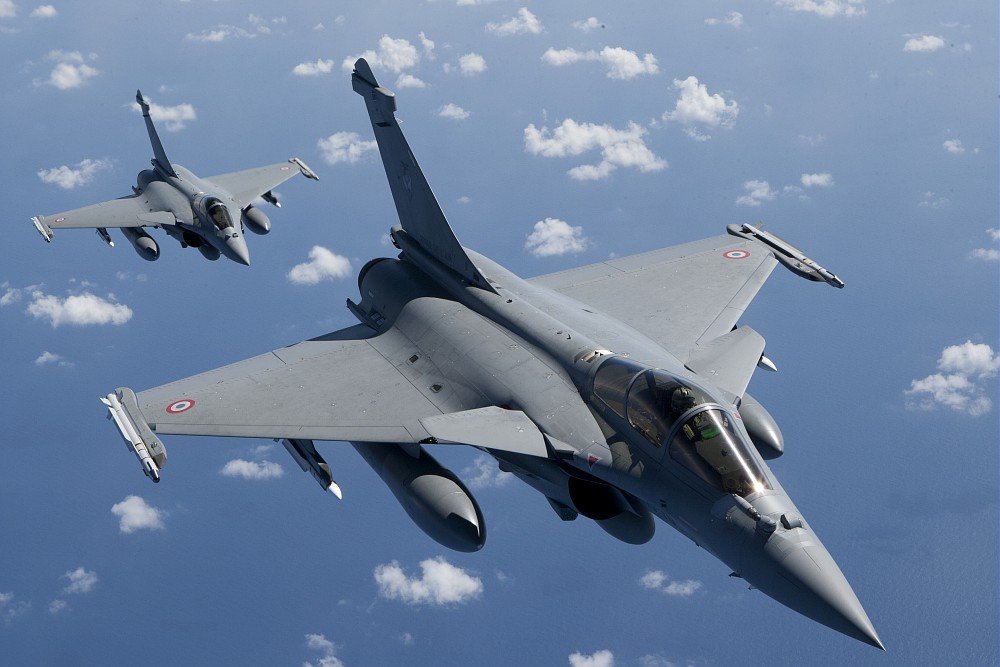
From fighter jets to submarines, including its tactical missiles and autonomous systems, notably drones, France is confirming its expertise in military high technology. But this success also relies on much broader geostrategic issues and efficient diplomacy.
In 2024, Dassault Aviation will have delivered no fewer than 21 Rafale fighters, exceeding the initial targets and thereby achieving a significant increase compared to the 13 aircraft delivered in 2023. This result marks an acceleration in the aircraft manufacturer's production rate, supported by growing international demand and strategic orders. The order book is already «comfortable» with these 220 aircraft awaiting delivery, the vast majority of which are intended for export. However, this French success highlights Dassault Aviation's growing dependence on its military branch, whilst on the civil side, its Falcon business jets are struggling to win customers.
The historic Rafale, an economic growth engine for the aircraft manufacturer
The Rafale, a French flag-ship certainly but above all of the know-how of Dassault Aviation's engineering and development teams, experienced a record year in 2024. But above all, this increase reflects a substantial industrial effort in order to reach a production rate close to two aircraft per month, excluding summer periods. Also, according to its management, Dassault aims to raise this cadence to three aircraft per month in the coming years, which should make it possible to meet ever-stronger demand.
This success is based on several economic and industrial factors. First of all, a notable increase in international orders can be observed. Contracts with Serbia (12 aircraft) and Indonesia (18 new aircraft) demonstrate a successful strategic positioning in emerging markets. Furthermore, the effects of global geopolitics, international tensions and rearmament needs, particularly in Europe, are reinforcing the demand for cutting-edge equipment such as the Rafale.
Dassault Aviation’s order book now stands at 220 aircraft, including 164 for export, guaranteeing long-term financial and industrial visibility.
Overall, a historic year for the French defence industry
The year 2024 closed with unprecedented performance for French arms exports. No less than €8 billion in orders were recorded, according to the Minister of the Armed Forces, Sébastien Lecornu, during a press conference in Paris. This exceptional figure makes 2024 the second best year of the 21stth century, just behind 2022 when the record of 27 billion was reached thanks to a monumental contract with the United Arab Emirates for the delivery of 80 Rafale fighter jets.
And it is France's military aviation flagship, the Rafale, that continues to dominate French military equipment sales. In 2024, Serbia acquired 12 aircraft, while Indonesia finalised an order for 42 jets, with 18 delivered this year. The success of the Rafale, dubbed «a global benchmark» by experts, reflects a technological expertise that is winning over an increasing number of countries across every continent.
Also, the French naval industry is not lagging behind and is taking its share of the pie. Indeed, Naval Group has also concluded a major contract with the Netherlands for the supply of four Barracuda submarines, for an estimated budget of 5.6 billion euros.
What will 2025 be made of in the arms market?
For Minister Sébastien Lecornu, arms exports go far beyond the economic sphere. « It is essential for our sovereignty, our trade balance and the maintenance of our defence industrial and technological base », he pointed out. Indeed, exports not only make it possible to finance the modernisation of national equipment, but also to create numerous jobs in several French regions.
However, the arms market is particularly competitive. In order to maintain its lead, France must not only innovate in disruptive sectors such as artificial intelligence, but also adequately meet customer expectations in terms of delivery times and production costs.
That is why the Minister for the Armed Forces is displaying pronounced optimism for 2025, which could well be a record year. Already, the signing of promising contracts, such as the sale of 14 Caracal helicopters to Iraq, shows that the momentum of French exports is continuing. Flagship equipment such as frigates, anti-aircraft systems and new-generation radars will continue to attract foreign buyers, according to experts.
R&D resources aimed at meeting industrial and technological challenges
To meet this exponential development and particularly in terms of production rates, Dassault Aviation must face major challenges, notably concerning an exceptional and necessary mobilisation of its supply chain. Indeed, with more than 400 suppliers and subcontractors, increasing production rates requires flawless coordination. Éric Trappier, CEO of Dassault Aviation, certainly recalled the importance of this effort during his statements in July 2024. Then the issue of technological innovation also comes into play. Thus, the company has launched the development of the fifth generation of the Rafale, which will integrate autonomous combat drones for collaborative operations. These innovations will allow Dassault to maintain its competitive advantage against players such as Lockheed Martin or indeed Airbus.
On the civil market, however, a more marked contrast
While military market performance has been particularly notable, the civilian segment remains somewhat sluggish. In figures, deliveries of Falcon business jets certainly increased, rising from 26 units in 2023 to 31 in 2024, but they remain below the manufacturer's targeted 35 firm deliveries. According to the company, these poor results are mainly due to subcontractor delays impacting the production line. Furthermore, there is increased competition in recent years in the business jet market, where new players are vying for highly coveted market share.
In this area, Dassault Aviation is relying on the launch of the Falcon 6X to revitalise its positioning, but the balance between military and civil aviation remains a strategic challenge for the French company. The performance of the Rafale has contributed significantly to Dassault Aviation's overall revenue, estimated at around €6 billion for 2024, up from 2023. This result illustrates the pivotal role of military aerospace in the group's economic health, offsetting the headwinds encountered in civil aviation.

 French
 English
 Chinese
 Arabic