
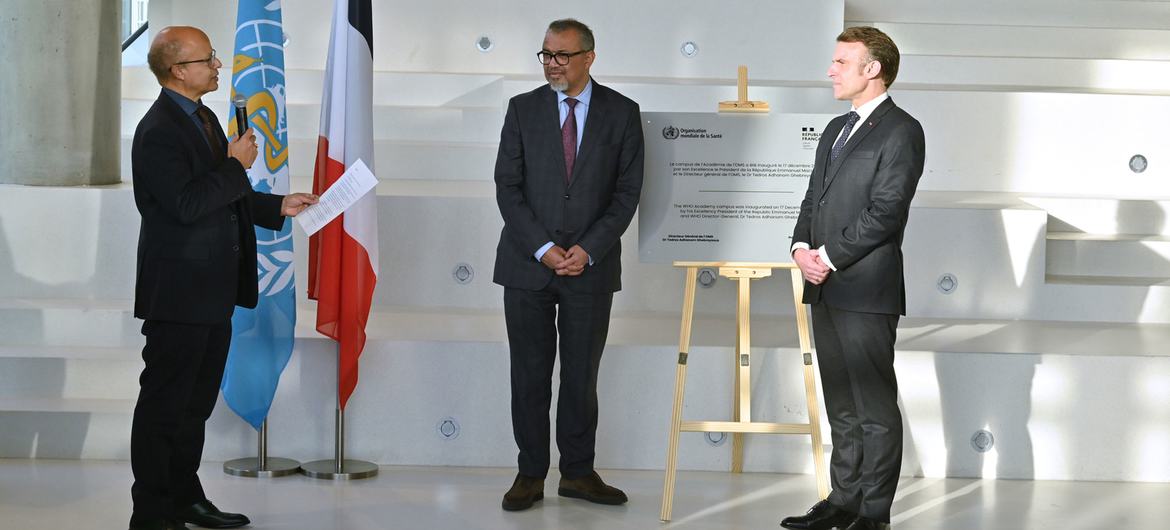
Hidden from the media spotlight, the World Health Organization (WHO) Academy officially opened its doors in Lyon last Tuesday. In the presence of WHO Director-General Dr. Tedros Adhanom Ghebreyesus, French President Emmanuel Macron, alongside dozens of health ministers, international representatives, donors, and local French partners.
The international event faded into the tumult of the boiling national political news. Nevertheless, this new positioning of France in the face of global health is no less significant. At this inauguration of international dimensions, Emmanuel Macron declared:« Today, we can be proud to open in the city of Lyon the doors of a new global institution, which will bring the best in terms of training and innovation in the field of health. ».
The acquisition of skills essential to the new global health issues
This project, described by the UN organization as «revolutionary,» is intended to enable health professionals and researchers from around the world, as well as policymakers and representatives of the WHO, to access essential knowledge and skills, share research data, and acquire cutting-edge clinical expertise through training delivered at its Lyon headquarters and across the world through its online platform.
According to the head of the WHO, « The agency's world-class technical products often remain unused and their translation into concrete actions hampered ».
Thus, « The WHO Academy will change the game; it is a global learning center, the first of its kind, that will equip health and care professionals, policymakers, and our own global workforce with the skills and competencies they need to transform health systems and ensure health for all. »", insists Dr Tedros Adhanom Ghebreyesu, on the occasion of this inauguration.
Clear and quantified objectives: train 3 million health workers in 5 years
The Academy has set an ambitious but realistic goal of training 3 million health workers from around the world, with new contemporary risks: nurses, clinical doctors, midwives, biologists, epidemiologists and researchers, as well as 900 political decision-makers and diplomatic representatives, 13,000 national public health managers, by 2028.
To do this, this international knowledge center will produce 50 to 80 courses per year between 2025 and 2028, totaling approximately 260 new courses by 2028, with access to all of them being generalized through its online learning and data sharing platform.
« This platform offers free and cutting-edge courses on priority health topics, thus enabling professionals from all over the world to access high-quality training, regardless of their geographic location. », it is thus specified in its charter.
According to the WHO, this is the continuing training program « the most ambitious ever conceived in the field of public health ».
Allowing access to the most advanced technological resources
The WHO Academy also intends to address the weaknesses identified in health information systems, particularly in low- and middle-income countries, especially in Africa.
The latter also aims to bridge the gap that is emerging in terms of access to the latest research and innovations, thanks to partnerships established with the best academic and public health research institutions worldwide, particularly those from developed countries.
With a view to building and sharing access to the most advanced technologies for health and care, as well as research and development in the field of health, including AI, the Academy will bring additional capabilities and efficiency directly to local health systems.
« The latest developments in technology and AI will be very powerful in making healthcare more accessible everywhere. This investment will benefit everyone, as better-trained healthcare workers are absolutely essential to make the world safer, especially to prevent and respond to future pandemics. »", emphasized for his part the French President Emmanuel Macron.
Lyon the capital of global health? Unquestionably
Historically a regional petrochemical hub, the capital of Gaul has already been equipped for several years with a high-level biological analysis laboratory, classified as P4 (NDLR: The P4 classification of a laboratory means «pathogen of class 4» and makes it susceptible to hosting very pathogenic microorganisms. In the world, laboratories of this type are also designated «BSL 4», from the English: biosafety level 4). These agents of class 4 are characterized by their high lethality (very high mortality rate in case of infection), the absence of protective vaccine, the absence of effective medical treatment, and the possible transmission via aerosols. The maximum protection required to handle these germs is designated by the NSB4 (Biological Safety Level 4) symbol.
Also, last December, the City of Lyon hosted the first edition of the World Health Festival. In fact, the Lyon region is strengthening its importance in the field of medical research and innovation.
Behind this festival lies a Lyon-based ecosystem that prompted the World Health Organization 23 years ago to establish a first branch in the city. Two decades later, the bar has been set even higher with this Academy, which will be located in the heart of the Gerland bio district.« The Academy must be an international institution at the service of all the member states of the WHO », argues its director David Atchoarena.« But she must also contribute to the momentum and efforts to promote global health from Lyon. Which is becoming a pole of influence in France to bring this vision to life. », adds the latter.
The new state-of-the-art campus of the WHO Academy covers 11,000 square meters and includes twenty-two training rooms, two distance learning rooms, a simulation center, an emergency operations center, a television recording studio, a modern auditorium, and finally a library.
Furthermore, the environmental approach to buildings, represented by the concept of One Health (one health), is not unwelcome to the Métropole and the City of Lyon, which have been running ecological pavilions since 2020. The Lyon region is therefore now holding a health festival in its own image and colors, as well as an international training hub that strengthens the territory’s Rhone Valley reputation.
This pioneering initiative, launched seven years ago, was, of course, made possible thanks to the generous support of the French government, the Auvergne-Rhône-Alpes region, the city and metropolitan area of Lyon, as well as other global partners. However, neither the overall amount of the operation nor its funding allocation have been made public.
« I am convinced that this strong partnership with the WHO will demonstrate our confidence in its ability to guide our health policies worldwide and to coordinate our actions, so that we can be ever more effective in serving our populations on the ground. », said Emmanuel Macron.

 French
 English
 Chinese
 Arabic