
A system designed to win seats for the right and which has never achieved its objectives.
The 11 MPs for French residents overseas are an innovation introduced by the constitutional reform of July 2008. Nicolas Sarkozy, who was behind it, was then pursuing two objectives: the praiseworthy one that French people abroad are represented in the National Assembly in order to be fully-fledged citizens. The other was to secure the gain of 9 constituencies out of the 11 created. Indeed, until 2007, French citizens living abroad had always voted on the right, as long as the latter was not populist. Only two of the 11 constituencies did not seem to be safe seats: the 7thth which groups together Germany, Central and Eastern Europe appeared tangential; the 9th which brings together the Maghreb and West Africa, considered impregnable.
Yet, that is not what happened. The right's drift towards uninhibited populism provoked an allergic reaction of a population attached to a France open to the world and whose level of education is higher than the French average. French citizens living abroad are the anti-CNEWS.
Another monumental political mistake, internally, was to entrust senators with the responsibility of the UMP and then LR Federation for French nationals abroad.. The dizzying decline dates from this period. Indeed, the sole concern of the said senators is to maintain control over some sixty councillors for French nationals abroad (their grand electors) in order to be re-elected, and certainly not to generate numbers, members, or, worse still, to have French deputies for abroad elected. The aim is to maintain a ghost system that they control in order to ensure their re-election
In 2012, only the 10th and 11thth constituencies sent a UMP deputy.
In 2017: only number 8th constituency, that of Meyer Habib (running under the strange label of UDI, though everyone knows his real convictions) was won.
In 2022: still the same and only Meyer Habib for reasons everyone knows.
During these snap legislative elections: no right-wing candidate in the 2ndth tour, except for the said Meyer Habib, who is now openly defending the National Rally.
Thus, the objective pursued by Nicolas Sarkozy, 9 additional constituencies for the right, proved to be a complete failure.
An inconsistent electoral boundary review that facilitates foreign interference
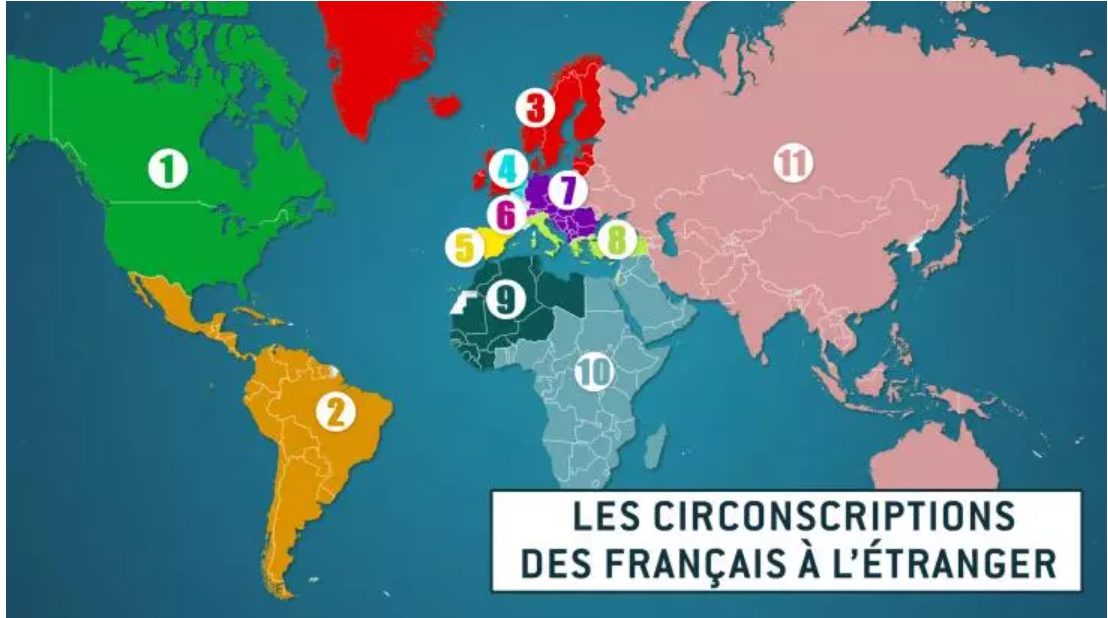
Indeed, instead of choosing a single global constituency, which is the case for Senators representing French citizens living outside France, it was decided to divide the world into 11 constituencies.
While some have a certain coherence, despite a scale that precludes any local campaign such as 1era which covers North America or the 2th which includes Central and South America, others do not have any. Both the Arab world and Africa are torn between the 9th and 10 constituencies. The 11th constituency stretches from Russia to New Zealand and covers 53 countries!
In reality, only two constituencies: the 4th (Benelux) and 6th (Switzerland and Liechtenstein) have any geographical coherence and actually make it possible to campaign.
In others, the decisive weight of a single country places the elections under the thumb of a foreign power
The most glaring case is that of number 8th constituency (Israel, Italy, Greece, Turkey, Cyprus, San Marino, Malta, the Vatican): it is actually the registered voters in Israel, who are ultra-dominant, that make the decision. To be elected, Meyer Habib only needs the support of French-Israelis. Thus we have an MP who is half-Knesset, half-National Assembly.
This most significant example is unfortunately not the only one. Those who want to understand can.
The other form of interference is financial. The National Commission for Campaign Accounts has no power to act and monitor financial flows abroad. If a state chooses a candidate, the money (in cash) flows freely without any oversight or sanction.
A change to the electoral system is essential
To escape these pitfalls, one means seems obvious and simple: list proportional representation with a single worldwide constituency. This would be the end of foreign interference and the myth of a local MP who does not exist. The debate would be nationalised and French people abroad less segmented. For elected members, if they so wish, to subsequently specialise in certain regions of the world by taking an active part in one or other friendship group. Voting could be entirely electronic if we are able to prevent foreign intrusions.
The Foreign Ministry is far from having the expertise of the Home Office in electoral matters
It is by no means a question of targeting diplomats whose excellence is well established and who suffer so much from having Ministers who are not up to the job. Quite the contrary, some have held very high the honour of French diplomacy by denouncing the subservience, inconsistency and bias of the foreign policy conducted in the Arab world. Nevertheless, there is no real electoral expertise within the Ministry for Foreign Affairs, that is the reality!
The reform of the voting system should be accompanied by a transfer of the organization of the election from the Ministry of Europe and Foreign Affairs to the Ministry of the Interior. who, in turn, is unaccustomed to organizing elections and is reactive.
I will first discuss the problems faced by all the candidates who were not outgoing MPs during this extremely short campaign.
On June 9, the President of the Republic announced the dissolution of the National Assembly.
On June 11, the Ministry of the Interior will publish the «candidate’s memo»; on June 15, the Ministry of Europe and Foreign Affairs will do the same. The Ministry of the Interior and the Prefecture of Paris are available around the clock. The election office (Direction des Français établis à l’étranger et de l’administration consulaire) of the Ministry of Foreign Affairs, never.
The consular electoral list (LEC) is the main tool available to candidates abroad to campaign by sending emails to registered French citizens (especially when the campaign account is not open, which prohibits any travel to the field). The Ministry of Foreign Affairs will not make this famous LEC available to candidates until June 17, 8 days after the announcement of dissolution and only 8 days before the start of electronic voting. The latter was, in fact, not up to date…We are dreaming!
As far as I am concerned, in particular, I was entitled to a «favor» treatment» My profession of faith, posted on the Ministry of Foreign Affairs website, was not in the correct format, This is a groundbreaking idea at a time when it is an essential element for forming a conviction for electronic voting!
In Tunis, in the main polling station, my ballot was absent. It wasn’t until my delegate arrived to note this anomaly that, after doing a little research, we found them. hidden under a bag.... Always in Tunis where incompetence seems notorious, My delegate was unable to attend the counting, but was kept away in a corridor, contrary to what the electoral code stipulates.
Like many other candidates, I was unable to designate representatives in all the cities or countries. As for me, Dakar, Algiers, Annaba, Oran, Marrakech, Fès, Tangier, Conakry remained without a delegate. How did the voting go in all these places? With the same anomalies as in Tunis It will forever be possible to know that.
The least we can do is be certain that the vote is genuine and not biased.
It is high time to consider French citizens living abroad as full citizens whose voice counts just as much as that of those living in France, far from foreign interference and flawed electoral procedures.

 French
 English
 Chinese
 Arabic