
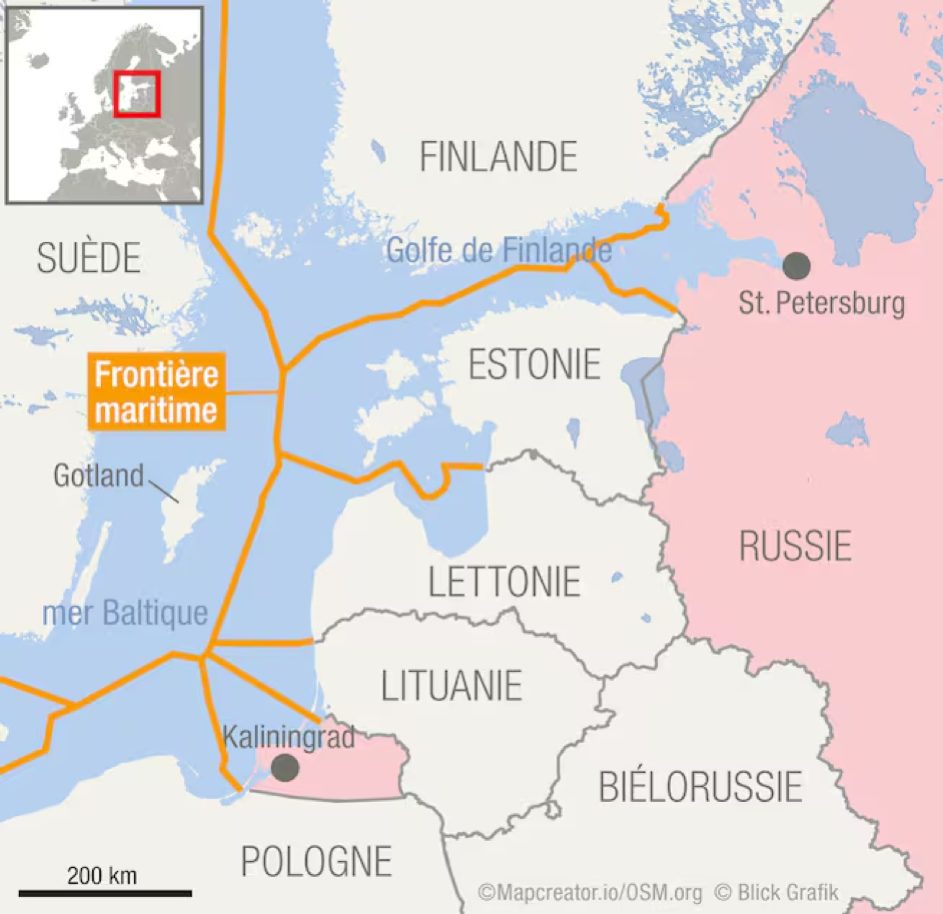
The Baltic Sea, stretching from the Scandinavian coast to the borders of Central and Eastern Europe, constitutes a major strategic crossroads in Europe. Connecting the Atlantic to the Nordic, Germanic, and Slavic powers, it unites key nations such as Sweden, Finland, Denmark, Germany, Poland, and Russia. Its unique geographical position, reinforced by the strategic enclave of Kaliningrad, makes it a central space for global economic, energy, and military issues.
An area that is experiencing increasing tensions
The Baltic Sea’s maritime routes, vital to international trade, play a key role in transporting Russian energy resources to Europe, via strategic ports such as Gdańsk, Saint Petersburg and Lübeck.
However, this economic importance is accompanied by growing tensions; the region is becoming a theater of confrontation between the West and Russia. The expansion of NATO and the European Union to the East has profoundly redefined the balance of power, accentuating instability in this strategic area.
Militarily, the Baltic Sea is proving to be a powder keg where the proximity of NATO bases and Russian forces fuels tensions. The Atlantic Alliance has intensified its presence, deploying multinational troops, increasing naval exercises such as «BALTOPS,» and establishing bases in Poland, Lithuania, and Latvia. In response, Russia has strengthened its stronghold in Kaliningrad, equipped with sophisticated defense systems and nuclear missiles. This reciprocal militarization fuels a genuine arms race, exacerbating the risks of escalation in a highly volatile region.
The accession of Sweden and Finland to NATO illustrates a profound transformation of security balances in Europe. Finland joined the Alliance on April 4, 2023, followed by Sweden on March 7, 2024. These countries, long rooted in a tradition of neutrality, chose to join the Atlantic Alliance in response to a strategic environment perceived as increasingly unstable. This move consolidates NATO’s defensive posture while strengthening the central role of the Baltic region in Euro-Atlantic dynamics. At the same time, this development further restricts Russia’s maneuvering room, notably by reducing its access to Saint Petersburg and Kaliningrad, thereby redefining regional balances in a changing geopolitical context.
Economic and energy issues
The Baltic Sea is an essential axis for trade and energy transit in Europe, hosting strategic infrastructure such as the Nord Stream 1 and 2 pipelines, which directly connect Russia to Europe. However, this energy dependence also reveals critical vulnerabilities. Political tensions and targeted attacks, such as sabotage of the pipelines, exacerbate the region’s vulnerability.
Furthermore, the economic sanctions imposed on Russia disrupt trade flows, profoundly affecting all regional trade.
The key ports of Gdańsk and St. Petersburg play a central role in trade between Europe and Asia, while the Swedish island of Gotland, under NATO auspices, emerges as a strategic point for controlling the maritime routes. However, for Moscow, this island also represents a tactical opportunity, thus fueling strategic rivalries.
The Baltic Sea thus positions itself as a strategic space where economic, energy and military issues intersect, reflecting the ever-evolving global geopolitical dynamics. Its increasing integration into the NATO framework alters regional balances, raises concerns in Russia and underscores the region’s importance in the transformations of international relations.
The region is also witnessing an intensification of military activity between NATO and Russia, marked by naval incursions and military aircraft overflights, which increases the risk of serious incidents. Moreover, the Baltic Sea is becoming a laboratory for cyberattacks and hybrid warfare, targeting critical infrastructure and relying on disinformation campaigns to weaken the neighboring states.
Vulnerability of energy infrastructure
Energy infrastructure, notably pipelines and electrical networks, remain strategic targets. The Nord Stream gas pipeline incident in 2022, which severely disrupted European energy supply, illustrates this vulnerability and has intensified tensions between NATO and Russia. Europe’s heavy dependence on Russian gas highlights how any disruption of flows can compromise the continent’s energy security.
Dynamics of regional and international actors
Regional actors
The Baltic States: Estonia, Latvia, Lithuania
At the forefront of tensions between East and West, the Baltic countries — Estonia, Latvia, and Lithuania — fully assume their strategic position. They are investing heavily in their defense, despite limited resources. Lithuania spends more than 2.5 % % of its GDP on military modernization, while Estonia is strengthening its cybersecurity capabilities, a key sector since the attacks suffered in 2007.
These efforts are supported by their allies. The NATO «enhanced forward presence» initiative deploys multinational battalions under the leadership of Canada, Germany, and the United Kingdom, ensuring indispensable collective protection in this tense context.
The European Union and NATO
The European Union and NATO play a structuring role in strengthening the capabilities of the Baltic countries. Major military exercises, such as Baltic Protector, strengthen their coordination, while strategic projects such as Rail Baltica They integrate economic and military aspects. The installation of modern defense systems, such as the Patriot batteries in Lithuania, and the development of a cybersecurity center in Tallinn are a testament to this commitment to protecting the region and strengthening its resilience against hybrid threats.
Russia
Facing the expansion of NATO, perceived as an existential threat, Russia has intensified its militarization of the Baltic Sea, particularly in the strategic enclave of Kaliningrad. This territory, which has become a veritable bastion, is equipped with Iskander ballistic missile systems, S-400 air defense systems, and Kinjal hypersonic missiles, enabling it to project considerable military power into the region and beyond.
The enclave also houses coastal batteries equipped with supersonic missiles, thus strengthening its maritime defense. This deployment of forces, complemented by a military contingent of 30,000 men, demonstrates Russia’s determination to assert its influence in the region. At the same time, Moscow is using its status as an energy supplier as a lever, seeking to divide European nations.
Role of external actors
The United States
The United States plays a central role in the security of the Baltic region, strengthening NATO’s capabilities by deploying strategic equipment such as F-35 aircraft and advanced surveillance drones. Joint exercises, such as Defender of Europe, They testify to the American commitment to strengthen the interoperability of allied forces and to deter any potential threat.
China
Although less militarily present, China is increasing its influence in the region through targeted economic investments. The initiative Belt and Road It offers him the opportunity to finance key infrastructure projects, such as the port of Klaipėda in Lithuania, allowing him to extend his economic reach while remaining largely outside of direct geopolitical tensions.
The Baltic Sea: A Future between Conflict and Cooperation
The Baltic Sea now embodies a major geopolitical crossroads, where military tensions, energy issues, and diplomatic dynamics converge. A strategically evolving space, it symbolizes the fragility of contemporary international balances. Its destiny will be shaped by the complex interplay between regional and global powers—NATO, Russia, and neighboring countries—whose strategies will continuously redraw the geopolitical contours. The future of this region remains intrinsically linked to the evolution of global power relations, oscillating between confrontation and reconciliation.

 French
 English
 Chinese
 Arabic