
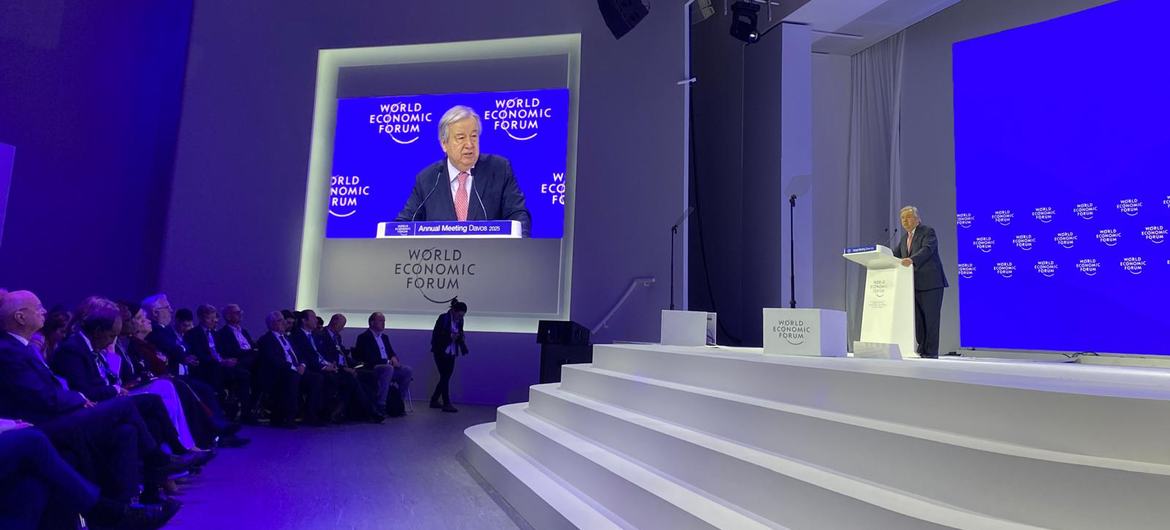
The global political and economic elite gathered in full pomp in Davos was ticked off last Wednesday during an uncompromising speech by UN chief António Guterres, who denounced the lack of multilateral collaboration in an «increasingly ungovernable world», threatened by two existential dangers: climate change and unregulated artificial intelligence (AI).
The UN Secretary-General spoke at the annual meeting of the World Economic Forum, an event held in the Swiss Alps attended by politicians, heads of state and the cream of CEOs from the world's largest and most influential companies.
António Guterres tackled the theme of the 2025 event without pulling any punches: «Collaboration in the era of intelligence». In a particularly alarmist tone, he did not hesitate to state « that there is hardly any evidence of collaboration or intelligence and that there is plenty of evidence of the worsening of many problems in the world, whether conflicts, inequalities or human rights abuses ».
« Nuclear war is no longer the only existential threat to humanity », he stated, referring to the climate crisis and the «uncontrolled expansion» of artificial intelligence.
A worrying addiction to fossil fuels
Comparing our dependence on fossil fuels to Frankenstein's monster, « sparing nothing and no one », the head of the international organisation hammered home with a certain irony the fact that« 13 of the world's largest supertanker ports are about to be submerged by rising sea levels, a consequence of higher temperatures and melting ice, caused primarily by the burning of coal, crude oil and natural gas ». Then to note, in a serious tone, that a number of financial institutions and industries are backtracking on their climate commitments. Thus saying: « This is a short-sighted decision which, paradoxically, is selfish and counter-productive. You are on the wrong side of history. You are on the wrong side of science. And you are on the wrong side of consumers who are looking for more sustainability, not less. ».
Against the bleak backdrop of yet another United Nations climate conference (COP30) to be held in Brazil towards the end of the year, António Guterres has reminded world leaders that they must keep their promise to produce new, economy-wide national climate action plans well ahead of the event. But with what scope?
In the organisation's usual leitmotif and before an assembly that is also usually stoic, developing countries need a « increase in funding »he argued once more for climate action, urging not only governments, but also all businesses and financial institutions to create robust and responsible transition plans.
The false and extraordinary promises of AI
Considering AI as the next existential threat, a double-edged sword, António Guterres also raised the issue of this new technology, « because it is already revolutionising learning, diagnosing diseases, helping farmers to increase their yields and improving the targeting of aid. Yet it is accompanied by profound risks if it is not regulated: it can disrupt economies, undermine trust in institutions and worsen inequalities », warned the Secretary-General as an inescapable prediction.
Indeed, the Global Digital Compact, a text integrated into the Pact for the Future adopted by UN member states last September, proposes a «roadmap to harness the immense potential of digital technology and bridge digital divides», with a shared vision of AI serving humanity, and not the other way around.
« Despite the challenges, the United Nations will never cease to demand peace, drawing upon the Charter of the United Nations, international law and the principles of sovereignty, political independence and the territorial integrity of States. », he warned.
Reform of institutions, from the global financial architecture to the United Nations Security Council, is, according to the UN chief, a necessity because governance systems are often ill-equipped to deal with current challenges.
« However, achieving these essential changes, to which world leaders committed at last September's Summit of the Future, will only be possible with political will », he stated, whilst issuing a warning: « I am not convinced that the leaders have understood ».
At the same time, promises only bind those who believe in them.

 French
  English
  Chinese
  Arabic