
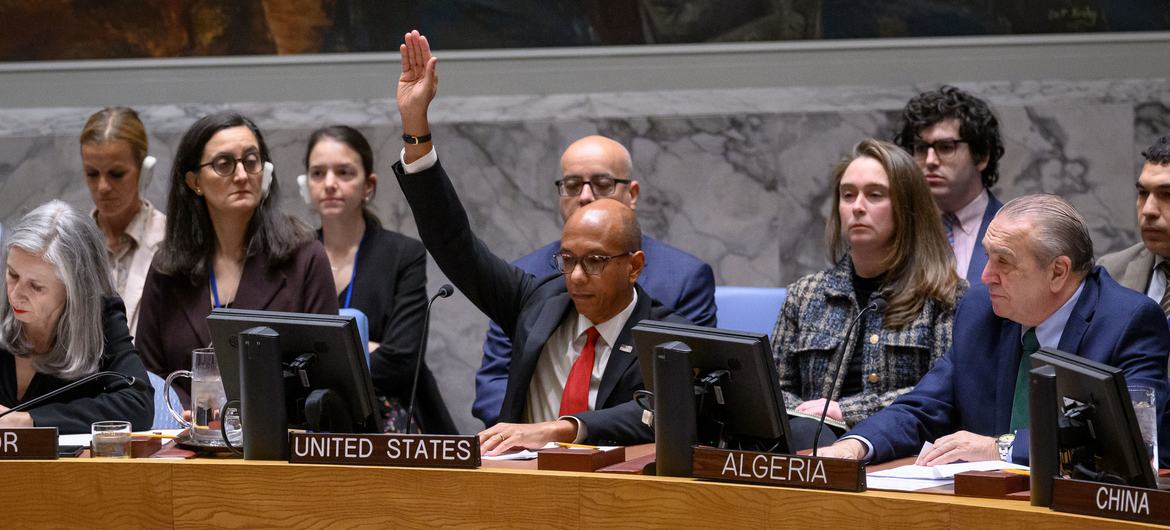
A new draft resolution concerning the war in Palestinian territory, the twelfth of its kind since the attacks of 7 October 2023, has been consigned to the Security Council's waste paper basket. Once again due to a US veto. This is the fourth time the United States has thwarted a draft resolution on the Gaza issue. The other 14 Council members voted in favour of it.
With their usual heavy use of rhetorical arguments barely veiling the substance of their position regarding the Hebrew State, the United States justified their vote by lambasting the «cynicism» of certain Council members who preferred to «provoke» their veto rather than seek a «compromised» wording of the text, notably on the issue of the hostages, which is «inextricably linked» to that of the ceasefire. The self-appointed world policeman has struck again, most certainly under the banner of its own interests!
This is a new episode since 10 June last, with the hard-won adoption of resolution 2735-2024, with 14 votes in favour and the abstention of the Russian Federation, when the Council was asked to vote on a text concerning the war in Gaza. As the representative of Algeria said after the vote, the draft resolution submitted was aimed solely at halting the « deafening silence », which has prevailed for five months over this endless, devastating conflict. The text, he added, « was far from perfect, but it represented the absolute minimum of what should have united us ». So, that's that.
A bare minimum text, just in case...
Proposed and drafted by Guyana on behalf of the 10 elected members of the Council, the text aimed as a priority to respond to the humanitarian crisis hitting displaced persons in Gaza hard. In a notable effort, the representative of Guyana, by way of introduction, presented the key points of the draft resolution: « the result of several weeks of intensive negotiations among the Council members »and even concluded that« an inclusive and constructive approach ».
The text required, amongst other things, a « immediate, unconditional, permanent ceasefire respected by all parties ». Naturally. While also highlighting the importance of« the immediate and unconditional release of all hostages ». Reminding the parties at the same time« their duty to fully respect international law and to comply with previous resolutions of the Council, in particular resolution 2735 adopted in June »And there, beyond good intentions, it just doesn't wash anymore.
On a humanitarian, not to simply say human, level, the resolution draft aimed to guarantee a « immediate access to basic services and essential humanitarian aid», and disapproved «any effort to starve the Palestinians ». The text also proposed rapid and unhindered entry of humanitarian aid across Gaza, insisting on its fair distribution to all civilians, « including civilians in besieged North Gaza », and this, « under the coordination of the United Nations ». Finally, the statement also recognised the central role of UNRWA (editor's note: United Nations Relief and Works Agency for Palestine Refugees in the Near East), as being « backbone of the humanitarian response in Gaza », while engaging all parties to the conflict to allow the organisation to fulfil its mandate throughout the region, unhindered. The final straw for Washington?
An attempt at American arguments: America first?
« We made it very clear that we could not support an unconditional ceasefire that did not lead to the release of the hostages », retorted the United States representative, for whom these two objectives are « irrevocably linked »According to the latter, the envisaged resolution would have sent a« dangerous message to Hamas », suggesting to them that it is no longer necessary to negotiate while more than 100 hostages, including American citizens, are still being held. Here we are.
Criticising, in the wake of their representative's speech, the reluctance of certain Council members to condemn unreservedly the 7 October attacks, the United States blamed Hamas for endangering millions of Palestinian civilians and for the escalation of conflict in the region. Furthermore, American diplomacy recalled its ongoing collaboration with the Hebrew State aimed at boosting the delivery of humanitarian aid and minimising civilian suffering. « An unconditional ceasefire with Hamas would mean accepting their control over Gaza. We will never accept that », asserted their representative before reiterating his country's commitment to continuing its diplomatic efforts.
It scarcely took more than that for Russian Federation of reacting by accusing the United States of signing a « new death sentence for tens of thousands of Palestinians »Seizing the opportunity, the Russian representative thus described the American position as an act of « inhumane and irresponsible », even going against Israeli interests. Seeing in this veto« the manifestation of the United States' propensity to stir up conflicts and violate the sovereignty of countries in whose affairs it interferes »Atmosphere.
An intolerable American veto for the Russian Federation
That was all it took to get a reaction from Moscow. Had the text proposed by Guyana been adopted, all the demands of the United States could have been met, according to the Russian diplomat, who did not fail to point the finger at the reasons« incomprehensible »provided by this permanent member, to justify once again his stooge within the Council. Then to remind us that « the US delegation, for example, exercised its veto on 18 October 2023 to block a text that explicitly condemned the 7 October attacks ». Then they added in a rather clear and substantiated account that« the causes of the atrocities committed since that date are rooted in the historical fact that Western countries allowed a state to be created at the expense of another in the Middle East, «, he accused again. " We will not let the Americans silence the Council and the voice of the Palestinians », he finally promised, thus mocking the transatlantic tendency to live « Groundhog Day » whilst systematically boasting the same rhetoric. Put simply, that of its own interests above all else.
China did not fail to also express its disappointment, the American veto having, according to its representative, « dashed all hopes of the people of Gaza ». « History will judge our actions as well as our inactions, and future generations will know that after every US veto, the toll of the conflict in Gaza has continued to rise », he claimed. For Beijing, casting a veto in the eyes of the world on such a text, « amounts to giving Israel carte blanche to continue its mass killing ». An accusation already made several times by Algeria, whose representative said once again that he was « sorry that a permanent member is sending the senseless message that the Israeli occupying power can continue to collectively punish the Palestinian people and pursue its genocide with impunity ». « The United States must stop being passive and allow the Security Council to impose a ceasefire without delay », the Chinese representative emphasised once more.
With a single, albeit feverish voice, France and the United Kingdom (Editor's note: France, which reiterated at the same time that two of its nationals are still among Hamas's hostages), regretted that the text, whose vision and humanitarian objectives they said they shared, could not be adopted. Reiterating in passing their commitment to continue working alongside their partners to put an end to this war, and then to obtain the release of all hostages, protect civilians and finally guarantee the delivery of the required amount of humanitarian aid. It takes the biscuit, as the saying goes...
On the side of the «voiceless», in other words the 10 members
Co-authors of the text, all expressed their deep disappointment. Previously cited, Algiers mentioned a « sad day for the Security Council, the UN and the international community. Gaza, the city of children, has become the city of orphans », she lamented.
« More than five months after the adoption of Resolution 2735, this draft reaffirmed our commitment to an immediate, unconditional and permanent ceasefire, to the immediate and unconditional release of all hostages, and to the safe, rapid and unhindered delivery of humanitarian aid to civilian populations », the traditional caregiver noted on her part Switzerland. Malta the discreet female, following in his footsteps lamenting that « the Council was not able to adopt a draft resolution, which nevertheless represented the bare minimum to begin remedying a catastrophic situation that has become unspeakable ».
For its part, the Japanese representative he, for his part, considered that « this non-adoption was not to be an opportunity to exchange empty accusations and he was keen to recall that the permanent member of the Council which was unable to support the draft resolution is working tirelessly to put an end to the Gaza nightmare »End of quote.
A dull and tasteless verbal brawl, devoid of even common sense, or any sense at all
Taking the floor after another exchange of sterile insults between the Stars and Stripes and the Kremlin, mutually accusing each other in a barely audible mishmash of acts of «barbarism» in the Middle East and Ukraine, the representative of (what ought to be) the State of Palestine condemned a « attempted annihilation orchestrated by Israel, affirming that no right justifies the massacres, forced displacement or starvation of civilians »No kidding…
The Palestinian envoy recalling that« thousands of Palestinians, including children, have perished under the rubble in Gaza and famine is spreading there, describing a « unbearable day-to-day reality »Indignant at the treatment inflicted on his people, the latter launched, not without banging his fist on the table: « We have the wrong nationality, the wrong religion, the wrong skin colour, but we are human above all and must be treated as such! ».
Of course, the Palestinian representative saw the US-made block as a « dangerous message encouraging the eternal ally Israel to continue its actions with complete impunity »Accusing the latter even of rejecting any ceasefire offer that is not of his own making, thus allowing the Hebrew State to annex even more Palestinian land. Furthermore, by calling upon the United Nations General Assembly to act where its Security Council has failed, the Palestinian diplomat pleaded for a future free from occupation and violence, concluding:« This world can exist today if we decide to act. »
In the rhetorical match to which the Council has sadly accustomed us, lthe representative of Israel has for his part issued a firm condemnation of this draft resolution, stating« ignoring the suffering of the hostages and legitimising the brutality of Hamas »Even accusing« most Council members »to have« betrayed their own principles, their duty to defend justice »Then finally to consider that by adopting the text, the Council« would have sent a message to the world saying that terrorists can act with complete impunity, that the UN will protect these murderers and rapists, rather than bringing them to justice ».
Then to treat oneself to a « the State of Israel thank the United States for standing on the side of morality and justice, for refusing to abandon the hostages and their families », happily reminding people at times that the 101 remaining hostages are being held in inhumane conditions and in Arab hands. Reminding anyone willing to listen once more, here too just in case, that Hamas bears the responsibility for the conflict and civilian casualties.
In its usual talking points, which are on the substance indisputable for any self-respecting State and at the very least its population, Israel reaffirmed that its priority was to protect its citizens and free the hostages.« We will never stop fighting to secure their release », hammered home the delegate, rejecting any ceasefire,« as long as Hamas did not lay down its arms ». Concluding as a subliminal reminder of the history of the 19th and 20th centuries: « history will remember those who defended the principles of peace and those who betrayed them »Match point, back to square one. And meanwhile, the real bullets keep whistling by.
The UN Security Council veto power, that never-ending saga
Veto power or a global blocking power? This provision of the United Nations Security Council is a right granted exclusively to the five permanent members of that Council, namely China, France, the United Kingdom, Russia and the United States. This significant prerogative enables them to block any «substantive» resolution, regardless of the majority opinion within the Council. These five permanent members exercise this right when they cast a negative vote, bearing in mind, however, that an abstention or absence of a position is not considered a veto. For votes on procedural matters, the veto power cannot be exercised, thereby enabling the Council to debate a draft resolution even if it is highly likely that one of the five will veto it.
The veto power is increasingly controversial. Many analysts and specialists in international law see this provision as the most anti-democratic element of the UN, and the main cause of inaction regarding war crimes and crimes against humanity. Indeed, and this is widely borne out by the facts, this right concretely prevents the United Nations and its multiple agencies, on the one hand, from endorsing a resolution that appears just to the majority, and on the other hand, from imposing them on the permanent members and their respective allies of the moment. Of course, proponents of this veto power consider it a factor of international stability, and a means of controlling military interventions.
Historically, the principle of the veto was thus established in order to protect the interests of the founding members of the United Nations, following the victorious outcome of the Second World War. Established during the Dumbarton Oaks Conference in 1944, and prevailing at the creation of the UN by the representatives of the Republic of China, the United States, the United Kingdom, the former Soviet Union and France, who also adopted the status of permanent members. France, although defeated and occupied by Nazi Germany, was nonetheless recognised as essential in its permanent position in the League of Nations, as well as being a colonial power of primary importance, particularly in Africa. The activities of the Free French Forces alongside the Allies thus enabled the small Gaulish country to sit at the same table as the Big Four. In its DNA, the veto power was notably justified by the desire to ensure the full participation of the major powers within the UN in the long term.
However, history was to prove the late League of Nations wrong – notably with the withdrawals of Germany, Italy and Japan, the great powers of the era – draining the organisation of its very substance. Seeking to prevent such withdrawals from happening again, the granting of the veto power was intended to guarantee a more pronounced and formal involvement of the great powers, and thus, at least in theory, the effectiveness of the brand-new UN. According to analysts, it is more than likely that one or other of the permanent members would not have joined the new international organisation in the absence of the veto power.
We will have to wait until April 2022 for the United Nations General Assembly to approve the establishment of a requirement aimed at «an oral explanation before the General Assembly within 10 working days after each veto cast by a member of the Security Council». However, this non-binding text does not entail sanctions if this obligation is not implemented by the Member State.

 French
  English
  Chinese
  Arabic