
A chosen place, a message sent
In the subtle theatre of international diplomacy, the choice of a meeting place between heads of state is never trivial. Each destination carries a symbolic weight, a historical memory, and implicit messages that are sometimes more powerful than official statements. On 15 August 2025, Alaska, a vast, isolated expanse in the northwest of the American continent, becomes this improbable stage where Donald Trump and Vladimir Putin meet for a summit of profound resonance.
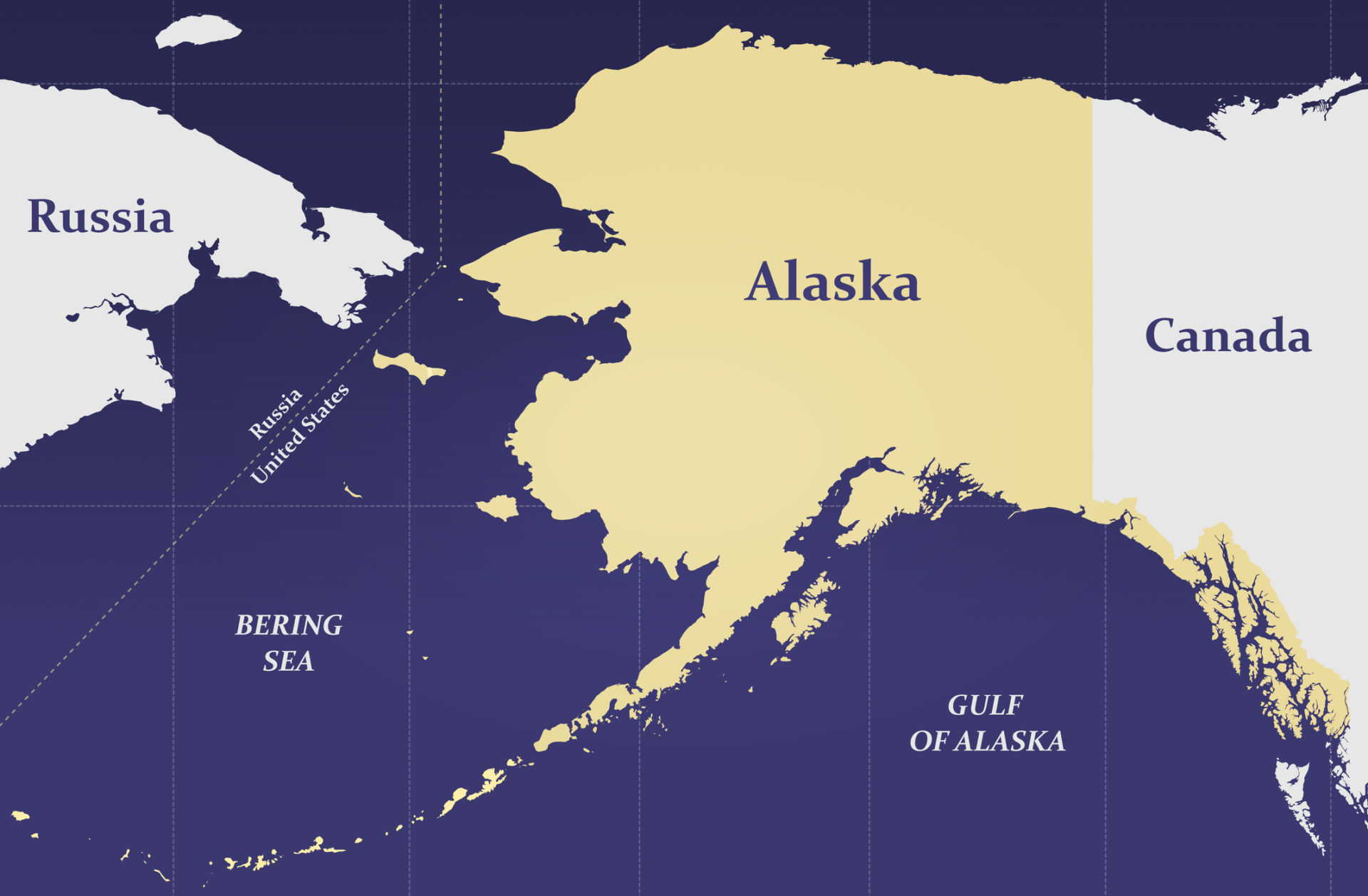
Territory ceded by Russia to the United States in 1867 for a modest sum, Alaska embodies much more than a geographical issue: it crystallises a shared past, latent rivalries and a keen strategic memory. Situated at the crossroads of America and Asia, just a stone's throw from Russia, this territory becomes a natural crossroads between two often adversarial powers.
Why, then, choose this remote location, far from the usual diplomatic capitals and multilateral forums? This is not a matter of convenience, but of significance. The choice of Alaska is a geopolitical act in itself — a silent yet clear language, where every mile of tundra and every breath of Arctic air tells a story of sovereignty, revenge, and the redefinition of power relations. Deciphering this gesture means understanding how a place can become a message.
When the past resurfaces on diplomatic terrain
The choice of Alaska as a meeting place between Donald Trump and Vladimir Putin is not merely strategic: it is profoundly symbolic. This territory, formerly Russian, carries within it a history that is forgotten by some, but never closed for others. Its mention reactivates national memories, geopolitical regrets and narratives of lost greatness — all levers that Putin knows how to skilfully mobilise.
1867: the sale (or the mistake) of the century?
In 1867, the Russian Empire ceded Alaska to the United States for 7.2 million dollars — a modest sum for a territory of 1.6 million square kilometres. This decision, negotiated in secret by the US Secretary of State William Seward, was driven by pragmatic reasoning: Russia, distant from its possessions in North America, feared a British annexation via Canada. By selling to a relative ally, Tsar Alexander II preserved indirect influence whilst avoiding a total loss.
The treaty is signed in Washington on 30 March 1867. Despite the ridicule of a doubtful American public opinion — which at the time referred to Alaska as an «ice box» —, the transfer is made official in October with the raising of the American flag in Sitka, formerly Novo-Arkhangelsk. This gesture marks the end of a century of Russian presence in North America.
Today, this transaction appears as an ambiguous turning point: a historical mistake for some Russians, a windfall for the Americans who, in hindsight, acquired a resource-rich and strategically key territory.
A symbolic revenge engineered by the Kremlin
More than 150 years later, Putin’s choice of Alaska transcends ordinary diplomacy. It stands as a symbolic revenge — not military, but narrative. By setting foot on formerly Russian soil to negotiate on an equal footing with the American president, Putin reactivates a narrative of power: that of a country which, despite setbacks, has not renounced its global standing.
In official Russian rhetoric, the sale of Alaska is often evoked as a moment of geopolitical weakening, or even humiliation. The actualisation of this location in a high-level summit transforms Alaska into a stage for reaffirmation: Russia is back, not as an owner, but as an indispensable player on soil that was once its own.
It is no coincidence that the meeting is taking place precisely here. She says: «We are now speaking not only as equals, but on ground that was once ours.»
Geography in the service of staging
Putin masters the art of spectacular diplomacy, where every location becomes a political act. By choosing Alaska, he combines history, geography and communication. This meeting is not merely an exchange of views: it is a message sent to multiple recipients — to Washington, to the West, and above all to the Russian people.
The Kremlin is thus transforming a peripheral territory into a focal point of power struggles. By holding discussions with Trump in Anchorage, Putin is showing that Russia can influence the very heart of the American space, without crossing a border. It is a demonstration of symbolic yet real power: geography is becoming a strategic lever.
When logistics becomes strategy
The choice of Alaska as the location for a summit between Donald Trump and Vladimir Poutine does not rely solely on symbols of the past, but also on concrete realities — geographical, legal and diplomatic. This territory, on the border of the continents, stands out as an exceptional site, at once practical, neutral and secure, ideal for a dialogue between two powers in tension.
A bridge between two worlds: proximity across the Bering Strait
The Bering Strait, about 200 km long, separates Russia from Alaska, but at its narrowest point it measures only 83 kilometres — between Cape Dezhnev (Russia) — translating Mys Peek as Cape Dezhnev as per standard UK geographic usage, though keeping it literal if preferred: Mys Peek (Russia) and Cape Prince of Wales (Alaska). This distance symbolically reduces the gap between two long-rival nations.
At the heart of the strait, the Diomede Islands, just 3 km apart, embody this paradoxical proximity: one belongs to Russia (Big Diomede Island), the other to the United States (Little Diomede Island), separated not only by a border, but also by the International Date Line. This geographical detail highlights just how much Alaska is the natural entry point between America and Asia, and therefore a logical place for Russian-American dialogue.
This proximity is not insignificant: it transforms Alaska into a strategic contact zone, where exchanges, whether military or diplomatic, can take place within a framework that is both close and controlled.
A neutral ground, far from Europe
Alaska lies outside traditional spheres of influence. Unlike Geneva, Vienna or Paris, it escapes European pressures, multilateral institutions such as NATO or the EU, and the prying eyes of Western allies.
In this context, the territory appears as a space of relative neutrality, ideal for sensitive bilateral negotiations. As the State Governor has often pointed out, Alaska is not merely a periphery: it is a geopolitical crossroads between North America and Asia, designed to host off-the-record dialogues, far from microphones and imposed agendas.
For Trump and Putin, this geographical withdrawal amounts to an assertion of autonomy: their decisions are not made under the gaze of Brussels or Berlin, but in an arena that they control.
A welcome legal loophole
A crucial factor, not openly discussed, weighed on the choice of location: the international arrest warrant issued against Vladimir Putin by the ICC for alleged war crimes in Ukraine.
However, the United States is not a signatory to the Rome Statute and does not recognise the jurisdiction of the ICC on its territory. By inviting Putin to Alaska, Washington avoids any risk of arrest or diplomatic incident, unlike what would happen in most ICC member countries.
This parameter, as strategic as it is legal, was doubtless decisive. Alaska thus offers a secure refuge — legal under American law, symbolic according to Russian diplomacy — where a head of state subject to an international warrant can nevertheless negotiate as an equal.
A tradition of secret diplomacy
Alaska is no stranger to delicate summits. In March 2021, Anchorage already hosted a tense meeting between high-ranking American and Chinese officials, demonstrating its capability to host high-tension dialogues in a secure, discreet and neutral setting.
This precedent established the State as a prime location for crisis diplomacy. Its isolation, suitable infrastructure and strict access control make it an ideal site for preventing leaks, demonstrations or external interference.
With the Trump-Putin summit, Alaska is confirming its status: not a periphery, but a strategic diplomatic hub at the heart of the Arctic.
The North Pole, new centre of the world
Alaska is not just a place steeped in history or a geographical waypoint: it has become one of the strategic hotspots of the 21st century, at the heart of a global competition for resources, routes and power. This US-Russian summit is not taking place on the fringes of the world, but at the heart of a major geopolitical transformation — that of the Arctic, now on the frontline of global issues.
Arctic treasure: hydrocarbons, minerals and new routes
Alaska and the Arctic region hold considerable wealth: natural gas, offshore oil, strategic minerals and rare earths — those key elements for green technologies and modern defence. With the accelerated melting of the ice due to global warming, these resources are gradually becoming accessible, while new maritime routes are opening up, such as the Northern Sea Route, which reduces the journey between Asia and Europe by 40 % compared to the Suez Canal route.
This shift is not merely economic: it is strategic. The United States and Russia, each claiming extensive zones of sovereignty in the Arctic, are deploying infrastructure, icebreakers and enhanced military capabilities there. Alaska is thus becoming an economic and military vanguard, where the exploitation of resources goes hand in hand with a race for the projection of power.
A bilateral dialogue, without a witness
The choice of Alaska sends a clear message: major decisions are no longer made in Brussels, Paris or Berlin, but directly between powers. By bypassing European capitals and multilateral institutions like NATO, Trump and Putin are asserting a model of exclusive diplomacy, where allies are kept at a distance.
This geopolitical «huis clos» perfectly embodies Trump’s «America First» vision and Putin’s anti-Western strategy. Together, they signify: «What is decided here concerns the United States and Russia — the rest of the world follows.» Such a framework symbolically weakens Atlantic solidarity and redefines the balance of power on a bipolar basis, even in a supposedly multipolar world.
Strategically, Alaska stands out as a logical location: within reach of Russia, outside the European sphere, legally secure for a leader facing an ICC arrest warrant, and well accustomed to the discretion of sensitive negotiations. It embodies a neutral yet controlled space, ideal for direct dialogue, without intermediaries or unwanted witnesses.
Beyond the Russian-American duel, the Arctic has become a geopolitical laboratory where the recomposition of the world is taking place. Multipolarity, systemic competition, control of strategic corridors: Alaska is a faithful mirror of this.
Russia, with its vast Arctic coastline and dozens of military bases, is asserting a historical and operational presence there. The United States, aware of its accumulated lag, is reviving its maritime and diplomatic presence in the region, notably to contain Chinese influence, which harbours ambitions of becoming a «polar power».
In this context, Alaska is no longer a periphery: it is a showcase of modern power, where climate challenges, economic ambitions and the diplomacy of force intersect. This summit does not merely seal a meeting between two leaders — it heralds an era where control of the pole determines a growing share of the global balance.
One place, three messages: history, power, future
The choice of Alaska as the setting for the Trump-Putin summit on 15 August 2025 is neither anecdotal nor purely practical. It is a geopolitical act in itself, where every mile of tundra, every breath of Arctic air, carries a message.
Three dimensions intersect there with rare intensity.
Symbolically, Alaska is reviving a long-neglected Russian memory: that of a territory lost in 1867, which has today become the theatre of a return to the American stage. For Putin, this is not a protocol visit, but an assertion of stature, a form of soft revenge — where diplomacy replaces weapons, but the weight of history speaks volumes.
Alaska: Trump and Putin's secret arena
Geopolitically, this summit is not limited to a bilateral meeting. It reflects the rise in power of the Arctic as a new strategic centre of gravity — a terrain for competition over resources, shipping routes and technological supremacy. By choosing Alaska, Trump and Putin are not merely talking to one another: they are laying the groundwork for a new, multipolar world order, where major decisions are made far from traditional capitals, on the fringes of the world.
This meeting could mark a turning point: that of a diplomacy where the setting speaks as much as the words, and where the poles, once forgotten, are becoming the new crucibles of power. History, here, is not content merely to repeat itself — it is reinventing itself, upon frozen ground, yet burning with current relevance.

 French
 English
 Chinese
 Arabic