
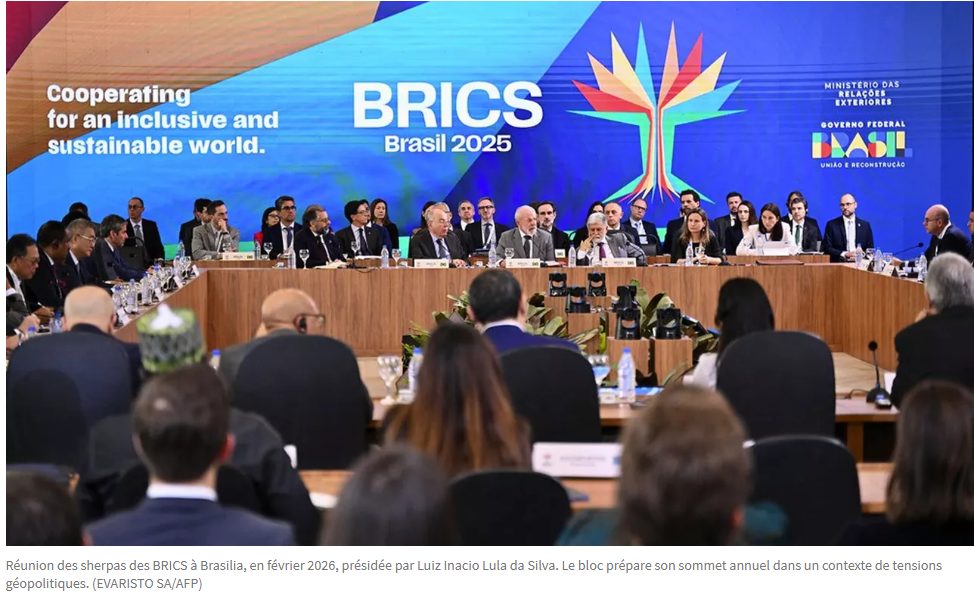
The BRICS: from emergence to redefining the international order
Genesis and strategic scope of the BRICS
Formed in 2001 as a financial concept designating Brazil, Russia, India, and China, the acronym «BRIC» quickly evolved into a truly geopolitical reality. The integration of South Africa in 2010 and the recent expansions have expanded its scope and strengthened its role. Today, the BRICS represent more than half of the world’s population and about 41% % of global GDP in purchasing power parity. They are emerging as the catalyst for a rebalancing of international power relations and embody the challenge to Western hegemony.
The «global South» they aspire to represent goes beyond a mere geographical dimension. It expresses a collective will for cooperation between historically marginalized nations, eager to break free from the institutional frameworks inherited from the post-war era. In this sense, the BRICS appear as a laboratory for South-South cooperation, combining efforts for equity, sovereign assertion, and long-term strategies. It remains to be seen whether this dynamic is permanent or contingent, in a context of globalization perceived as unbalanced.
But the heterogeneity of national trajectories — socialist China, democratic India, authoritarian Russia, and Brazil and South Africa facing internal fragilities — raises the question of cohesion. This diversity, both a wealth and a constraint, questions the group’s ability to project a common vision on the international stage without compromising the autonomy of its members.
A structural and strategic lever
The strength of the BRICS rests on an impressive structural foundation. In 2025, they alone account for 41 % % of global GDP at purchasing power parity and more than half of the world’s population. This weight gives them unprecedented legitimacy in international debates. Their influence is particularly evident in key sectors: the BRICS produce nearly 30% % of the world’s oil and dominate several strategic commodity markets, giving them considerable leverage in the energy transition.
Despite internal challenges, their economic dynamism remains robust, with an estimated average growth % of 3.4% in 2025, compared to 2.8 % % for the rest of the world. This difference in attractiveness fuels investment flows and stimulates innovation. In this context, the Rio de Janeiro summit in July 2025 promises to be a crucial milestone: it will allow us to gauge how this heterogeneous coalition intends to exert its influence in a world in transition. The question is no longer about the weight of the BRICS, but rather about the modalities for exercising it.
Historical background: The progressive affirmation of the BRICS on the international stage (2001–2025)
Phase I – From economic fiction to geopolitical reality (2001–2010)
The term «BRIC», coined in 2001 by Jim O’Neill at Goldman Sachs, initially referred to four major emerging economies — Brazil, Russia, India, and China — destined to rival the traditional powers. Designed as an investment category, this purely economic construct quickly took on a political dimension. In 2006, the foreign ministers of the BRIC countries met for the first time at the United Nations, initiating a regular dialogue.
The founding summit in Ekaterinburg in 2009 attests to this evolution: the BRIC countries affirm their common will to reform the international financial institutions, which are deemed too Western-centric. The accession of South Africa in 2010 broadens the scope of the group, which then becomes a fully-fledged political entity representing the collective voice of the global South.
Phase II – Institutional consolidation and growth (2011–2023)
The following decade marks the institutional anchoring of the group. In 2014, the BRICS created the New Development Bank (NDB) in Fortaleza, with an initial capital of 50 billion dollars. This institution positions itself as a credible alternative to large multilateral banks, offering a more flexible model, without political conditionalities, focused on the financing of infrastructure and sustainable development.
Since its inception in 2016, the NDB has approved more than 120 projects totaling $39 billion. A Reserve Fund complements this framework, designed to protect members from financial shocks. In 2023, the group reached a milestone with a first wave of significant expansion, inviting six new countries to join, thereby expanding its base within the global South.
Phase III – Accelerated expansion and institutional restructuring (2024–2025)
The year 2024 marks a new milestone. Egypt, Ethiopia, Iran, and the United Arab Emirates officially join the group, strengthening its foothold in the Middle East and Africa.
In January 2025, Indonesia becomes the tenth full member. In parallel, a «partner country» status is established for nine additional states, allowing for a gradual and structured accession.
In two decades, the BRICS have thus gone from a financial acronym to an institutional entity capable of influencing the major economic, political, and strategic issues of the present day. This trajectory bears witness to a clear ambition: to offer an alternative to the international system dominated by the West, while ensuring the cohesion of an increasingly diverse ensemble.
Geopolitical context of the Rio summit (2025): Between multipolarity and confrontation
An international environment under high tension
The BRICS summit in Rio took place in a tense geopolitical climate marked by the questioning of the balances inherited from the post-war era and by the intensification of rivalries between major powers.
The multipolar dynamic driven by the BRICS is directly at odds with an American strategy of trade confrontation. Under the leadership of Donald Trump, Washington threatens to impose additional tariffs of 10 percent on % any country that adopts positions close to the group, with surcharges reaching up to 84 % percent for China. This protectionist logic aggravates the fragmentation of the global trading system and accentuates the polarization of economic relations.
At the same time, multilateralism is undergoing a crisis of legitimacy. Brazilian President Lula denounced an «unprecedented collapse» of the institutions of Bretton Woods, calling them obsolete in the face of the realities of the 21st century. The BRICS, like other emerging powers, are calling for a deep reform of global governance, in the name of more equitable representation.
Regional tensions also weighed on the summit’s agenda. A common position was adopted on the crisis in Gaza: calling for an immediate ceasefire and condemning the attacks against Iran, without explicitly naming the perpetrators. This diplomatic caution reflects the need to preserve the internal balance of the group, given the complexity of regional crises.
Signs of internal fragility and diplomatic absences
The summit was marked by symbolic absences, revealing internal tensions. For the first time since 2013, Chinese President Xi Jinping did not attend, delegating his representation to Li Qiang.
Vladimir Putin, under an arrest warrant from the International Criminal Court, participated in the meeting via videoconference. These absences reflect the political, judicial, or strategic constraints that weigh on the group’s balance.
The disagreements between members, particularly between China and India, are a factor of structural vulnerability. Their border disputes and rivalries for influence complicate the development of a common political line.
This tension has also been expressed on the Palestinian issue: China firmly advocates the creation of a Palestinian state as a guarantee of regional stability, while India, committed to its strategic partnerships with Israel, adopts a more cautious stance. This disagreement illustrates the group’s difficulty in harmonizing its positions on sensitive issues, where national interests often prevail over collective cohesion.
Thus, the Rio summit symbolizes both the affirmation of a claimed multipolarity and the limits of such a heterogeneous group. It highlights the tensions inherent in the BRICS’ rise on the international stage, shared between common ambitions and divergent interests.
Crossed Portraits of the BRICS: Ambitions, Divergences, and Power Relations
China: The engine of the bloc and architect of a parallel order
China constitutes the economic epicenter of the BRICS. With a GDP of 18.56 trillion dollars in 2025, it dominates the group and is establishing itself as the second world power. In terms of purchasing power parity, it even surpasses the United States, consolidating its central position in the strategic orientation of the bloc.
Geopolitically, Beijing is using the BRICS as a lever for resilience against Western pressure. The platform is becoming a vector for an alternative multilateralism based on South-South cooperation and the challenge to established norms. The Belt and Road Initiative, to which the majority of members – with the notable exception of India and Brazil – adhere, illustrates this ambition for global influence, articulated around a new international architecture centered on China.
India: The strategic balancer with dual allegiance
With growth estimated at 6.2% % in 2025, India is emerging as the world’s third-largest economy, driven by a dynamic tertiary sector and a young demographic. But it is on the geopolitical front that New Delhi stands out, cultivating a hybrid stance between the East and the West.
A member of the Quad alongside the United States, Japan, and Australia, while maintaining strong relations with Moscow, India refuses to fully align itself. This strategy of balance engenders tensions within the BRICS, particularly with China, its main regional rival. Border disputes and competition for leadership in the Global South undermine the group’s cohesion and reveal opposing visions of the international order.
Russia: An ally under pressure and a disruptive actor
For Russia, the BRICS represent a diplomatic bulwark against Western isolation. The group forms an area of exchange and legitimation, allowing Moscow to circumvent sanctions, defend an alternative narrative, and strengthen its partnerships outside the Euro-Atlantic sphere.
But this ambition faces structural weaknesses. The Russian economy, heavily dependent on hydrocarbons and ill-diversified, limits its ability to exert lasting influence. While its military power and nuisance capacity remain significant, its place within the group rests more on its strategic value than on its economic performance.
Brazil and South Africa: Between regional ambitions and internal vulnerabilities
Brazil, the engine of Latin America, relies on a diversified economy and world-class agriculture. However, the recurring political instability undermines the clarity of its foreign policy and limits its role as a driving force within the group.
As for South Africa, the continent’s leading economic power, it aspires to play a role as a bridge between BRICS and Africa. But persistent social inequalities, structural unemployment, and low growth (3.4 % expected in 2025) constrain its ability to project regional influence.
The BRICS thus form a unique entity, bringing together national trajectories that are deeply contrasting. This heterogeneity constitutes both a wealth — a reflection of the diversity of the global South — and a weakness; it complicates the development of a common strategic vision. The multipolarity that the group embodies therefore remains marked by internal tensions, which will condition its credibility and its ability to exert influence in the face of the traditional great powers.
An economic mosaic: Between complementarities and gaps
Five models for a group: strategic diversity or dispersion?
Behind the apparent unity of the BRICS lies a wide variety of economic models, shaped by unique historical trajectories and political choices.
- China It is based on a state-run market economy, combining manufacturing power, massive investments, and technological upgrading. This strategy has enabled it to establish its place as a global hub while initiating a shift towards domestic consumption.
- India It favors an economy of services that is expanding rapidly, driven by information technologies, financial services, and a dynamic demographic profile. While this orientation generates rapid growth, it leaves significant challenges in infrastructure and rural development.
- Russia, Faithful to a rentier model, it remains largely dependent on its energy and mining resources. This exposure to fluctuations in global markets hinders its diversification, despite an industrial base inherited from the Soviet era.
- Brazil It displays a more balanced structure, with a robust tertiary sector, efficient agriculture, and a large domestic market. However, its potential is hampered by persistent inequalities, a heavy bureaucracy, and chronic political instability.
- South Africa It combines wealth with natural resources and a developed financial sector, but its ambitions are hampered by moderate growth and deep social divisions.
Growth at two speeds: weak engines and weak links
This diversity is reflected in the group's economic performance. In 2025, China (5.5 %) and India (6.2 %) They pull the bloc upwards, attracting capital and innovation. Conversely, Russia, Brazil and South Africa They struggle to maintain a sustained pace. International sanctions, dependence on raw materials, instability or institutional fragility explain this two-speed dynamic, often described as «falling behind».
These disparities highlight a central paradox: the diversity that underpins the overall legitimacy of the BRICS also constitutes their main challenge. The disparities in terms of resources, human development, and economic strategies make the formulation of a common vision difficult.
In this context, The Rio summit questions the group's ability to overcome its fault lines and exert collective influence on the major global economic balances. Offering a credible alternative to the existing international order requires not only shared political will, but also a minimal convergence of economic priorities.
The Rio Summit: Between the affirmation of the global South and the quest for international credibility
A stated vision for more inclusive global governance
The BRICS summit in Rio de Janeiro has established itself as a strategic milestone in the quest for a more representative international order. Held under the theme «Strengthening global South cooperation for more inclusive and sustainable governance,» it resulted in 126 commitments covering areas as diverse as the reform of international financial institutions, public health, artificial intelligence or the climate.
The event was also marked by a new phase of expansion. Indonesia was admitted as the tenth full member, while ten partner countries They have been granted official status. This opening reflects the bloc’s geographical and political expansion, but also raises the question of whether the EU is still relevant in the 21st century. cohesion of an increasingly diverse ensemble.
Three structural innovations: climate, AI, health
- An unprecedented framework for climate financing: Adopted in May 2025, the Joint statement on climate financing constitutes a first for the BRICS. It aims to influence the reform of multilateral development banks, to defend the interests of the countries of the South and to prepare an ambitious position for the COP30 in Belém, Based on climate justice and shared responsibility.
- Towards a global governance of artificial intelligence:
The BRICS also called for the development of a International framework for regulating AI, under the auspices of the UN. The initiative highlights the Digital sovereignty, It reflects a desire to prevent the exclusive appropriation of critical technologies by Western powers. - A partnership for equitable public health:
In a cross-sectional approach, the group launched a partnership against socially determined diseases, highlighting the link between health, inequalities and development. The goal is to strengthen prevention, health education and access to care for vulnerable populations.
These initiatives demonstrate the ability of the BRICS to propose a The alternative global agenda, Even if their rapid expansion complicates the balance between collective ambitions and national interests.
Measured but strategic positions
Geopolitically, the BRICS have Reaffirmed their rejection of unilateral protectionist measures, They denounced, in particular, the trade surcharges imposed by some countries. They reiterated their commitment to the multilateralism in trade, while calling for more flexibility for emerging economies within the framework of the WTO.
The group has also renewed its Support for the expansion of the UN Security Council, This demand, particularly in favor of India and Brazil, reflects a desire to rebalance the structures of global governance in line with current geopolitical realities.
Finally, on the regional files, The BRICS adopted a common position condemning the attacks against Iran and calling for a Immediate ceasefire in Gaza, This illustrates their willingness to express themselves collectively on major international crises, without disrupting the internal balance of the group.
Ultimately, the Rio summit confirms the BRICS as a A global player in the making, They are capable of articulating economic ambitions, institutional innovations, and a proven diplomatic stance. But their influence will now depend on their ability to translate these commitments into concrete actions, to ensure a sustainable internal cohesion, and to establish itself as The force of structuring global governance in the 21st century.
Cross-section view of Rio: Confrontation, caution, fascination
United States: confrontation strategy and risky bet
In the wake of the Rio summit, the US reaction was a hardening of tone. President Donald Trump reiterated his threats to impose additional tariffs of 10 percent on % any country deemed aligned with the BRICS« »anti-American policies.” Notices of notification were sent as early as July 7, with the prospect of a surcharge of up to 50 percent as % early as August.
This coercive approach aims to curbing the growing influence of the bloc, However, it has drawn sharp criticism within the American economic establishment. Many experts warn of the perverse effects of such a policy: disruption of supply chains, increased costs for consumers, weakening of industrial competitiveness, but most importantly strengthening the strategic cohesion of the BRICS, encouraged to build alternative economic circuits. This muscular response illustrates both The escalation of the global confrontation and the limits of an exclusively punitive strategy.
Europe: Strategic caution and persistent disunity
The European Union has reacted with more restraint. The European Parliament recently called for an Better coordination of external policies in the face of the rise of the BRICS and the emergence of competing international structures, notably under Chinese leadership.
But in reality, The EU remains divided, Unable to formulate a coherent strategy vis-à-vis the group, the heterogeneity of national priorities prevents a common line between those who perceive the BRICS as potential partners and those who view them as systemic rivals. Europe thus oscillates between attachment to classic multilateralism and the need to adapt to a changing global order, where the Global South is increasingly asserting its ambitions.
Global South: between strategic affiliation and institutional prudence
The Rio summit sparked great interest among the countries of the global South. More than thirty states They expressed their desire to join the BRICS, hoping to diversify their alliances and escape the historical tutelage of institutions dominated by the West, such as the IMF or the World Bank.
This dynamic confirms the growing attractiveness of the group, which is now perceived as a catalyst for representativeness and economic sovereignty. However, accelerated expansion poses a real governance and cohesion challenges, Because integrating new members with very diverse backgrounds requires more robust institutional mechanisms and a constant effort to converge.
In short, the international reactions at the Rio summit reflect a world in transition. The trade confrontation with the United States, European hesitation, and the appeal of the global South They testify to the tensions, but also to the opportunities, that surround the rise of the BRICS. The challenge for the group will now be to turn this growing interest into structural influence, Without getting lost in the dispersion of his ambitions.
Between power and fragmentation: The strategic paradox of the BRICS
A major economic and diplomatic lever
With nearly 41 % percent of global GDP in purchasing power parity and growth above the international average, the BRICS are emerging as a major economic force. An indispensable economic actor.
This dynamism gives them increasing legitimacy in international negotiations and increases their influence over the standards of the global economy.
Beyond their economic weight, the BRICS have managed to develop alternative institutional tools, Like the New Development Bank (NDB), which has already financed more than 39 billion dollars worth of projects, These mechanisms often lack political conditions. They reflect a desire to build autonomous South-South cooperation that is less dependent on traditional channels dominated by the West.
On the diplomatic level, their ability to bringing together a growing number of countries from the global South Around shared interests, makes BRICS a platform for contesting Western hegemony, and a potential pole of reform of global governance.
A power hampered by its internal contradictions
But this apparent strength masks Persistent structural flaws. The diversity of economic models, political regimes, and strategic priorities hinders the building of a lasting consensus. This increasing heterogeneity It makes it difficult to develop common positions and make collective decisions.
Internal rivalries, in particular Between China and India, This exacerbates tensions. Their border disputes, their opposing visions of regional leadership, and their divergent geopolitical orientations undermine the group’s strategic unity.
The rapid expansion of the bloc, if it strengthens its overall weight, also accentuates the disagreements, revealing often contradictory interests. The debates on key issues — de-dollarization, reform of international institutions, technological governance — suffers from a lack of consensus, This weakens the ability of the BRICS to act as a coherent force on the global stage.
Ultimately, the BRICS embody a paradox: a consolidated economic power but a fragile political cohesion. Their future will depend on their ability to overcoming these internal fractures, They must strengthen their coordination mechanisms and formulate a shared vision. Only under these conditions will they be able to transform their economic weight into structural political influence, and claim to play a decisive role in redefining the global order in the 21st century.
What future for the BRICS? Three scenarios for a world in transition
The Rio summit highlighted the asserted ambitions but fragile the BRICS, which increasingly appear as a Laboratory of a global order in reassembly.
Amid internal heterogeneity, geopolitical rivalries, and systemic pressures, their trajectory remains uncertain. Three main scenarios emerge, bearing major strategic implications.
Three scenarios of evolution: between balance, confrontation and disintegration
1. Pragmatic cooperation: the path to multipolar stability
In this scenario, the BRICS prioritize economic cooperation without taking a frontal stand against the West. The group consolidates its existing institutions – such as the NDB – and strengthens its mechanisms for technological and financial cooperation. This moderate approach maximizes common benefits while leaving each member with a margin of maneuver for its bilateral relations.
The BRICS would then emerge as a multipolar actor with a structuring role., Capable of influencing global standards without entering into an antagonistic bloc logic.
Opposition Bloc: The rise of an anti-Western front
In a more radical dynamic, driven in particular by Beijing and Moscow, the group opts for a Confrontation assumed with the Western order. This would translate into intensifying de-dollarization efforts, the establishment of parallel institutions, and a tightening of cooperation in the fields of security, AI, or trade.
Within this framework, the BRICS would become a systemic pole of protest, This cohesion within the opposition would strengthen the group in the short term, but at the cost of lasting instability on a global scale.
Fragmentation: the breaking down under the weight of contradictions
The most pessimistic scenario would see the group gradually disintegrate, unable to overcome its internal differences. Sino-Indian tensions, divergent economic policies, and regional rivalries would undermine cohesion, pushing some members towards bilateral or regional partnerships more compatible with their interests.
This fragmentation would reduce The collective influence of the BRICS, revealing the limits of such a heterogeneous group when it fails to overcome the primacy of national interests.
Three key variables: internal tensions, war in Ukraine, and the Western response
1. The Sino-Indian factor: between strategic cooperation and lasting rivalry
The relationship between China and India remains the main one point of internal fragility. Despite growing economic interdependence, their border disputes and competing ambitions complicate any political convergence. Managing this rivalry, through dialogue or confrontation, will condition the group’s balance.
2. The Ukrainian conflict: Moscow, a factor of unity or division
The invasion of Ukraine continues to redefine Russia’s role in the group. While its isolation strengthens its foothold within the BRICS, it also creates diplomatic tensions With members more concerned with maintaining their relations with the West. The evolution of the conflict will therefore have a direct impact on the stability of the bloc.
3. The Western strategy: dialogue or pressure?
Finally, the way in which the Western powers choose to interact with the BRICS will be decisive. Inclusive approach, based on commitment, could encourage a moderate and constructive evolution of the group. Conversely, a strategy of Aggressive containment It would risk pushing the BRICS towards an identity-based retreat and geopolitical radicalization, reinforcing the lines of global division.
In short, the BRICS embody the Promises and the contradictions of a new world order in gestation. Their future will depend on their ability to overcome their internal divisions, to adapt to global challenges, and to avoid being locked into rigid patterns of confrontation. That they become one The pragmatic engine of multipolarity, one bloc of opponents or one exploded ensemble, Their trajectory will profoundly shape the political, economic, and geostrategic balances of the 21st century.
Conclusion: The BRICS, between promises and challenges of a new global order
The 2025 Rio summit confirms the emergence of the BRICS as a major player on the international stage. Beyond their impressive economic and demographic weight, they embody the growing will of the South to reinvent global governance.
This heterogeneous group, combining divergent regimes and interests, presents itself as an unprecedented laboratory of an emerging multipolarity.
Yet this apparent power masks deep vulnerabilities. The disputes, sometimes acute, between members — notably between China and India — weaken the cohesion essential for lasting political influence. The real question is whether the BRICS will be able to overcome these tensions to pursue a common vision capable of competing with a declining Western order.
Beyond a simple cooperation platform, the BRICS carry the hope of a more just, multipolar, and representative order of the global South. Their future will largely determine the geopolitical re-composition of the 21st century, oscillating between fragmentation and unity, confrontation and reconciliation. The world watches, suspended by their ability to transform their ambitions into a new global power balance.

 French
 English
 Chinese
 Arabic